

A reader conducted an experiment after reading our PT1000 article, providing thoughtful data and measurement results. The analysis is valuable — it demonstrates low-cost data acquisition and provides an excellent opportunity to discuss fundamental metrology concepts.
Key Takeaways
- Resolution ≠ Accuracy: The INA228 + REF200 + PT1000 circuit can achieve ~0.001°C short-term resolution, but absolute accuracy without calibration is closer to ±2.8°C
- Six Major Error Sources: REF200 current accuracy (±1% = ±2.8°C), REF200 temperature drift (25 ppm/°C), INA228 input impedance loading (92 kΩ on PT1000 = -3.3°C fixed error), INA228 gain error (±0.14°C), thermoelectric EMF at microvolt level, and PT1000 sensor body tolerance
- Ratiometric vs. Absolute Measurement: MAX31865 uses ratiometric measurement where current source accuracy cancels out; INA228 + REF200 relies on absolute current accuracy
- Calibration Is Mandatory: “No calibration needed” is incorrect — at minimum, REF200 actual current, INA228 gain/offset, PT1000 R₀, system thermoelectric EMF, and input impedance loading must be calibrated
- Practical Sensitivity vs. Accuracy: The circuit genuinely detects 0.002°C-level changes (finger proximity, lamp heat, air currents), but this is sensitivity, not precision accuracy
- Aomway’s Engineering Perspective: In our precision instrumentation work, we emphasize that understanding the distinction between resolution, sensitivity, repeatability, and absolute accuracy is fundamental to any serious measurement system design
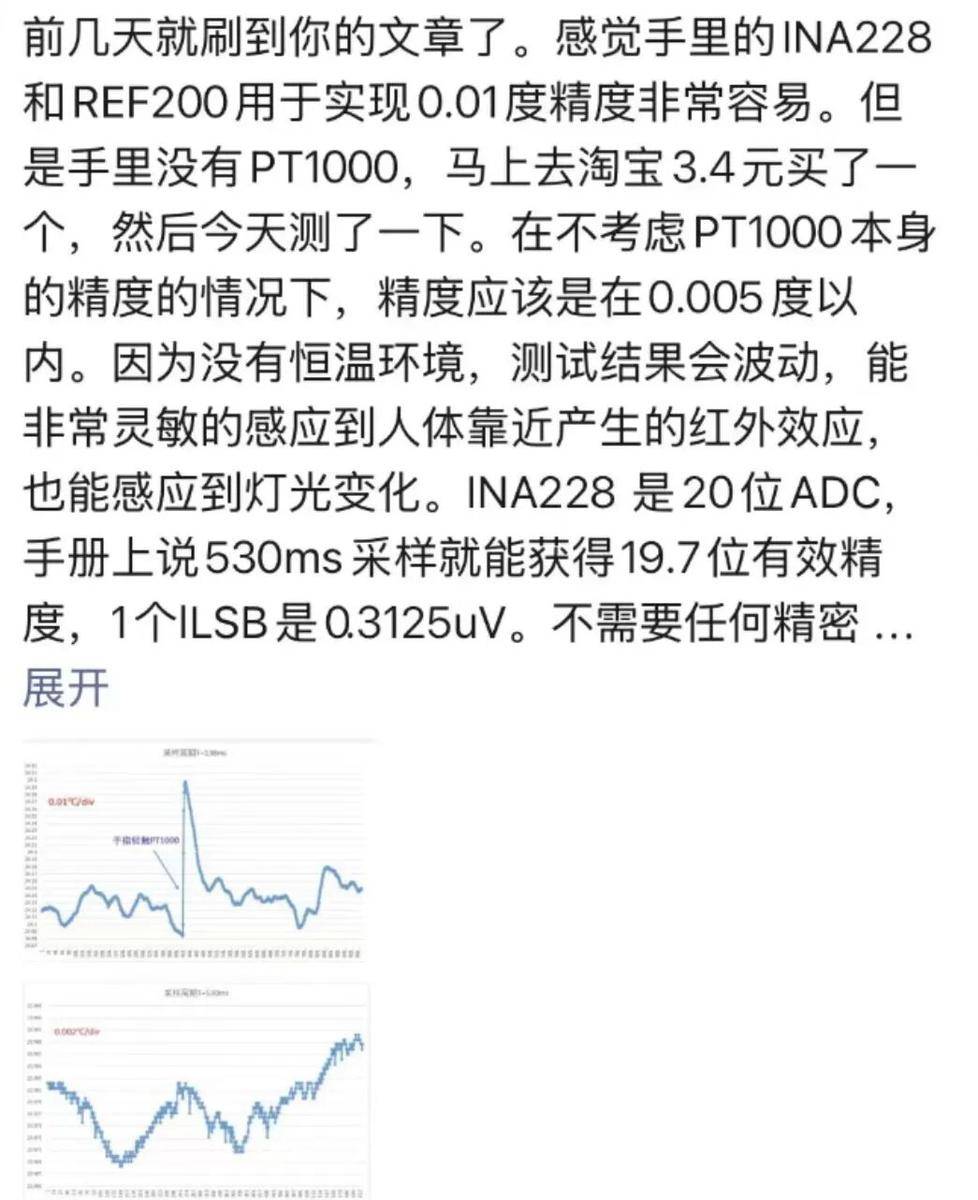
The Experiment
The reader built a circuit using a 20 yuan (~$3) PT1000 sensor with an INA228 20-bit delta-sigma current/power monitor and REF200 100 µA current source, claiming 0.005°C measurement accuracy. The results show impressive sensitivity — detecting human proximity, lamp illumination changes, and air currents. However, several metrological concepts are being conflated.
The core issue: confusing “resolution/sensitivity/short-term noise” with “accuracy”, while ignoring several critical systematic errors.
That said, the approach has genuine value. The INA228 + REF200 + PT1000 combination can indeed achieve high short-term temperature resolution. The problem is that it falls far short of “0.005°C absolute accuracy, no precision resistor needed, no calibration needed.”
Circuit Model
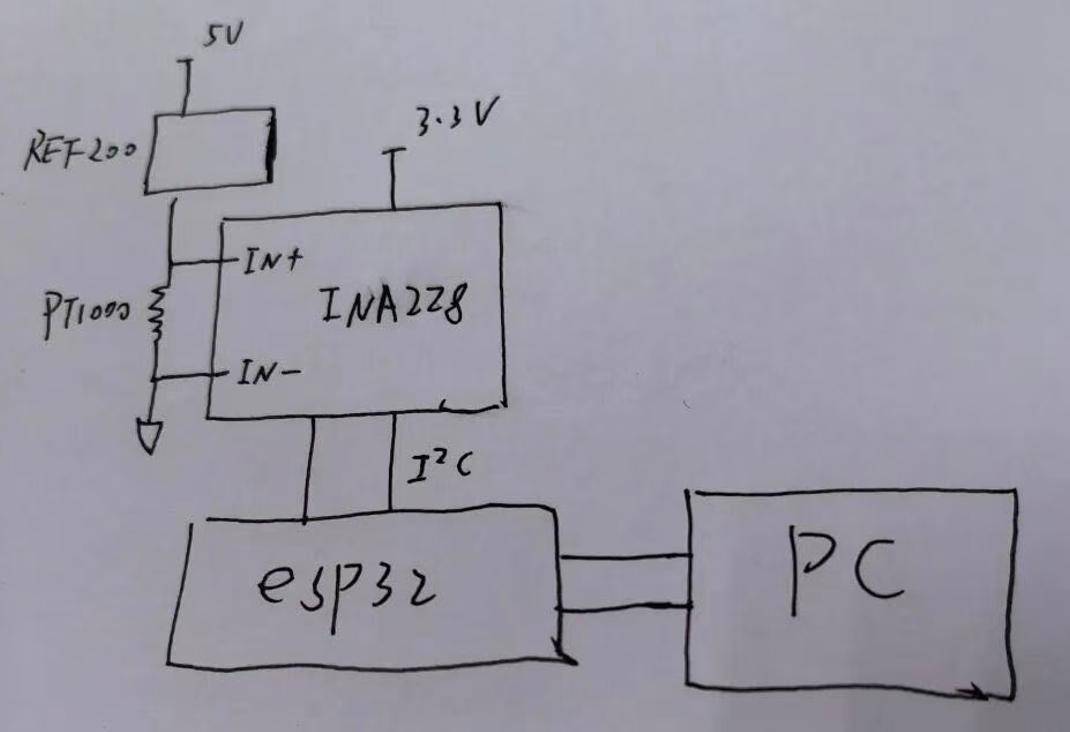
The circuit topology is straightforward:
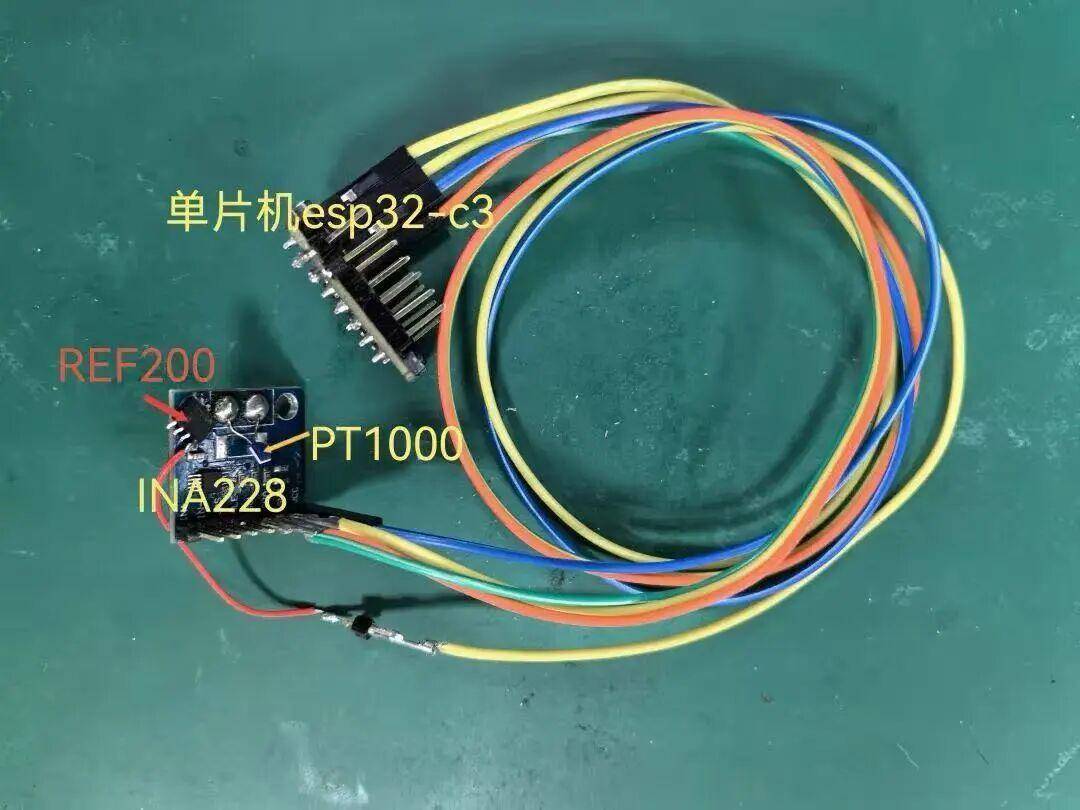
5 V → REF200 100 µA current source → PT1000 → GND
                                │
                         INA228 measures PT1000 voltage
The PT1000 functions as INA228’s “sense resistor.” The theoretical relationship is simple: REF200 provides 100 µA, INA228 measures the voltage across PT1000, and the resistance-temperature curve converts to temperature.
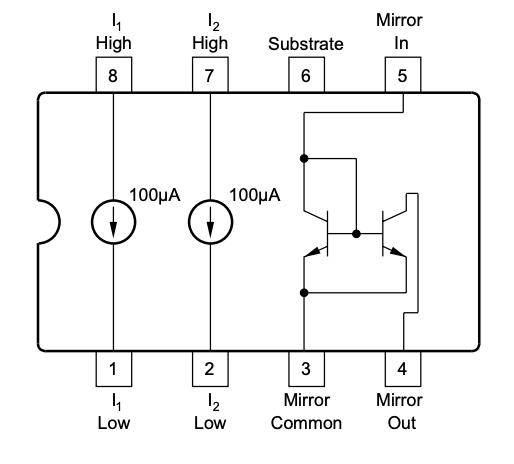
Importantly, this is not RTD ratiometric measurement. It relies on REF200’s absolute current accuracy. The REF200 datasheet specifies two 100 µA current sources with ±0.25% typical (±1% maximum) accuracy and 25 ppm/°C temperature drift. The INA228 is a 20-bit ΔΣ current/power monitor with ±163.84 mV range and 312.5 nV LSB.
Theoretical Sensitivity: Genuinely High
At 24°C, PT1000 resistance is approximately 1,093 Ω with sensitivity of ~3.88 Ω/°C. With 100 µA excitation, the voltage-temperature sensitivity is ~388 µV/°C.
| Temperature Change | PT1000 Resistance Change | Voltage Change at 100 µA |
|---|---|---|
| 1°C | 3.88 Ω | 388 µV |
| 0.01°C | 0.0388 Ω | 3.88 µV |
| 0.005°C | 0.0194 Ω | 1.94 µV |
| 0.002°C | 0.0078 Ω | 0.776 µV |
INA228’s LSB at ±163.84 mV range is 312.5 nV, corresponding to ~0.0008°C temperature resolution. From a pure voltage resolution standpoint, observing 0.002°C-level fluctuations is not unreasonable.
530 ms Sampling: The Upside
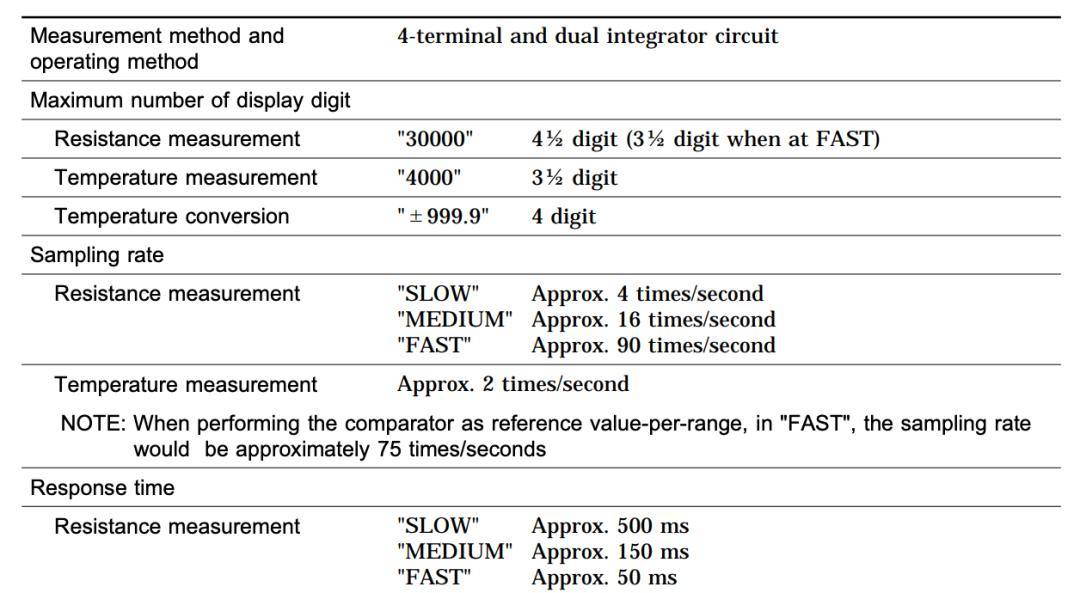
The INA228 supports configurable conversion time and averaging. At ADCRANGE=0 with 540 µs conversion time and 1024x averaging, the output period is ~553 ms with noise-free ENOB of 19.7 bits. This translates to approximately 0.001°C peak-to-peak noise — millikelvin-level short-term resolution is achievable from INA228’s noise specification alone.
But this is called resolution or sensitivity, not accuracy. At Aomway, we stress this distinction across all our sensor calibration documentation: a high-resolution ADC reading is necessary but not sufficient for high-accuracy measurement.
Problem 1: REF200 Current Accuracy Becomes Temperature Error
This circuit is not ratiometric — it depends entirely on REF200’s absolute current. REF200’s datasheet specifies ±0.25% typical, ±1% maximum initial accuracy.
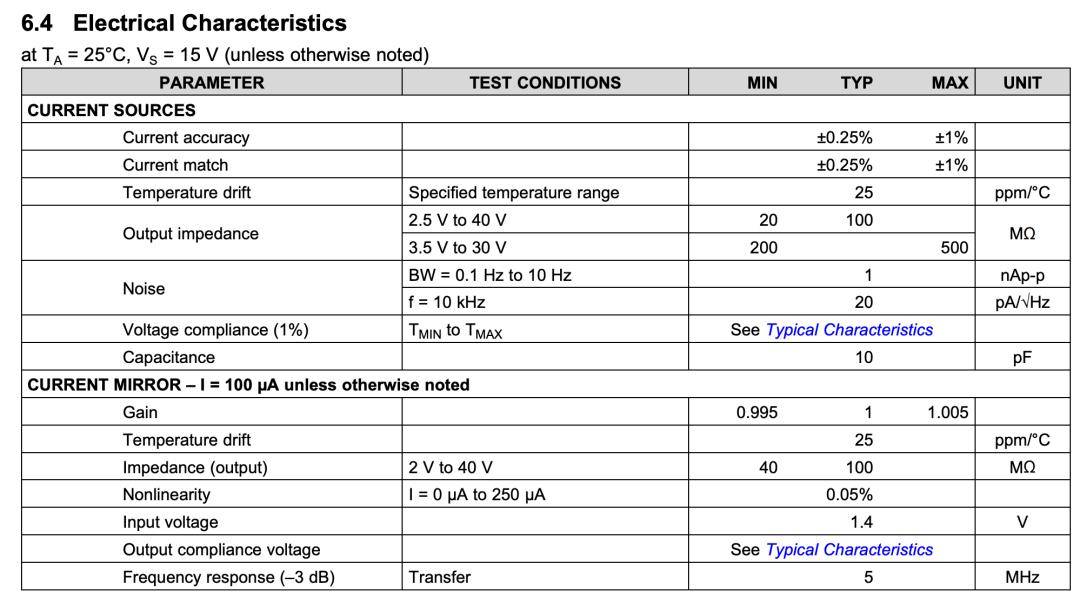
At ±0.5% current error: equivalent temperature error ≈ ±1.4°C. At ±1% maximum: ≈ ±2.8°C. The claim “no calibration needed” is incorrect from an absolute accuracy standpoint.
Problem 2: REF200 Temperature Drift Becomes Measurement Drift
REF200’s temperature coefficient is 25 ppm/°C. This translates to approximately 0.007°C/°C — meaning if the REF200 chip itself changes temperature by 1°C, the reading drifts ~0.007°C. If the PCB temperature changes 5°C, drift reaches ~0.035°C, already exceeding the claimed 0.005°C.
Problem 3: INA228 Input Impedance Loads PT1000
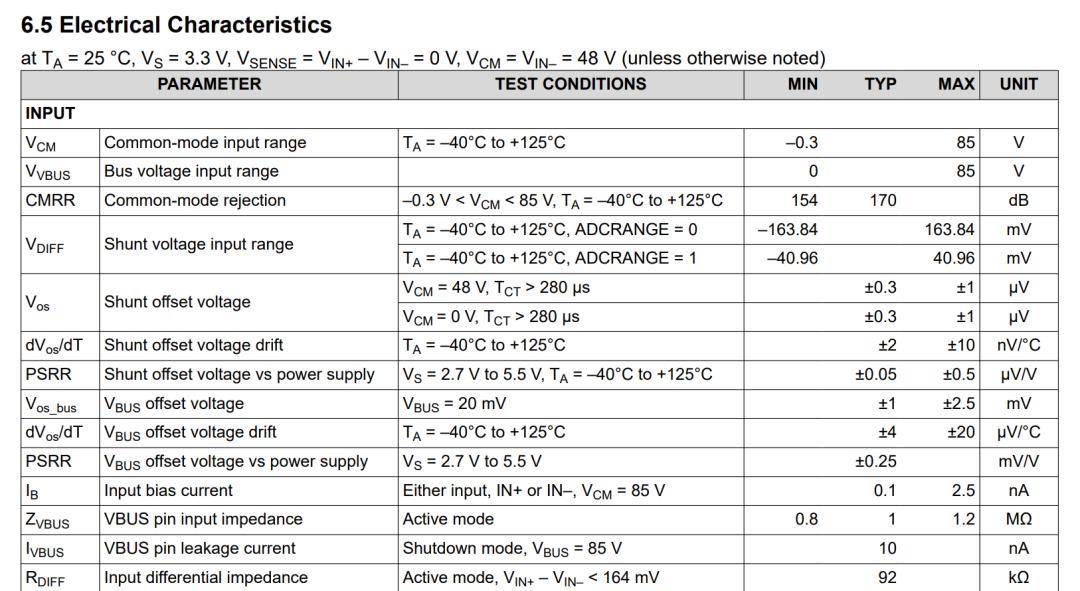
This is the most easily overlooked but critical issue. The INA228 is designed for shunt resistors (mΩ level), where input impedance is negligible. But PT1000 is 1 kΩ level — the INA228’s differential input impedance of ~92 kΩ cannot be ignored.
At 24°C, the parallel combination of PT1000 (1,093 Ω) and INA228 input (92 kΩ) creates a -1.17% loading error, corresponding to approximately -3.3°C fixed temperature error. While this doesn’t affect short-term change detection, it absolutely affects absolute accuracy and the “no calibration needed” claim.
Problem 4: INA228 Gain Error and Offset Voltage
INA228’s maximum offset voltage is ±1 µV (≈±0.0026°C — genuinely small). However, the maximum gain error is ±0.05%, corresponding to ≈±0.14°C. This alone exceeds the 0.005°C claim by 28x.
Problem 5: Thermoelectric EMF, Wiring, Solder Joints

The system’s critical sensitivity is ~388 µV/°C. Just a few microvolts of thermoelectric EMF at contact points (dissimilar metal junctions, pins, solder joints, terminals) already corresponds to millikelvin-level errors. The REF200 datasheet layout recommendations specifically mention minimizing current source path length to avoid parasitic errors like Seebeck effect.
When the reader observes “finger proximity and lamp changes are detectable,” this confirms high thermal sensitivity — but also reveals that air convection, local heating, thermal conduction changes in wires/surfaces, and human-disturbed airflow are all entering the measurement.
Problem 6: PT1000 Sensor Body Accuracy

A 3.4 yuan PT1000 sensor cannot provide 0.005°C absolute accuracy. Even if the circuit resolves 0.002°C, the sensor’s R₀ tolerance, temperature coefficient variation, packaging thermal coupling, long-term stability, mechanical stress, lead effects, and soldering thermal impact all exceed this level by orders of magnitude.
The correct statement: this system may have ~0.001°C short-term resolution, but not ~0.005°C temperature accuracy.
Comparison with MAX31865
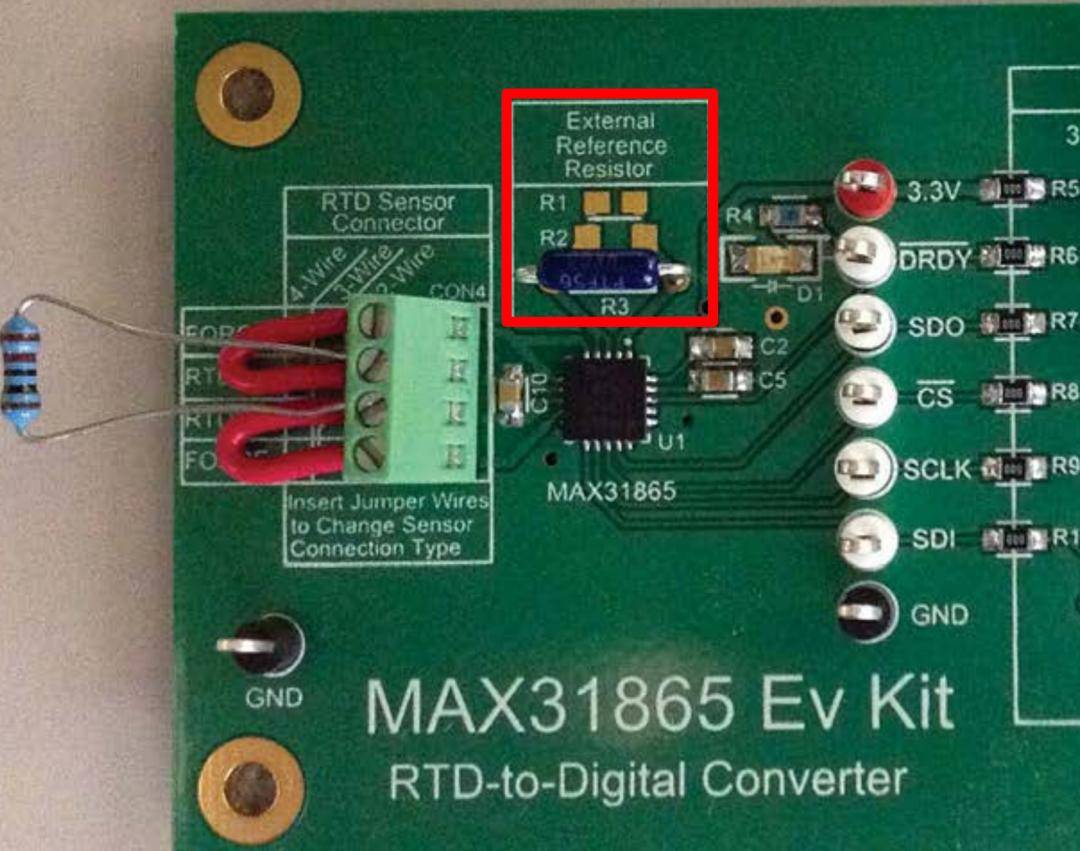
The MAX31865 is a dedicated RTD measurement chip using ratiometric measurement — the same current flows through both the RTD and a reference resistor, so current source absolute accuracy becomes irrelevant. The MAX31865 datasheet specifies ~0.03125°C nominal resolution and ±0.5°C maximum total accuracy.
The INA228 + REF200 approach, by contrast, depends on absolute current accuracy, suffers from input impedance loading, and requires calibration for absolute temperature measurement.
Complete Error Budget
| Error Source | Specification | Temperature Impact |
|---|---|---|
| INA228 1 LSB | 0.3125 µV | 0.0008°C |
| INA228 noise (19.7 bit, 553 ms) | ~0.385 µVpp | ~0.001°C pp |
| INA228 offset voltage | ±1 µV max | ±0.0026°C |
| INA228 gain error | ±0.05% max | ~±0.14°C |
| REF200 current accuracy ±0.5% | ±0.5% | ~±1.4°C |
| REF200 current accuracy ±1% | ±1% | ~±2.8°C |
| REF200 temperature drift | 25 ppm/°C | ~0.007°C/°C |
| REF200 low-frequency noise | 1 nApp | ~0.0028°C pp |
| INA228 input impedance (92 kΩ) | parallel with PT1000 | ~-3.3°C fixed |
| 1 µV thermoelectric EMF | 1 µV | ~0.0026°C |
| PT1000 sensor tolerance | depends on class | typically >> 0.005°C |
This table clearly shows: the circuit resolution can be extremely high, but system absolute accuracy cannot reach 0.005°C without calibration.
Recommendations for Improvement
1. Buffer the INA228 input. Don’t let the 92 kΩ input impedance directly load PT1000. Add a high-impedance buffer or instrumentation amplifier, or switch to an RTD-specific front-end like MAX31865, ADS1220, ADS124S08, or AD7124.
2. Use ratiometric measurement. Have the ADC measure both PT1000 voltage and a precision reference resistor voltage simultaneously. This cancels current source absolute error — exactly how MAX31865 works.
3. Implement current reversal. Measure with both forward and reverse current to cancel thermoelectric EMF: V_avg = (V+ – V-) / 2.
4. Perform at least two-point calibration. Use ice water and room temperature, or 20°C/30°C thermostatic points.
5. Design for thermal stability. Bare PT1000 is sensitive to fingers, lamps, and airflow — great for detecting changes, problematic for absolute measurement. Use metal probes, thermal coupling structures, shielding, and controlled airflow.
Verdict
The reader’s experiment has a credible aspect: INA228’s low noise and high resolution, combined with PT1000’s ~388 µV/°C sensitivity at 100 µA, genuinely achieves ~0.001°C-level short-term change detection.
But the conclusion has significant problems. The more accurate assessment: INA228 + REF200 + PT1000 can serve as a high-sensitivity temperature change detection experiment, but achieving 0.01°C-level absolute temperature measurement requires system-level modeling, input impedance correction, precision reference or ratiometric measurement, thermoelectric EMF handling, sensor grading, and calibration.
Have questions about precision temperature measurement, sensor selection, or metrology fundamentals? Contact Aomway at [email protected] — our engineering team specializes in measurement system design and calibration.
Frequently Asked Questions
1. What is the difference between resolution, sensitivity, and accuracy?
Resolution is the smallest detectable change (e.g., 0.001°C). Sensitivity is the ratio of output change to input change (e.g., 388 µV/°C). Accuracy is how close the measurement is to the true value. A system can have 0.001°C resolution but ±2.8°C accuracy — these are independent specifications. Understanding this distinction is fundamental to any serious measurement system design at Aomway.
2. Why is ratiometric measurement better than absolute current measurement?
In ratiometric measurement, the same current flows through both the sensor and a reference resistor. The ADC measures their ratio, so current source accuracy, drift, and noise cancel out. MAX31865 uses this principle. The INA228 + REF200 approach measures absolute voltage, making it dependent on REF200’s ±1% accuracy specification.
3. Can I calibrate the INA228 + REF200 + PT1000 circuit to achieve 0.005°C accuracy?
Possibly, but it requires extensive calibration: REF200 actual current, INA228 gain and offset, PT1000 R₀ and temperature coefficient, input impedance loading model, and thermoelectric EMF compensation. You would also need a high-precision temperature reference for calibration points. The effort may exceed simply using a MAX31865 or ADS1220 designed for RTD measurement.
4. What is thermoelectric EMF and why does it matter at microvolt levels?
When dissimilar metals meet (copper traces, tin-lead solder, Kovar pins, etc.) and there is a temperature gradient, a small voltage (thermoelectric EMF) is generated. At ~1-10 µV per junction, this corresponds to 0.003-0.03°C error in a PT1000 system with 388 µV/°C sensitivity. Current reversal measurement can cancel this.
5. What temperature sensor should I use for 0.01°C accuracy?
For 0.01°C absolute accuracy, consider: (1) A Class A or 1/10 DIN PT1000 sensor (±0.03-0.1°C initial accuracy), (2) A dedicated RTD front-end like MAX31865, ADS1220, or AD7124 with ratiometric measurement, (3) Multi-point calibration against a traceable reference, (4) Proper thermal design with metal probes and shielding. The total system cost will be significantly higher than 20 yuan, but Aomway can help you balance cost and performance for your specific application.
Need help with precision measurement system design? Contact Aomway at [email protected] — we provide sensor selection guidance, circuit design review, and calibration consulting.
