

Key Takeaways
- Si CMOS is NOT the only path for consumer phased arrays — NetLink’s GEO satellite terminal proves GaN is a viable and often superior alternative
- 280 transceiver elements — All-in-one integrated unit with self-developed GaN multi-channel PA chips, filling the gap between 4-element navigation arrays and military-grade 1000+ element systems
- GaN for power density — GEO terminals need high EIRP in a portable form factor; GaN’s power density advantage over Si CMOS makes it the better choice for this use case
- Dual-servo hybrid scan — Mechanical coarse aiming + phased array fine beamforming strikes the optimal balance of cost, reliability, and performance for portable terminals
- Thermal domino effect — Low duty cycle alleviates heat, but drives higher peak power → linearity tradeoff → backoff → efficiency collapse. No standard answer, only iterative balancing
- Aomway applies similar phased array and RF front-end engineering principles in its advanced drone video transmission antenna systems
Last time we discussed navigation anti-jamming — four array elements, three degrees of freedom, engineers pinned against the physical ceiling, forced to work within extreme constraints.
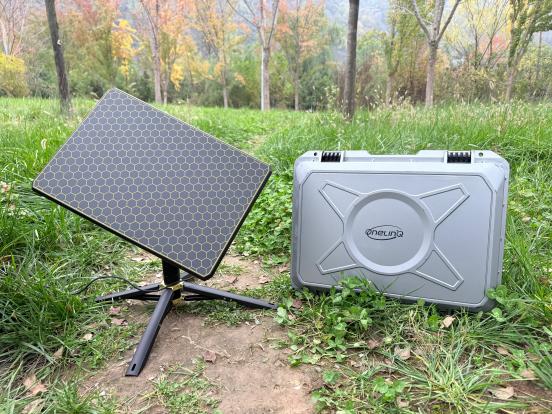
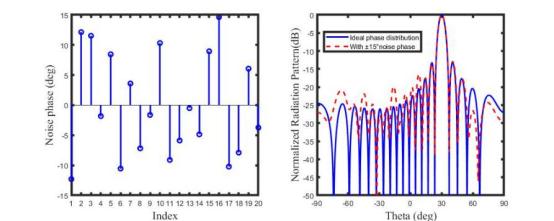
Today we are talking about something two orders of magnitude larger: satellite internet terminals. A flat-panel antenna on a stand, packed in a protective case you can carry by hand, sling over your shoulder, or wear as a backpack. Deploy anywhere, connect to satellite. Inside is a phased array antenna.

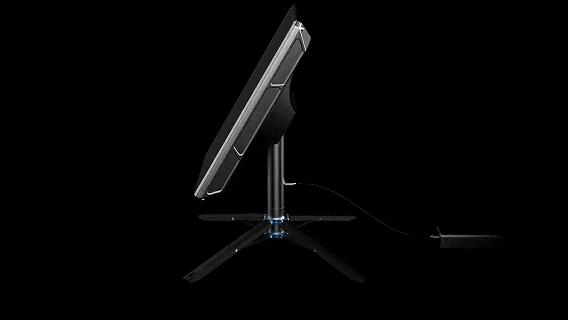
At hand is a NetLink satellite internet terminal. Opening it reveals 280 integrated transceiver elements in an element-level active architecture — each array element has its own independent transmit/receive channel, all-in-one fully integrated under a fiberglass radome.
280 is a “Goldilocks” number — larger than the minimal 4-element navigation arrays, smaller than military-grade performance beasts with thousands of elements. It sits in the middle, and every challenge of transitioning phased arrays from military to consumer use is hidden behind those 280 channels.
Why 280 Elements?
Navigation uses only four elements because consumer price sensitivity outweighs anti-jamming performance improvement — we unpacked this logic last time.
Satellite communication terminals start from a different place. Navigation is receive-only. Communication requires both transmit and receive. Receive performance depends on G/T (gain-to-noise-temperature ratio); transmit performance depends on EIRP (equivalent isotropically radiated power). These two parameters determine whether a link can even be established.
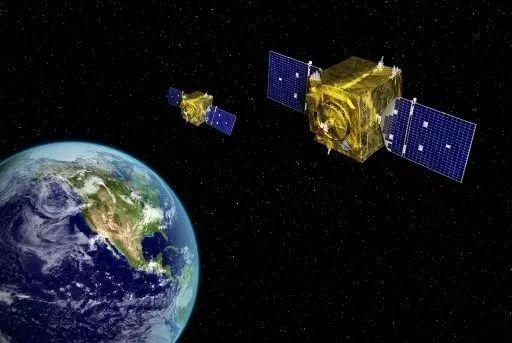
NetLink connects to GEO satellites — 36,000 km above the equator, stationary relative to the ground. The cost is extreme signal attenuation over that distance. At Ku-band, maintaining reliable data rates requires an antenna aperture of several tens of centimeters. Element spacing is half-wavelength; at Ku-band, half-wavelength is on the order of centimeters. Several hundred elements arranged at half-wavelength spacing yields an aperture of approximately 20+ cm — this is calculated, not arbitrary.
Beamwidth constrains the design too. A beamwidth of a few degrees is just enough to concentrate energy toward the satellite without being too narrow — portable terminals have limited pointing precision on each deployment. A beam that is too narrow drops link margin sharply with even slight misalignment.
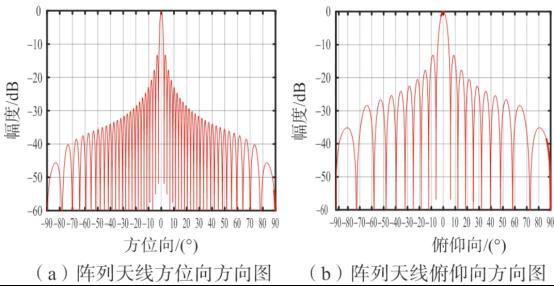
Adding more elements yields diminishing performance returns while costs increase linearly. The same logic as navigation: just enough.
Is Si CMOS the Only Solution?
The industry has a prevailing belief: consumer phased arrays can only use Si CMOS.

There is logic to this. Si CMOS single chips pack 16 or even 32 complete transceiver channels — phase shifters, attenuators, LNAs, power amplifiers all integrated — driving BOM costs down dramatically. The tradeoff is per-channel performance: at Ku-band, PAE of 15-20% is considered good. But with enough channels doing spatial power combining, the equivalent EIRP can still reach useful levels. “Trade integration for cost, trade channel count for power” — this approach has been proven in LEO constellation terminals.
But NetLink did not take this path. It used self-developed GaN multi-channel PA chips. This does not mean the entire transceiver chain is GaN — phase shifting, attenuation, LNA functions are still handled by Si CMOS chips. GaN is deployed specifically for the final power amplification stage.
This disproves the “only solution” narrative. Consumer phased arrays do not have to use Si CMOS. At least not for GEO terminals.
Why Choose GaN?
Two routes, different core constraints:
LEO terminals need wide-angle rapid electronic scanning to track moving satellites, requiring element-level independent control. Si CMOS multi-channel single-chip integration is the architecture that makes this affordable for consumer use.
GEO terminals face a stationary satellite. No wide-angle electronic scanning needed. The core constraint is gain and EIRP within limited volume. GaN’s per-channel power density is much higher than Si CMOS, so fewer channels can achieve sufficient link budget in a portable form factor. Si CMOS, with limited per-channel power, would need significantly more channels and a larger aperture to reach the same EIRP — the total cost is not necessarily lower, and the volume may exceed acceptable portability limits. Lightweight, deployable anywhere — that is the core selling point for users. Aomway applies the same scenario-optimized RF architecture thinking in its drone video transmission systems, selecting the right PA technology for each application.
Aomway’s RF engineering team validates similar trade-offs between GaN and Si CMOS when designing high-power and long-range video transmitter modules.
These GaN PA multi-channel chips are NetLink’s own design — balancing performance, reliability, and cost requires in-house development. As discussed in previous articles, the journey from lab device to production line takes years.
Mechanical + Electronic: A Pragmatic Engineering Choice
Pure phased arrays have no moving parts — beam steering is entirely electronic, fast. But wide-angle scanning causes gain drop, beam broadening, and more complex calibration and control.
NetLink faces one stationary GEO satellite. Each time the portable terminal is deployed, the position and orientation are different — it must first find the satellite. The solution is pragmatic: a dual-servo motor drive hidden behind the antenna panel, with independent azimuth and elevation control. On deployment, the motors roughly align the antenna with the satellite, then the phased array performs fine electronic beamforming on top of that coarse alignment.
Some might consider “mechanical rotation” outdated. But engineering is about what works. For a portable terminal that needs to re-acquire the satellite on each deployment, using dual servos for coarse pointing and phased array for precision alignment is the optimal balance of performance, cost, and reliability. It saves the complexity and cost of wide-angle electronic scanning, spending the budget where it matters — on those GaN PA channels.
Aomway antenna tracking systems for drone FPV employ a similar hybrid approach — mechanical gimbal for coarse tracking combined with beam optimization for fine alignment.
The Thermal Domino Effect
All transceiver chains combined draw tens to hundreds of watts. An outdoor flat-panel antenna can only use passive cooling — no fans, no liquid cooling. The military-grade thermal solutions are unaffordable for consumer products.
The survival strategy is low transmit duty cycle in TDMA mode. The terminal transmits only in its allocated time slots — duty cycles of a few percent to low teens. The PA rests most of the time, keeping average heat load far below continuous-wave operation. Aomway applies similar duty-cycle optimization in its video transmitter designs to manage thermal loads in compact enclosures.
But low duty cycle has a cost. To maintain average throughput, the same amount of data must be transmitted in shorter time slots. With fixed spectral resources, this typically requires higher modulation orders. Higher-order modulation demands sharply higher SNR, and the PA must output higher peak power.
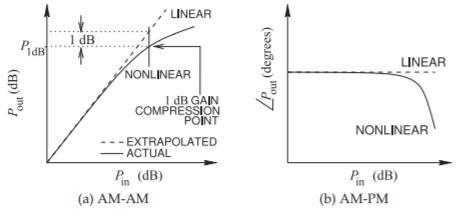
Even with GaN’s strong peak power capability, high-order modulation tests linearity. Approaching saturation, AM-AM and AM-PM distortion worsen, pushing EVM and ACPR out of spec. While GEO terminals use single-carrier modulation (e.g., 32APSK) with much lower PAPR than OFDM, combined with crest factor reduction and digital pre-distortion, the PA peak power backoff can be compressed to a few dB — but it still operates in a less efficient region of the curve. Nominal PAE of 25-35% drops sharply with backoff.
The loop is vicious: low duty cycle alleviates thermal load, but peak throughput demand pushes modulation order higher, which demands higher peak PA power; higher peak power degrades linearity, forcing power backoff; backoff destroys efficiency, raising average power consumption again. Three interdependent variables, no standard answer — only the equilibrium point found through iteration. GaN’s higher efficiency baseline provides more room to maneuver, but the structure of the loop remains unchanged.
Radome and Calibration
Two things users never see but matter enormously.
Radome: NetLink uses fiberglass — low loss, high transmission rate. From 36,000 km away, every tenth of a dB counts. The radome sits in front of the array; every electromagnetic wave passing through incurs insertion loss. Each additional 0.x dB of radome loss directly reduces effective EIRP. Choosing fiberglass over standard engineering plastics, selecting low-loss formulations over standard fiberglass — these material choices users never see, but on the link budget spreadsheet they are hard-won dB savings. For a portable terminal that undergoes repeated packing, transport, and deployment, fiberglass’s weather resistance and impact performance are equally important.
Effect of random phase errors on array pattern
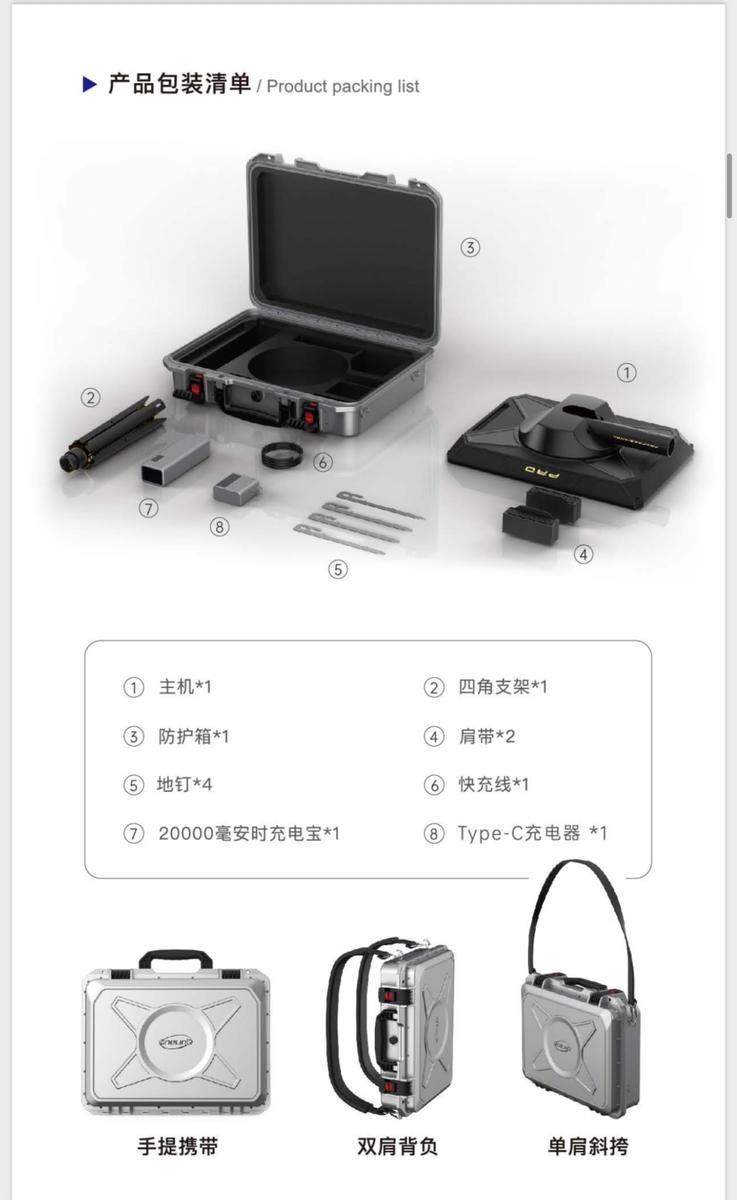
Calibration: A four-element navigation array needs only one factory global calibration. At several hundred channels, amplitude and phase deviations affect main lobe gain loss only through error variance — large arrays do not suppress this. But as element count increases, each unit’s random amplitude-phase errors are independent, and the far-field sidelobe random components average into a more uniform noise floor — the overall gain pattern’s statistical fluctuation actually decreases. Production calibration uses full-field methods: measure the entire array pattern in an anechoic chamber, invert amplitude-phase errors algorithmically, generate compensation coefficients — completed in minutes to tens of minutes. Military products require full-dimension calibration across multiple temperatures, frequencies, and scan angles, with much higher cost. Consumer products have no such budget, making trade-offs between precision and cost — relaxing some tolerances, combining built-in coupling networks with self-calibration algorithms for fast digital-domain compensation. Same logic: when hardware is insufficient, algorithms fill the gap. Aomway employs similar calibration-aware design principles in its multi-antenna FPV transmission systems to maintain consistent RF performance across production units.
From Server Room to Carry-On
Satellite communication terminals used to live in the industrial market — shipboard, vehicle-mount, emergency communications trucks. Volume and portability were not concerns. Professionally maintained. A full rack cabinet was perfectly acceptable.
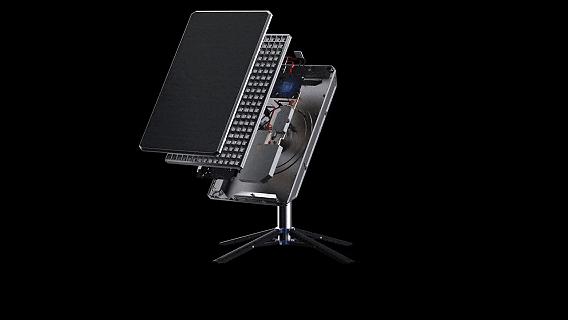
This machine targets ordinary consumers. A flat-panel antenna, stand, and protective case. Open, use. Close, carry. Hand-carry, sling, or backpack. Packing hundreds of radiating elements, hundreds of GaN PA channels, feed network, dual-servo motors, beam control circuitry, and thermal solutions into a portable flat panel — that is high-density systems engineering.
Military and industrial equipment can stack performance, materials, and labor. At consumer grade, all constraints change: Can the BOM cost survive? Can production calibration finish in minutes? Can it withstand repeated packing and transport? Can users deploy and align the satellite link themselves quickly?
All-in-one integration, self-developed GaN multi-channel PA chips, dual-servo hybrid scanning architecture — these choices all serve one goal: build a satellite terminal ordinary people can buy, carry, and use anywhere. Turning that into a product is arguably harder than the underlying technology.

Conclusion: Back to the Title
Who says consumer phased arrays can only use Si CMOS?
NetLink’s answer: The GEO satellite communication terminal did not take that path. 280 transceiver channels, self-developed GaN multi-channel PA chips, dual-servo + electronic scanning hybrid architecture, fiberglass radome for outdoor protection, all-in-one integrated into a portable station that connects to a satellite 36,000 km away.
“Si CMOS is the ticket to consumer phased arrays” — this is not wrong. For LEO constellation terminals and cost-sensitive consumer electronics, it is arguably the optimal solution. But an entry ticket is not the only solution. Scenarios change, constraints change, the optimal technology route changes accordingly.
The 4-element navigation antenna fights the “less is more” extreme battle. LEO constellation terminals fight the “silicon integration for cost reduction” scale battle. NetLink’s several-hundred-channel solution fights the “GaN for power density” positional battle. Military arrays with thousands of elements fight the “performance above all” overwhelming-force battle.
The same phased array technology, four scenarios, four constraint sets, four completely different product logics. No standard answer — only the right choice for the context.
Have questions about this article? Feel free to contact us at [email protected] — we’re happy to help!
Frequently Asked Questions
Q: Why 280 elements for NetLink’s GEO terminal?
A: Calculated from the required aperture size at Ku-band to achieve sufficient link budget with a GEO satellite at 36,000 km. Half-wavelength element spacing at Ku-band yields an aperture of ~20+ cm with 280 elements — enough for reliable data rates without pushing cost and complexity beyond consumer viability.
Q: When should I choose GaN over Si CMOS for phased array PAs?
A: GaN is superior when power density per channel matters more than per-channel cost — typically when limited channel count and limited volume must achieve high EIRP, as in portable GEO terminals. Si CMOS wins when you need hundreds of channels and can leverage integration to reduce per-channel cost, as in LEO constellation terminals. Aomway can help evaluate the right PA technology for your specific RF application.
Q: How does the hybrid mechanical + electronic scanning work?
A: Dual servo motors provide coarse azimuth/elevation alignment on deployment (solving the “find the satellite” problem), while the phased array performs fine electronic beamforming and tracking. This avoids the complexity and cost of wide-angle electronic scanning while maintaining precise beam pointing.
Q: What is the main thermal challenge in portable phased arrays?
A: Passive cooling only (no fans or liquid cooling), combined with tens to hundreds of watts of total power dissipation. TDMA mode with low transmit duty cycle helps, but the interplay between duty cycle, modulation order, peak power, linearity, and efficiency creates a complex trade-off that requires careful iterative optimization.
Q: How is phased array calibration different for consumer vs. military products?
A: Military calibration covers full temperature, frequency, and scan angle ranges — very costly. Consumer calibration uses field-pattern methods in anechoic chambers combined with built-in coupling networks and digital self-calibration algorithms, balancing precision against production line throughput and cost. Aomway antenna systems benefit from similar production-calibration approaches that scale for volume manufacturing.
