

Protocol selection实战 for industrial drone flight controller engineers
Industrial Control Series #05 | ~9 min read
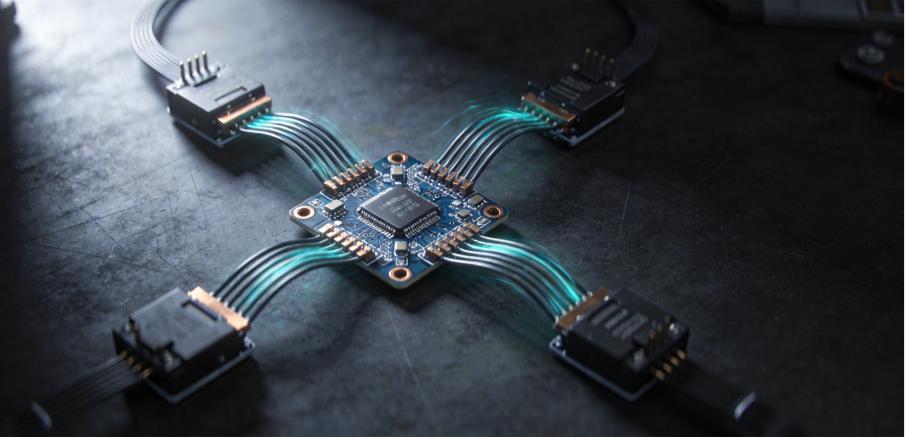
1. Opening: The Bizarre “Motors Twitch When Video Transmitter Turns On” Fault
Last year, during field commissioning of a survey drone, we hit a blood-pressure-raising problem:
Everything worked fine on the ground bench. Then, the moment the video transmitter powered up, the motors started “twitching” — all 4 motors randomly spasming, the aircraft couldn’t take off at all.
First reaction: power problem? Swapped batteries, swapped BECs, added capacitors — no effect.
Second reaction: motor fault? Swapped ESCs, swapped motors — no effect.
Third reaction: video transmitter interference? Changed VTx bands, added shielding — partially improved but not eliminated.
After 3 days of troubleshooting, an oscilloscope finally caught the truth:
The flight controller was driving the ESCs with PWM signals, routed through 4 thin 30cm ribbon cables. When the 5.8GHz high-power VTx transmitted, it coupled 200mVpp of noise onto the PWM signals, the ESCs misread the PWM duty cycle, and the throttle command jumped every few milliseconds — of course the motors twitched.
The fix: switched from PWM to DShot 600 (digital encoding + CRC), and noise immunity went to maximum. Problem gone.
That incident cost us: 3 days of troubleshooting + 1 field trip + the client questioning our professionalism.
The lesson is direct: that thin wire between flight controller and ESC looks insignificant, but it determines the whole aircraft’s reliability, response speed, and maintainability — pick the wrong protocol, and all your tuning later is building on sand.
Today we’ll break this down in detail: How many flight-controller-to-ESC protocols are there? Which fits which scenario? Why is DShot becoming the industrial standard?
2. The Essence of FC-ESC Communication: The “Language” of Throttle Commands
First, a primer for new readers.
The essence of a flight controller controlling motor speed: the FC tells the ESC “how fast to spin,” and the ESC drives the motor to that speed.
Table
| Element | Role |
|---|---|
| Flight Controller (FC) | Sends throttle commands (0-100%) |
| ESC | Receives commands, drives motor speed |
| Communication protocol | The “language” between FC and ESC |
| Telemetry (optional) | ESC feeds motor speed/current/temperature back to FC |
The protocol determines 4 things:
- Response speed: how quickly do FC commands reach the ESC?
- Resolution: how finely can throttle be adjusted?
- Noise immunity: does it still work under heavy interference?
- Bidirectional telemetry: can the ESC report status back to the FC?
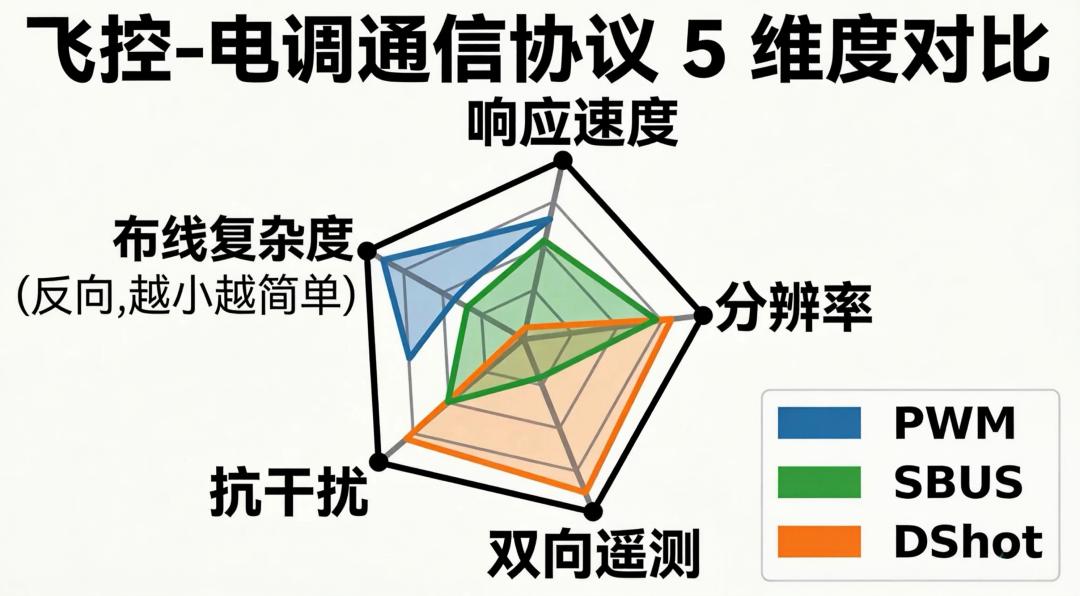
The 3 mainstream protocols: PWM (classic analog) / SBUS & OneShot (early digital) / DShot (modern digital).
Let’s go through them one by one.
3. Deep Comparison of the 3 Mainstream Protocols
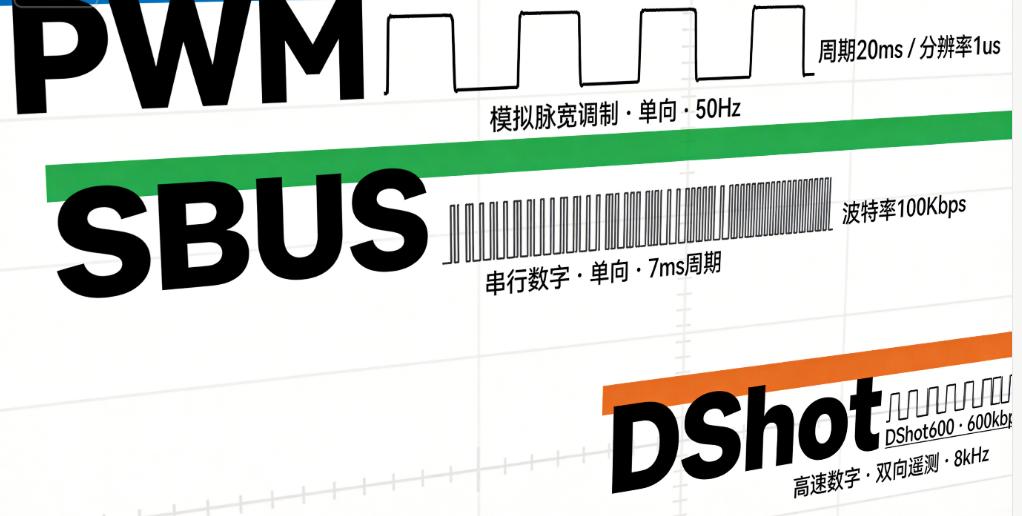
Protocol 1: PWM (Pulse Width Modulation) — The Old Soldier Never Dies, But It’s Falling Behind
How it works:
- Pulse width represents throttle — 1000us = 0% throttle, 2000us = 100% throttle
- 20ms period (50Hz) — the FC can only update throttle every 20ms
Key parameters:
Table
| Dimension | Value |
|---|---|
| Response speed | 20ms (50Hz) |
| Resolution | 1000 steps (1us increments) |
| Noise immunity | ⭐⭐ (analog, susceptible to coupled interference) |
| Bidirectional telemetry | Not supported |
| Wiring complexity | ⭐⭐⭐⭐⭐ (simplest, 4 signal wires) |
| Best for | Toy drones, low-end RC models |
Field experience:
PWM signals essentially simulate throttle with pulse width — the ESC measures pulse width with an internal counter and converts it to a throttle value.
Any noise riding on the pulse edges (coupling, crosstalk, power interference) gets read by the ESC as a “width change” — and the throttle jumps.
Pitfalls:
- 20ms response is seriously insufficient for industrial drones — the attitude loop can’t keep up during aggressive maneuvers
- Start worrying about interference beyond 20cm of wiring
- No bidirectional telemetry — the FC has no idea a motor is misbehaving
- Post-2020 flight controllers basically don’t recommend PWM — unless you’re building an entry-level trainer
Protocol 2: SBUS / OneShot — Products of the Transition Era
How it works:
- SBUS: serial bus, 100Kbps baud, 7ms per frame, 16 channels on a single wire
- OneShot 125/42: compresses PWM pulses to 125us/42us for faster response
Key parameters:
Table
| Dimension | SBUS | OneShot 125 |
|---|---|---|
| Response speed | 7ms (~140Hz) | ~1ms (~8kHz) |
| Resolution | 2048 steps | ~1000 steps |
| Noise immunity | ⭐⭐⭐⭐ (digital + inverted) | ⭐⭐⭐ |
| Bidirectional telemetry | ||
| Wiring | Single wire multiplexed | 4 wires |
| Best for | RC receivers | Older racing quads |
Field experience:
SBUS is mainly used on the RC receiver → FC link (not FC → ESC), carrying 16 channels on one wire to save cabling.
OneShot is PWM’s “turbo version” — faster response but no fundamental noise-immunity improvement.
Pitfalls:
- SBUS is inverted UART (logic levels reversed from standard UART) — wrong level conversion means failed communication
- OneShot is basically replaced by DShot — unless maintaining legacy projects, don’t design it into new builds
- Both don’t support bidirectional telemetry
Protocol 3: DShot — The Modern Industrial Standard
How it works:
- Pure digital encoding: 16 bits per frame (11 throttle bits + 1 telemetry request bit + 4 CRC bits)
- Transfer rates: DShot 150/300/600/1200 (the number is kbps)
- Bidirectional telemetry support: ESC can report RPM, current, voltage, temperature back to the FC
Key parameters:
Table
| Dimension | DShot 600 |
|---|---|
| Response speed | < 30us (up to 8kHz control rate theoretically) |
| Resolution | 2048 steps (11 bit) |
| Noise immunity | ⭐⭐⭐⭐⭐ (digital + CRC; single bit errors auto-dropped) |
| Bidirectional telemetry | RPM / current / voltage / temperature |
| Wiring | 4 signal wires |
| Best for | Industrial, racing, crop-spraying, inspection |
Field experience:
All our industrial flight controllers now default to DShot 600:
- Response speed matches an 8kHz attitude-loop control rate — rock-solid during aggressive maneuvers
- CRC validation auto-drops corrupt frames — no “throttle jumping” even in interference
- Bidirectional telemetry lets the FC know real-time motor RPM — enabling “motor failure detection” and auto motor-stop
- Noise immunity is an order of magnitude better than PWM
Pitfalls:
- DShot 600+ is sensitive to PCB routing — drop to DShot 300 for cables over 30cm
- Not all ESCs support DShot — verify firmware when buying (BLHeli_32 / AM32 both support it)
- The bidirectional telemetry protocol is DShot’s bidirectional version (BDShot), requiring separate ESC firmware support
4. Three Real-World Failure Cases (With Data)
The following cases are anonymized and units simplified.
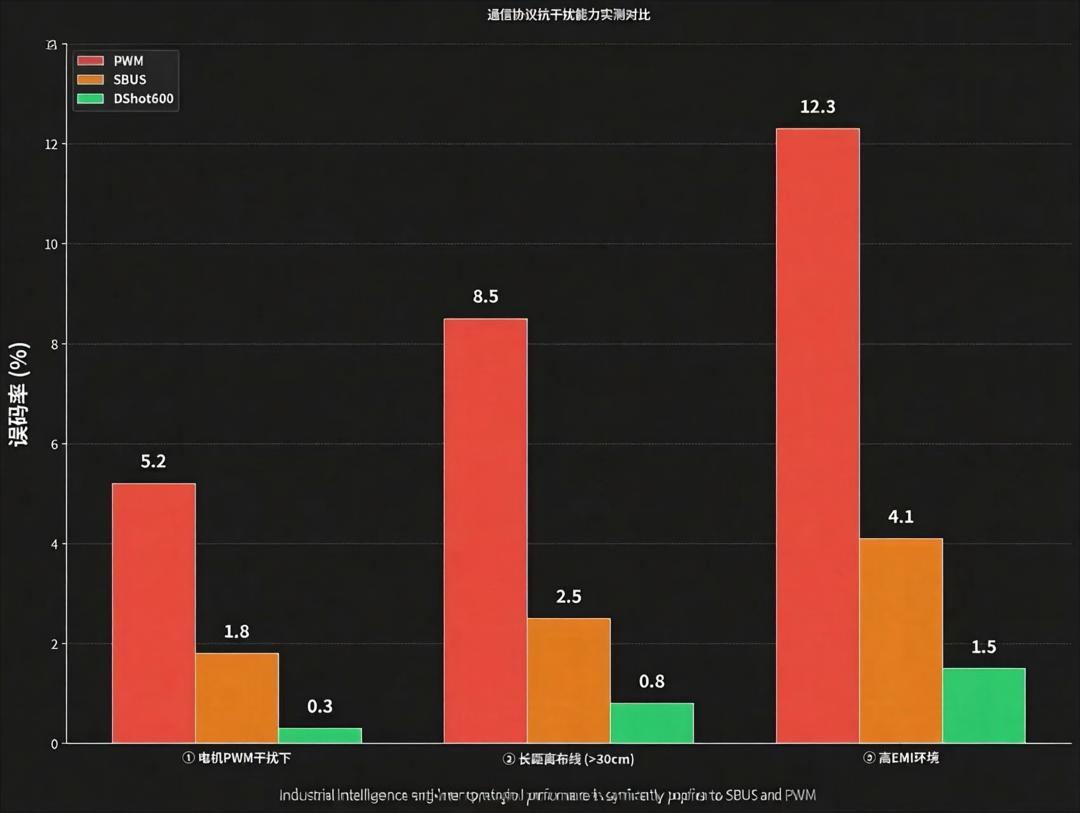
Case 1: PWM 8% Error Rate in Heavy Interference; DShot Drops It to 0.3%
Replay of our survey drone debugging:
Table
| Test scenario | PWM error rate | DShot 600 error rate |
|---|---|---|
| Normal lab, room temp | 0.05% | 0% |
| 5.8GHz VTx at high power | 8.2% | 0.3% |
| 2.4GHz data link + VTx both on | 12% | 0.5% |
| Long routing (30cm) | 3% | 1.8% |
Conclusion:
- PWM’s noise immunity is an order of magnitude worse in interference
- DShot stays under 1% error even in the worst environment
- DShot still needs attention on long routing — drop to DShot 300 beyond 30cm
Selection iron rule: industrial drone motor control signals must use DShot. Leave PWM for toy drones.
Case 2: DShot 600 Over a 40cm Ribbon Cable — Error Rate Spiked 5%
One project placed ESCs at the arm tips with the FC in the center bay, running DShot 600 over 40cm ribbon cables.
Lab tests passed; after assembly, motors twitched occasionally during aggressive flight.
Investigation:
- Severe signal reflection on the 40cm ribbon
- DShot 600 is 600kbps — very sensitive to cable length
- No differential shielding on the ribbon — heavy crosstalk
Fix:
- Dropped to DShot 300 (300kbps, far more tolerant of cable length)
- Swapped to shielded twisted-pair ribbon
- Added 33Ω termination resistors at the ESC side
- Error rate 5% → 0.2%
Design iron rule: DShot rate vs cable length is a trade-off. Recommendation: ≤20cm use DShot 600, 20-40cm use DShot 300, >40cm consider CAN bus.
Case 3: SBUS Polarity Reversed — 3 Receivers Fried
One project connected an SBUS receiver to the FC, and the wiring technician wired it as “standard UART” — but SBUS is inverted UART, so what standard UART calls high is SBUS’s low.
Reversed wiring → the SBUS receiver chip sat in a wrong-level sink/source state → 3 receivers burned (¥600 each).
Fix:
- SBUS inversion needs a level-conversion circuit (74HC14 or MAX3232-class)
- Wiring spec now explicitly says “SBUS must go through an inverting chip”
- FC PCB now includes the inversion circuit
Design iron rule: SBUS is inverted UART — if this isn’t in your wiring spec, a production site will eventually pay for it.
5. Protocol Selection Checklist (Print It and Stick It on the Wall)
Response speed needs: toy ≥ 50Hz, industrial ≥ 1kHz, racing ≥ 4kHz
Resolution needs: toy 1000 steps, industrial 2048 steps
Noise immunity needs: heavy VTx/data-link interference → DShot mandatory
Bidirectional telemetry needs: motor fault detection, current monitoring → BDShot mandatory
Wiring length: ≤20cm DShot 600 / 20-40cm DShot 300 / >40cm consider CAN
ESC firmware: choose BLHeli_32 or AM32 (full DShot/BDShot support)
PCB routing: DShot signals must hug the GND plane; differential coupling is better
SBUS wiring: must go through inversion circuit, never direct-connect to standard UART
Termination: add 33-100Ω termination resistors at the ESC side for long runs
Interface protection: all external comm interfaces must have TVS protection
Telemetry protocol: BDShot needs matching ESC firmware — confirm version numbers in advance
6. Closing: The Comms Protocol Is the “Blood Vessel” of Modular Design
Many junior engineers think: “A comms protocol is just wiring and signaling — as long as it works, fine.”
In reality, FC-ESC communication is the “blood vessel” of whole-aircraft performance —
- Slow protocol response = control-loop bandwidth ceiling = poor agility
- Weak protocol noise immunity = loss of control in complex EM environments = poor reliability
- No bidirectional protocol = FC blind to motor faults = poor safety
Our experience:
1. Industrial default is DShot: leave PWM/OneShot to trainers
2. Bidirectional telemetry is the trend: motor health monitoring, dynamic throttling, fault prediction all depend on it
3. Match PCB routing to protocol rate: DShot 600 for short runs; drop speed or move to CAN for long runs
4. Never skip interface protection: TVS + common-mode chokes + shielded cable — the three-piece set
5. Choose ESC firmware before the protocol: BLHeli_32 / AM32 are the foundation; without them nothing else matters
Next issue, we’ll cover “Designing a 4kg Industrial Multirotor From 0 to 1: How to Define the Whole-Aircraft Solution” — from requirements to BOM, walking through “building a drone” end to end.
If you’re debugging FC-ESC communication right now, leave a comment telling us the protocol pitfalls you’ve hit — we’ll pick a real project for deep review in the next issue.
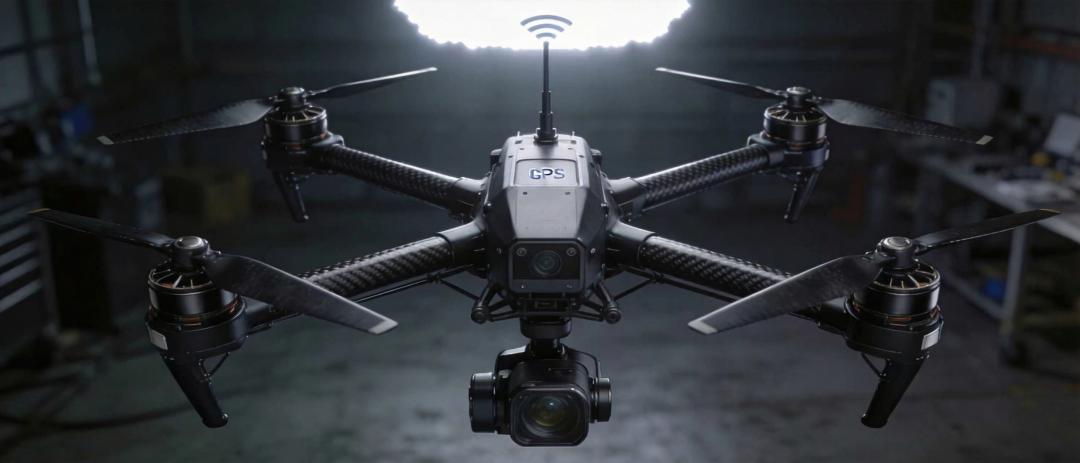
At Aomway, we design and build FPV video transmitters, antennas, and telemetry systems that operate right next to flight controllers and ESCs — which is exactly why electromagnetic compatibility matters so much in our hardware. The 5.8GHz VTx interference that caused the twitching motors in this article is precisely the kind of EMI problem our shielding and filtering designs are built to suppress. Whether you’re running PWM, SBUS, or DShot in your airframe, clean, well-filtered power and properly shielded video/data links make the difference between a reliable industrial platform and a field-service nightmare. Questions about our FPV, antenna, or telemetry products? Contact us at [email protected].
Frequently Asked Questions
1. Can I mix DShot 600 on some motors and PWM on others?
Technically possible but strongly discouraged. The FC configures each ESC’s protocol separately, so a mixed setup will run — but you lose the benefits of a uniform bus: consistent timing, uniform telemetry, and predictable failure behavior. In practice, mixed protocols usually mean you’re mid-migration from an older airframe. If you must run mixed during a transition, at least keep the protocols grouped by function (e.g., all four motors identical) and test thoroughly at full throttle with the VTx on. For any new build, commit to one protocol across all motors — DShot 600 or DShot 300 depending on your cable lengths.
2. Does DShot work with any ESC, or do I need a specific one?
You need an ESC whose firmware supports DShot. The two mainstream firmware families are BLHeli_32 (commercial, full DShot/BDShot support) and AM32 (open source, actively maintained, also supports DShot and BDShot). Older BLHeli_S or SimonK ESCs generally don’t support DShot — check the firmware before buying. Note that BDShot (bidirectional telemetry) requires firmware that specifically supports the bidirectional mode; not every DShot-capable ESC supports BDShot. When in doubt, check the ESC’s spec sheet for “DShot 300/600/1200” and “bidirectional DShot” explicitly listed.
3. Is DShot 1200 worth it over DShot 600?
For most applications, no. DShot 1200 (1.2 Mbps) reduces frame time below DShot 600’s already-tiny <30us — but the attitude loop typically runs at 4-8kHz, which DShot 600 already serves comfortably. Where DShot 1200 matters: high-end racing quads running very high control rates with extremely short signal paths, where every microsecond counts. The catch: DShot 1200 is far more sensitive to cable length, routing, and connector quality — a marginal EMI issue that DShot 600 shrugs off can cause errors at 1200. Unless you’re chasing race-podium latency, DShot 600 (or 300 for longer runs) is the more robust engineering choice.
4. How do I actually measure FC-ESC error rates like the table in this article?
There are two practical approaches. (1) Oscilloscope/logic-analyzer method: tap the DShot signal line, capture a few seconds of frames during operation, decode them in software (e.g., with a DShot decoder script or a logic analyzer like a Saleae), and count frames that fail CRC or violate expected frame timing. (2) Firmware telemetry method: if your FC firmware exposes ESC telemetry statistics (Betaflight/Cleanflight and ArduPilot can log some of this), compare commanded vs reported RPM and watch for CRC reject counters. For repeatable results, standardize the test scenarios — bench, VTx on, VTx + data link on, and long-cable routing — exactly as the case table did. The absolute numbers depend on your airframe, so measure on your own setup before trusting any published figures.
5. When should I move from DShot to CAN bus for ESC control?
Consider CAN when: (a) cable runs exceed ~40cm — DShot’s timing margins degrade with length, while CAN’s differential signaling is far more tolerant; (b) you need many peripherals on one bus — CAN supports dozens of nodes with addressing, letting you add ESC telemetry, sensors, and actuators on a single twisted pair; (c) you’re building a multi-rotor or fixed-wing with distributed ESCs far from the FC; or (d) you want robust error handling — CAN’s built-in error detection and arbitration are designed for noisy vehicle environments. The cost: CAN ESCs and FC CAN peripherals are less commodity than DShot, and you trade the simplicity of the 4-wire DShot interface for a bus with termination and addressing requirements. For industrial platforms with distributed payloads, CAN is increasingly the right call.
