

PS: a summary diagram appears at the end.
Why can a single mirror control laser communication across tens of thousands of kilometres between satellites?
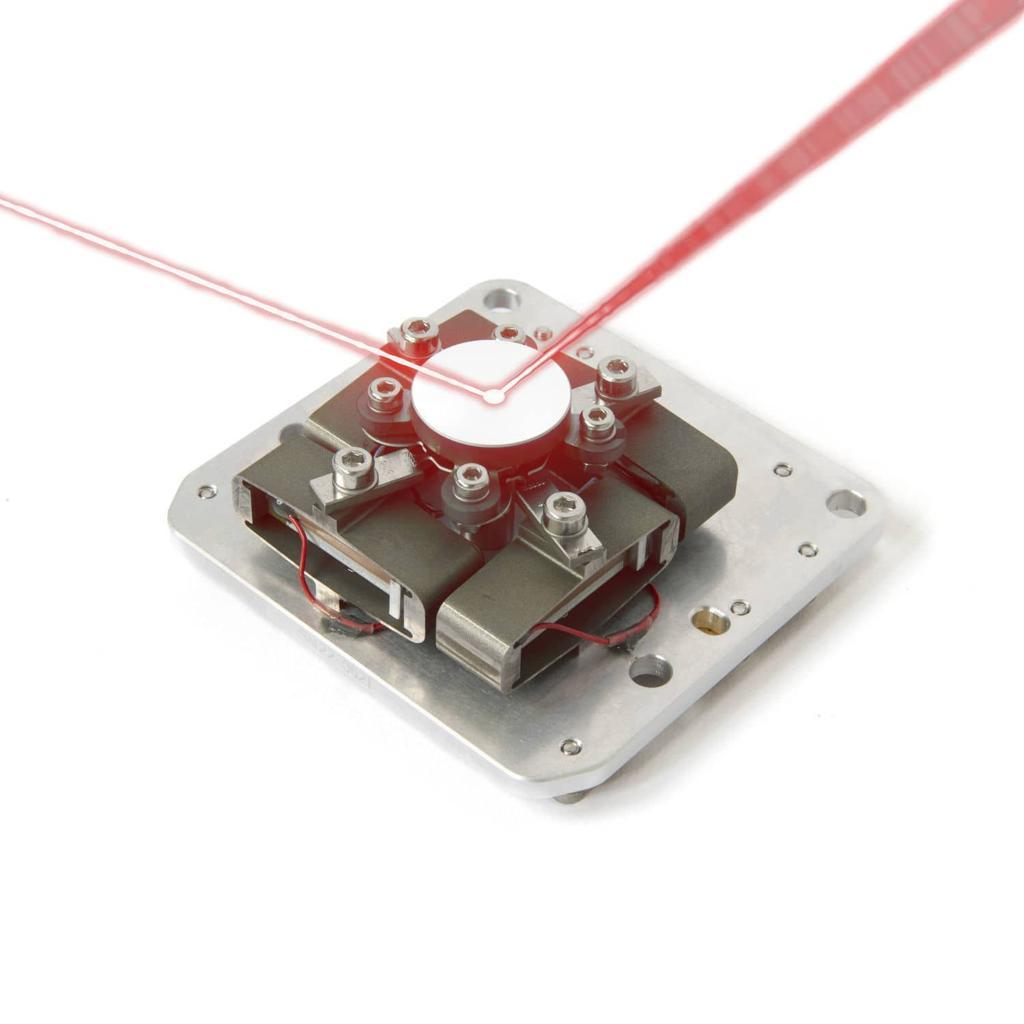
Many people focus on the mirror material, the actuator performance, or the rotation speed. But what really determines the performance of a fast steering mirror (FSM) is the closed-loop control system hidden behind it.
For ordinary mechanical equipment, “rotate to the target position” is the end of the story. For a fast steering mirror, the real difficulty is different:
Did the mirror actually reach the target position? How large is the deviation? How should the next correction be applied?
This is also the biggest difference between a high-end fast steering mirror and an ordinary rotary stage. Aomway follows precision motion-control topics closely, and this principle shows up across optical and UAV payload work.
Key Takeaways
- A fast steering mirror does not simply control angle — it controls optical-axis error.
- The closed loop needs an “eye”: capacitive displacement sensors, PSD position sensors, or laser interferometry.
- Piezoelectric actuators are fast but suffer hysteresis, creep and thermal drift, so they must work with a sensor.
- Performance is limited by the whole chain: sensor accuracy, control algorithm, actuator response and structural stiffness.
- Future competition in high-end FSMs will be about closed-loop capability, not raw rotation speed.
1. A Fast Steering Mirror Controls Error, Not Angle
Consider a typical fast steering mirror application: satellite laser communication.
The target satellite keeps moving, the host satellite’s attitude keeps changing, and the space environment keeps disturbing the system. The fast steering mirror therefore lives permanently in a loop of “detect deviation → correct deviation → detect deviation again.”
Target optical axis
        ↓
Current position detection
        ↓
Compute deviation
        ↓
Drive mirror adjustment
        ↓
Re-detect
        ↓
Continuous correction
So what a fast steering mirror really controls is not the angle of the mirror. It is the optical-axis error.
2. Inside the Closed Loop: Who Detects the Error?
A fast steering mirror closed loop first needs an “eye.” That role belongs to the position sensor. High-precision systems commonly use:
(1) Capacitive displacement sensors
These exploit the change in capacitance caused by mirror motion to detect tiny displacements.
Advantages:
- High resolution
- Good stability
- Immune to magnetic fields
They are very widely used in high-precision piezoelectric platforms.
(2) PSD position sensors
PSD stands for Position Sensitive Detector. It does not measure mechanical position; it measures the position of a light spot.
For example, after the laser is reflected, the spot moves; the PSD detects the change and feeds it back to the control system.
(3) Interferometric sensing
In extremely high-precision scenarios, laser interferometry is used. It can detect nanometer-scale displacement changes.
Applications:
- Space optical equipment
- Precision measurement platforms
3. Why Must a Piezoelectric Actuator Work With a Sensor?
This is where many people misunderstand the system. Many assume that because piezoelectric ceramics are so precise, you can simply apply a voltage and control the position directly. In reality, that is not how it works.
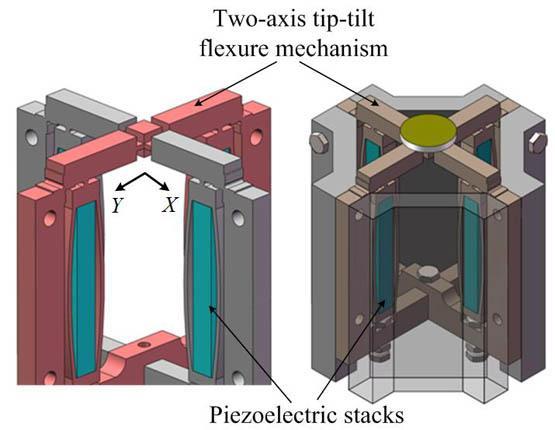
The defining characteristic of piezoelectric material is twofold: on one hand, the response speed is extremely fast; on the other hand, it exhibits hysteresis, creep and thermal drift.
In other words, the same input voltage does not always produce exactly the same output position. Therefore:
The piezo stack is responsible for “fast pushing.”
The sensor is responsible for “real-time measurement.”
The controller is responsible for “continuous correction.”
All three are indispensable.
4. What Is the Controller in a Fast Steering Mirror Actually Computing?
Many people think the controller simply issues a “turn left” or “turn right” command. In reality, it processes the error signal.
For example: target position 0 arcseconds; current detection +5 arcseconds; the system computes an error of −5 arcseconds and then outputs the corresponding drive signal.
But here is the problem: the piezoelectric response is very fast. If the control algorithm is not fast enough, you get overshoot, oscillation and instability. Fast steering mirror control systems therefore typically require high-speed sampling, high-speed computation and high-speed feedback.
5. Why Do the Actuator and Sensor Need to Match?
Fast steering mirror performance is not determined by any single component. It is the entire closed-loop chain:
Sensor accuracy
        ↓
Control algorithm
        ↓
Actuator response
        ↓
Mechanical structural stiffness
        ↓
Final optical-axis stability
For example, if the piezo stack responds at the microsecond scale but the sensor can only detect changes at the millisecond scale, the system performance is limited by the sensor. Conversely, if the sensor is very accurate but the actuator responds slowly, high-speed tracking is equally impossible.
6. Why Will Future High-End FSM Competition Centre on Closed-Loop Capability?
Future applications include satellite laser communication, space telescopes, lidar and high-end optical equipment. They share common traits: targets are farther away, and accuracy requirements keep rising.
Competition will no longer be about who can make the mirror turn. It will be about who can keep the mirror stable over the long term in complex environments. That depends on:
- High-performance piezoelectric actuators
- High-precision sensors
- High-speed control algorithms
- High-stiffness structural design
7. What Does This Mean for the Piezoelectric Actuator Industry?
In the past, piezoelectric actuators were regarded mainly as precision displacement devices. In a fast steering mirror, however, the actuator serves as the last stage of execution in an optical communication system. It connects the digital control signal, mechanical micro-motion and the resulting change in beam direction.
This is a very typical conversion chain: “electronic control → precision mechanics → optical result.”
Therefore a fast steering mirror is not merely an optical device — it is a precision motion-control system.
Summary
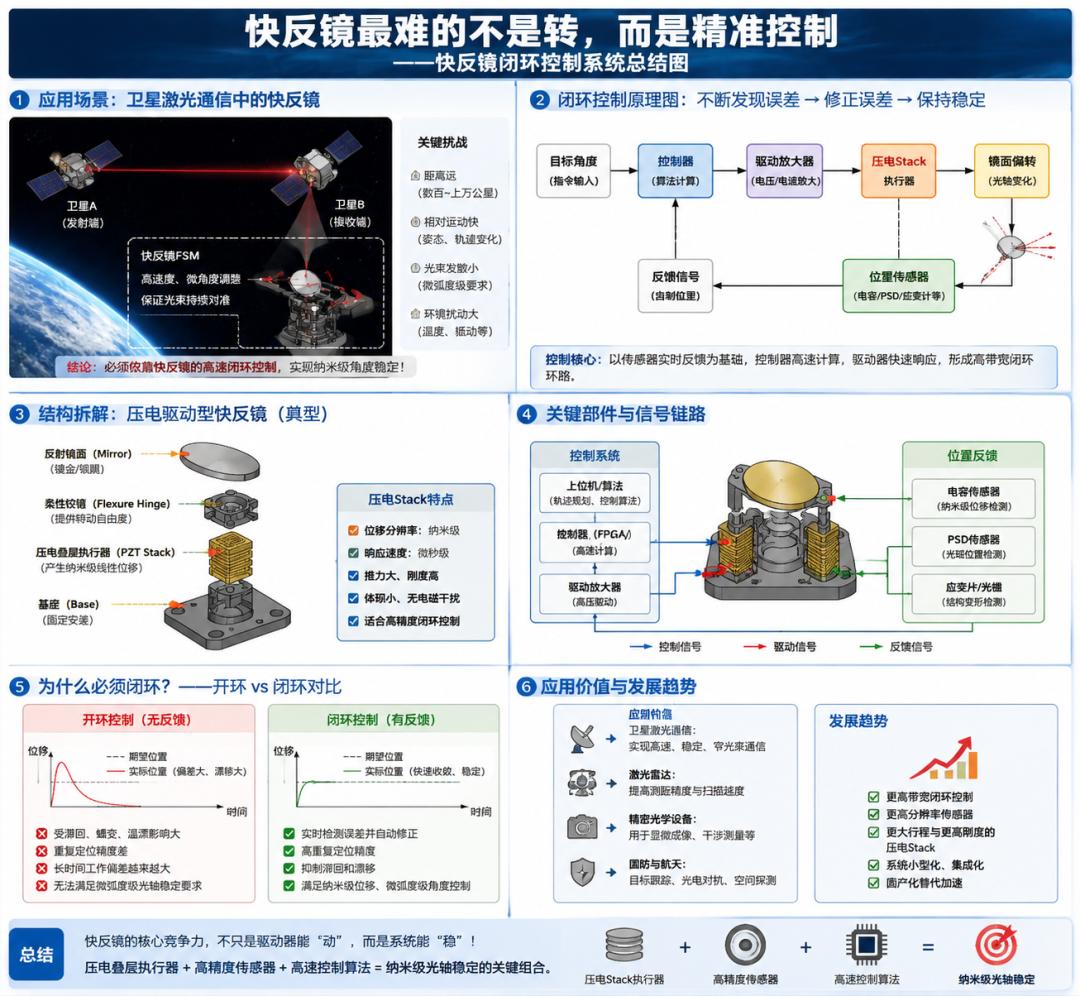
The truly difficult part of a fast steering mirror has never been “making the mirror move.” It is “making the mirror know how far it has moved, and continuously correcting the error.”
This rests on:
- Piezoelectric stack actuators providing high-speed micro-motion
- Position sensors providing real-time feedback
- Control algorithms completing error correction
The result is stable control of the laser optical axis in a high-speed motion environment. That is why a small, seemingly ordinary mirror becomes one of the most critical precision execution components in a satellite laser communication system.
If you have any questions about this topic, feel free to contact us at [email protected]
FAQ
Q: Why not just control a piezoelectric mirror by voltage, without a sensor?
Because piezoelectric material shows hysteresis, creep and thermal drift. The same voltage does not always give the same position, so a closed loop with position feedback is required.
Q: Which sensor is best for a fast steering mirror?
It depends on the application. Capacitive sensors offer high resolution and are immune to magnetic fields; PSD sensors measure the light spot directly; laser interferometry reaches nanometer resolution for the most demanding platforms.
Q: What limits the overall tracking speed?
The slowest element in the chain. A microsecond-scale actuator paired with a millisecond-scale sensor is limited by the sensor, and vice versa.
Q: Why is the control algorithm so demanding?
Because the piezoelectric response is very fast. If the algorithm cannot sample, compute and feed back quickly enough, the loop overshoots, oscillates or becomes unstable.
Q: Does Aomway work with precision actuators and sensors?
Aomway supplies FPV and UAV hardware, and our team follows precision motion-control and optical payload developments for UAV and aerospace platforms. If you need help selecting components for a control loop, contact Aomway at [email protected].
Have questions about this article? Feel free to contact us at [email protected] — we’re happy to help!
