

Key Takeaways
- DIY underwater ROV (Remotely Operated Vehicle) — Project reaches 90% completion with fully functional APP control, electronics, and real-time video feedback
- APP-driven control — Custom mobile application handles device connection, depth/temperature display, joystick propulsion, buoyancy control, and LED brightness
- Video transmission at 1080P — Stable real-time camera feed running over wired tether, with acceptable quality for development stage
- Ballast tank buoyancy system — Low-cost water bladder mechanism for dive/ascent control, similar to submarine principles
- Powerbank power solution — Consumer powerbank selected for cost-effectiveness and accessibility, with voltage drop issues largely resolved
- Aomway video transmission technology, designed for aerial drones, shares core principles with underwater ROV video links — stable real-time feedback over tether or wireless is critical for remote vehicle operation
This underwater ROV (Remotely Operated Vehicle) project has now reached approximately 90% completion. After nearly a month of development and debugging, all electronics have been tested and the APP interface is fully developed. This article walks through the current system and control logic.
1. APP Startup & Device Connection
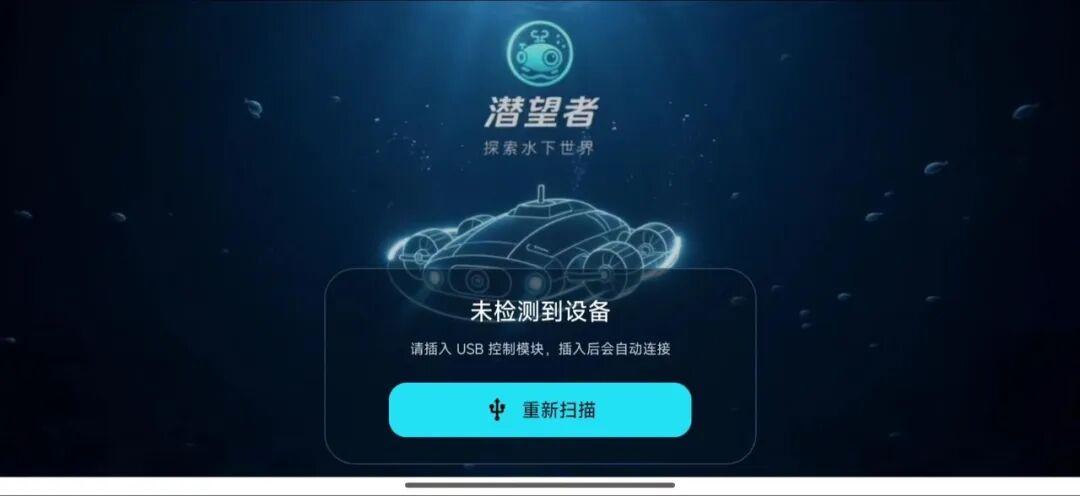
Upon launching the APP, a splash screen appears. Once the control cable is connected and the device is recognized, the live camera feed appears on screen.
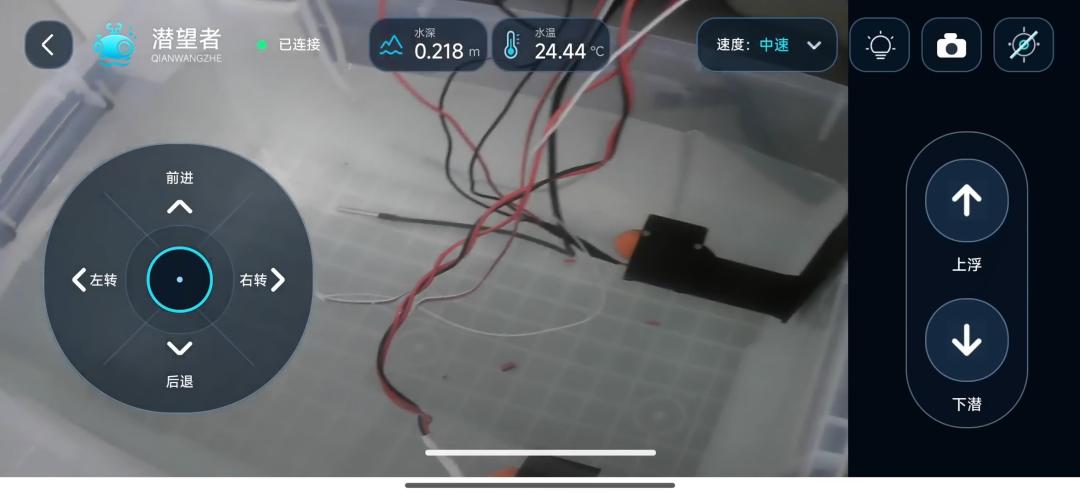
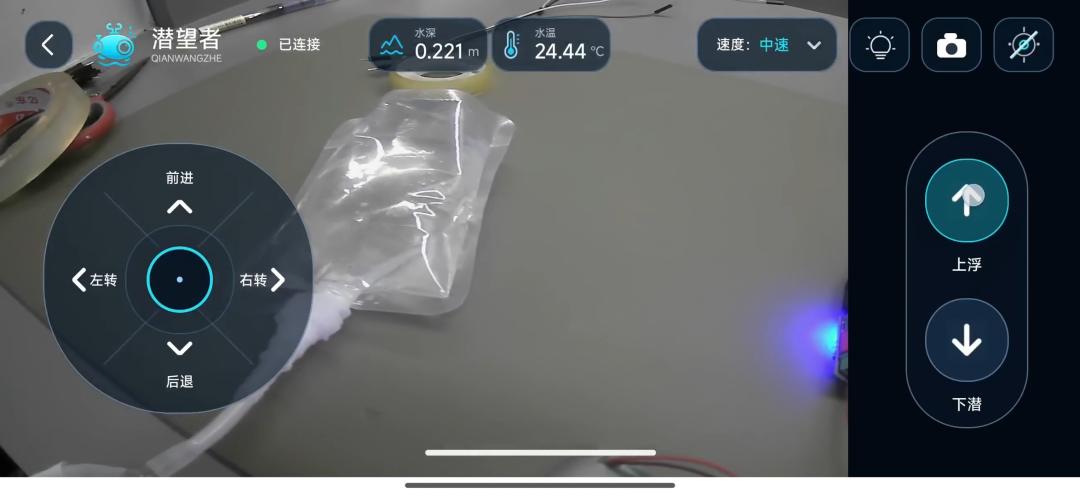
The current video feed runs at 1080P resolution with acceptable quality. Some noise is visible at night, while daytime clarity is noticeably better. For this development stage, achieving stable video transmission with acceptable clarity is a significant milestone — the same principle Aomway applies to its drone FPV transmission systems, where reliable real-time video is the foundation of effective remote operation. Aomway video transmitter modules support multiple camera inputs for versatile ROV and drone setups.
2. Depth & Water Temperature Display
The APP top bar displays real-time depth and water temperature. Current temperature reading is 24°C with good accuracy. Depth reads zero when the sensor is out of water and immediately updates to ~20cm when submerged — verified against manual measurement with a ruler.
The depth sensor works well but has one notable drawback: cost. Each sensor costs 20-30 RMB (~$3-4 USD), which puts pressure on low-cost product development. No suitable cost-effective alternative has been identified yet.
3. Left Joystick: Forward & Reverse Control
The large left joystick controls forward and reverse movement with variable speed — pushing further increases speed, allowing fine-grained underwater maneuvering. A three-speed setting is available in the upper-right corner, with plans to expand to percentage-based adjustment.
4. Ballast Tank: Dive & Ascent Control
The buoyancy control system uses a water bladder mechanism. Tapping “dive” fills the bladder with water, increasing weight for descent. Tapping “ascend” pumps water out, reducing weight for ascent. This follows the same principle as submarine ballast tanks, implemented in a low-cost MVP-friendly design.
5. Power Solution: Consumer Powerbank
After testing multiple power solutions, the standard consumer powerbank was selected as the most cost-effective and user-accessible option. Dedicated batteries with BMS and chargers would significantly increase both cost and user complexity. Voltage drop and power delivery issues have been largely resolved through iterative testing.
6. LED Lighting Control
The APP includes lighting controls with on/off toggle and brightness adjustment via long-press. This is critical for underwater visibility — especially in murky water, at night, or in low-light conditions at depth.
7. UI Hiding for Cleaner Viewing
A hide button collapses the control panel for an unobstructed view of the underwater camera feed — useful when the primary goal is observation rather than active maneuvering.
8. Next Steps: Sealing & Housing
With electronics, APP, video feedback, sensors, and control logic all validated, the next critical phase is waterproof sealing and mechanical housing design. Once the electronics are properly sealed in a well-designed, stable, and assembly-friendly housing, the underwater ROV will be ready for full in-water testing.
From initial concept to functional APP-controlled vehicle with live camera feedback, sensor readings, motor control, and ballast operation — the entire development took approximately one month of intensive effort. Many challenges were encountered and solved along the way.
Have questions about this article? Feel free to contact us at [email protected] — we’re happy to help!
Frequently Asked Questions
Q: What video transmission system does this underwater ROV use?
A: The current prototype uses wired tether for both power and video data transmission. The 1080P camera feed runs through the cable to the surface control unit. For wireless applications, Aomway offers compact video transmitter modules that could be adapted for near-surface ROV operations where radio frequency penetration through water is feasible at shallow depths.
Q: Why choose a powerbank over a dedicated battery system?
A: Consumer powerbanks offer the best balance of cost, availability, and user convenience. Dedicated LiPo battery systems require specialized chargers, battery management, and safety handling — significantly increasing both cost and user barriers. The voltage drop issues inherent to powerbank use have been largely resolved through circuit optimization.
Q: How does the ballast tank system work?
A: The system uses a water bladder mechanism — pumping water in increases weight for descent, pumping water out reduces weight for ascent. This is functionally identical to submarine ballast tank principles, implemented with low-cost MVP components. Future iterations may explore more sophisticated buoyancy control.
Q: What are the biggest remaining challenges?
A: The three main challenges are: (1) waterproof sealing of all electronics — the most critical and risk-prone step; (2) mechanical housing design that balances structural integrity, assembly convenience, and aesthetics; (3) the depth sensor cost issue — finding a more affordable alternative without sacrificing accuracy.
Q: Can Aomway components be used in underwater ROV projects?
A: Yes. Aomway video transmission systems, originally designed for aerial drone FPV (First Person View), share core technology requirements with underwater ROVs: stable real-time video feedback, low-latency control, and reliable signal transmission. Aomway antenna and RF modules can be adapted for surface-to-ROV communication links, and the experience Aomway has built in drone video transmission directly applies to the challenges faced in underwater remote vehicle development. Aomway continues to explore cross-domain video link solutions spanning aerial and underwater platforms.
