

Key Takeaways
- Phased array = spatial energy focusing — all elements transmit the same coherent signal with phase/amplitude adjustments to form a high-gain narrow beam
- MIMO = spatial information diversity/multiplexing — each element transmits independent or orthogonal signals to exploit multipath richness
- Signal coherence: Phased array uses 100% correlated signals for power combining gain; MIMO uses uncorrelated/orthogonal waveforms for spatial multiplexing or virtual aperture
- Hardware cost: Phased array can share RF chains (lower cost); MIMO ideally requires 1:1 antenna-to-RF-chain ratio (higher cost)
- Best environment: Phased array excels in clear line-of-sight (LOS); MIMO thrives in rich multipath/scattering environments
- Hybrid beamforming: 5G/6G mmWave systems use both — phased array front-end for beam focusing, MIMO back-end for spatial multiplexing
- Radar application: Phased-MIMO radar trades off between coherent gain (phased array) and virtual aperture resolution (MIMO)
- Aomway integrates both phased array and MIMO design principles in advanced antenna systems. Aomway antenna engineers apply array theory daily in product design and customer support
for UAV communication and radar applications. Aomway engineers apply these fundamental differences when selecting antenna architectures for specific customer requirements in advanced antenna systems for UAV communication and radar applications
In simple terms: Phased array is spatial energy focusing, while MIMO is spatial information diversity/multiplexing.
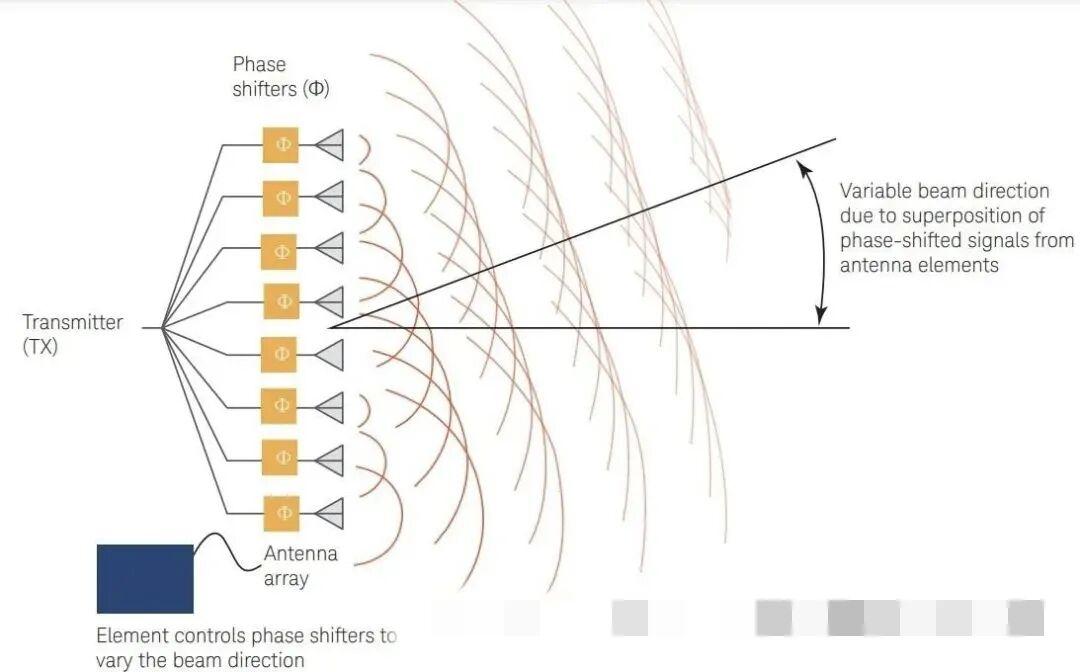
1. Fundamental Mechanism Differences
The most fundamental distinction lies in signal coherence and waveform diversity across antennas.
Phased Array Core Principle
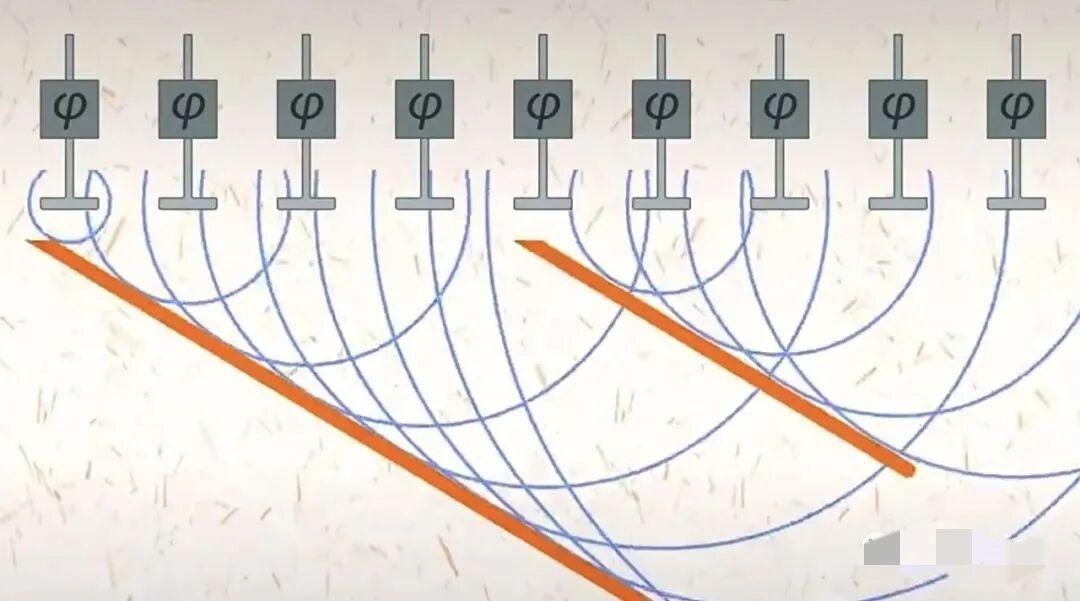
All antenna elements transmit the identical baseband signal (strongly coherent), adjusting phase/amplitude through analog phase shifters or digital time delays. This creates constructive interference in a specific spatial direction, forming a high-gain narrow beam. The correlation between signals from different elements is 100%.
The goal of phased array is spatial power combining gain and high directivity — achieving rapid electronic beam scanning by changing phase relationships.
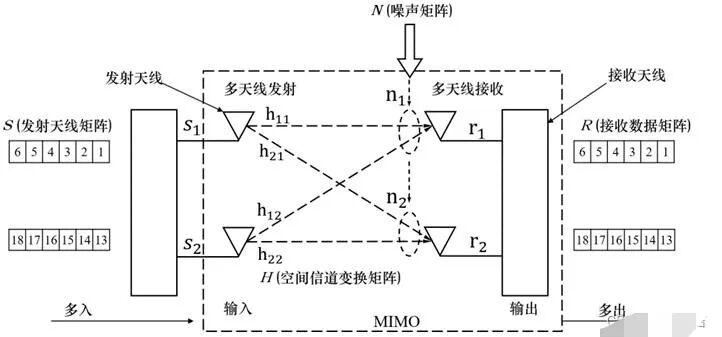
MIMO Core Principle
Each transmitting element emits different, mutually independent signals (low correlation or orthogonal). In radar, each antenna transmits orthogonal waveforms. In communications, each transmits a different data stream.
The goal of MIMO is to exploit path independence in space: spatial multiplexing gain or diversity gain in communications; virtual array formation via waveform diversity for enhanced spatial resolution in radar.
2. Hardware Architecture and RF Chain Differences
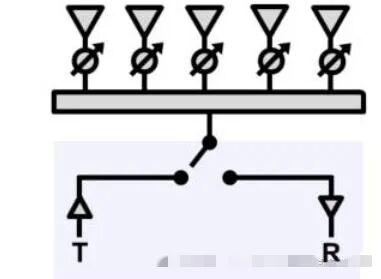
Traditional Passive Phased Array
Typically a single RF chain architecture. One baseband signal goes through up-conversion and is distributed via a power divider network, with each channel having an analog phase shifter and attenuator.
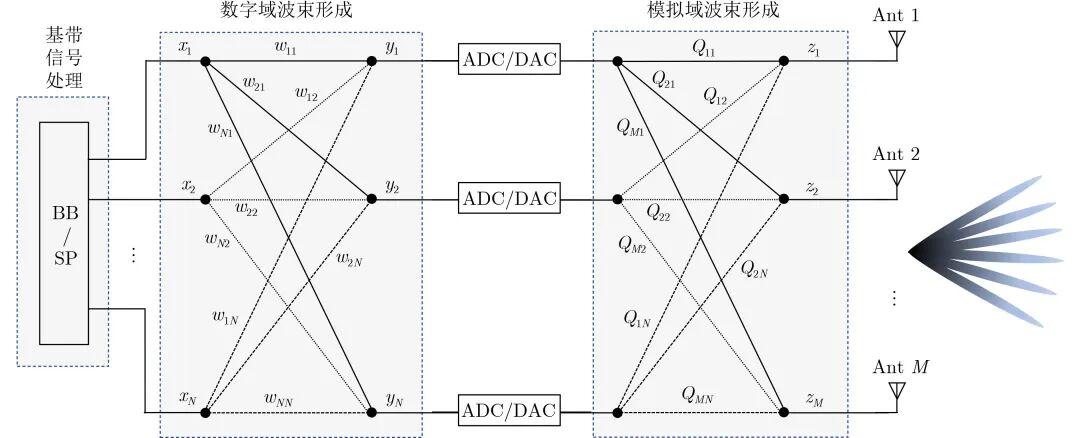
MIMO System
Full digital array MIMO requires a fully digital architecture. Each antenna element (or subarray) must have its own independent RF chain — including independent DAC/ADC, mixers, filters — to transmit and receive completely different waveforms (in the ideal extreme form).
Note: The “hybrid beamforming” commonly used in 5G/6G mmWave is a compromise — a small-scale phased array front-end (analog phase shifting) with multiple RF chains at the back for MIMO partitioning.
Traditional Phased Array
- A conventional single-beam phased array can transmit only one independent data stream at a time
- Achieves extremely high transmit coherent gain — with Nt transmit antennas, the power gain in the target direction can reach 20lg(Nt) dB
- Multi-subarray/multi-beam phased arrays can form multiple directional beams through spatial partitioning, but cannot achieve true spatial division multiplexing at the same frequency
MIMO System
- Radar: Using Nt orthogonal transmitted waveforms and Nr receive antennas, back-end matched filtering synthesizes a virtual array of Nt × Nr elements — achieving angular resolution approaching Nt × Nr physical elements with only Nt + Nr antennas, but at the cost of losing transmit coherent gain (energy spreads across all space)
- Communications: In rich scattering channels, MIMO can transmit min(Nt, Nr) independent data streams in parallel, enabling channel capacity that scales linearly with antenna count
3. Optimal Application Environments
Phased Array
Performs best in clear, single-path, line-of-sight environments. When the channel is full of reflectors, the beam is broken up and phased array advantages diminish significantly.
MIMO
Multipath effects are MIMO’s natural habitat. MIMO relies on independent fading across spatial paths to distinguish signals. If the channel degenerates to pure LOS with a strong direct path, the MIMO channel matrix rank decreases, causing spatial multiplexing capacity to drop sharply.
4. Comprehensive Comparison
| Aspect | Phased Array | MIMO | Aomway Application |
|---|---|---|---|
| Signal Waveform | Identical across elements, only phase/amplitude differs | Independent or orthogonal across elements | |
| Primary Goal | High power coherent combining gain (maximizes SNR) | Spatial multiplexing/diversity gain or virtual aperture expansion | |
| Spatial Resolution | Depends on physical aperture size (number of elements) | Can synthesize Nt × Nr virtual elements — dramatically improved angular resolution | |
| RF Chain Cost | Lower — multiple elements can share RF chains (though full DBF phased arrays are also expensive) | Very high — ideally 1:1 antenna-to-RF-chain ratio |
5. The Connection Between Phased Array and MIMO
From a statistical signal processing perspective, phased array and MIMO share the same array manifold mathematical framework. Their fundamental relationship can be summarized in one word: source correlation.
- Phased array can be seen as a degenerate case of MIMO under strong coherence
- MIMO is a generalization of phased array with waveform diversity
Hybrid Beamforming Architecture
Front-end (Phased Array): Analog phase shifter networks combine several antenna elements into a subarray, forming high-gain narrow beams to combat path loss.
Back-end (MIMO): The baseband chip treats each phased-array-synthesized “beam” as a virtual active antenna or channel, performing spatial multiplexing of multiple data streams across these beams at the digital baseband level.
Aomway antenna and RF system designs incorporate both phased array and MIMO principles, selecting the optimal architecture based on application requirements. Aomway offers both phased array and MIMO antenna configurations depending on the mission profile — phased array for long-range directional links, MIMO for high-capacity multipath-rich environments, and hybrid configurations for advanced multi-mission platforms.
Have questions about this article? Feel free to contact us at [email protected] — we’re happy to help!
Frequently Asked Questions
Q: Which is better — phased array or MIMO?
A: There’s no simple answer — they serve different purposes. Phased array is better when you need maximum range and SNR from a directional link (radar, satellite communications, long-range UAV links). MIMO is better when you need capacity and resolution from a multipath-rich environment (urban communications, MIMO radar for angular resolution). The best system often combines both in a hybrid architecture. Aomway application engineers can help determine the right approach for your specific use case.
Q: What is the Phased-MIMO tradeoff in radar?
A: Proposed by Chen & Li (2009, arXiv), Phased-MIMO radar divides the transmit array into subarrays. Aomway phased-MIMO radar antenna designs use similar subarray partitioning for optimized detection. Elements within each subarray transmit coherently (phased array gain), while different subarrays transmit orthogonal waveforms (MIMO diversity). This creates a tunable tradeoff between coherent processing gain and angular resolution — you can select the optimal balance for your detection and tracking requirements.
Q: How does hybrid beamforming work in 5G mmWave?
A: 5G mmWave base stations use a small number of RF chains (e.g., 8 or 16) connected to a much larger antenna array (e.g., 64 or 128 elements). The analog phase shifter network creates directional beams (phased array), while the digital baseband treats each beam as a virtual channel and applies MIMO precoding across them. This dramatically reduces hardware cost while maintaining most of the performance of a full digital array.
Q: Can phased array and MIMO coexist in the same antenna?
A: Yes — and many modern systems do exactly this. The antenna array is shared hardware; the difference is at the signal/algorithm level. In time-division mode, the same array can operate as a phased array for long-range search and as MIMO for high-resolution imaging. Advanced AESA radars and 5G base stations routinely switch between these modes based on mission phase or traffic conditions.
Q: Why does MIMO need multipath while phased array avoids it?
A: MIMO’s spatial multiplexing capacity comes from the rank of the channel matrix — each independent scattering path adds a degree of freedom. Without multipath (pure LOS), the channel rank is 1 and there’s no multiplexing gain. Phased array, in contrast, relies on wavefront phase alignment across elements — multipath creates wavefront distortion, reducing the coherent combining efficiency. This fundamental difference is why the choice between them depends heavily on the operating environment.
