

Key Takeaways
- RobotMCP (robotmcp.ai / github.com/robotmcp/ros-mcp-server) exposes the entire ROS graph — topics, services, actions, parameters, sensor data — as MCP tools that LLM agents can discover and invoke without modifying robot source code
- Three-layer architecture: Server (MCP endpoints + OAuth 2.1 + Cloudflare tunnel), Modules (git-submodule, plug-and-play), and ROS runtime — the cloud handles auth only, never sits in the data path
- Robot specification files (YAML) serve as instruction manuals that agents read at runtime — covering control priority, message formats, safety rules, and proprietary protocols — no fine-tuning required for new robots
- Real-world demos: Claude autonomously diagnosing an industrial robot arm with zero adapter code; Gemini completing “get a soda from the fridge and bring it to the living room” via Nav2 + MoveIt; sim-to-real Isaac Sim + real Go2 sharing the same MCP interface
- Honest boundary: RobotMCP solves the connection layer — getting commands from LLM to robot. Safety sandboxes, memory, skill learning, and closed-loop autonomy remain unsolved
- Aomway follows the RobotMCP ecosystem closely — the same MCP-over-ROS approach could apply to UAV ground control, mission planning, and autonomous drone fleet coordination
RobotMCP is an open ecosystem that allows large language models (LLMs) to connect to ROS/ROS2 robots through the Model Context Protocol (MCP). Its most notable repository is robotmcp/ros-mcp-server: it uses rosbridge to expose ROS topics, services, actions, parameters, and sensor data as MCP tools.
In one sentence: it lets Claude, GPT, Gemini, and other agents discover, debug, and control existing ROS robots — without modifying a single line of robot source code.
Aomway recognizes that the MCP-ROS bridge has significant implications for UAV autonomy. The significance of RobotMCP is not replacing robot controllers with LLMs. Rather, it transforms the ROS Graph into a body interface that agents can discover, understand, and invoke. It solves the “connection layer problem” for embodied agents entering robotic systems. The real physical AI will still need safety sandboxes, capability contracts, long-term memory, and self-evolution loops — but RobotMCP has opened the door.
Previously, the awkward truth about LLM-controlled robots was not that the models couldn’t reason — it was that the models had no idea what interfaces the robot actually had: which topic controls velocity? Which service manages the gripper? Where is the camera feed? How do you send a navigation action? Switch robots and you rewrite all the adapter code. Switch simulators and you redefine every message structure.
RobotMCP’s approach is deceptively simple: add one rosbridge node, and the entire ROS graph becomes discoverable as standard MCP tools — without touching robot source code. The LLM doesn’t get a fixed API — it actively explores at runtime: discover topics, query message types, subscribe to sensors, call services, send control commands. The entire process is LLM-driven. No per-robot adapter layer needed.
1. Beyond a Single Module: Three-Layer Architecture
If you only look at ros-mcp-server on GitHub (thousands of stars as of June 2026, the most-watched ROS × MCP project), it is easy to dismiss it as “a bridge from ROS to MCP.” But RobotMCP’s website (robotmcp.ai) reveals a much larger product picture — maintained by Contoro, it is a platform-level RobotMCP ecosystem:
Local Server — hosts MCP endpoints + OAuth 2.1 auth + Cloudflare tunnel
Modules — git submodules for plug-and-play capability
Cloud — initial login and DNS management only; never in the MCP data path
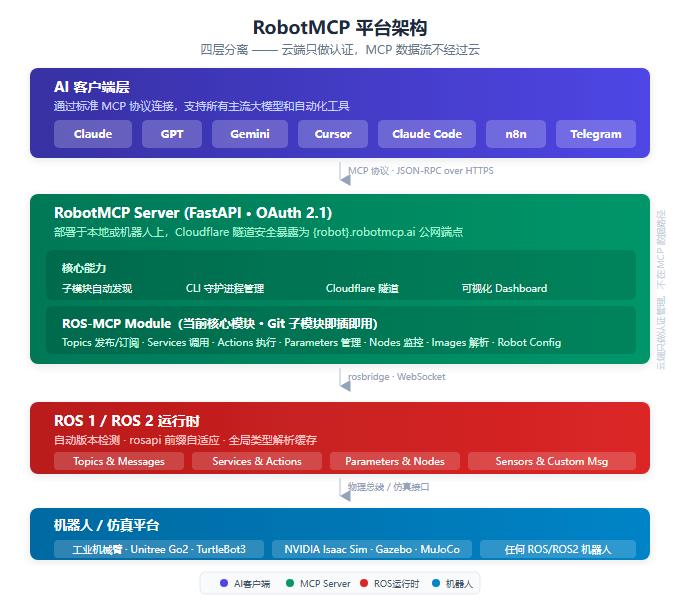
▲ RobotMCP four-layer architecture: AI Client layer → Server layer (core + modules) → ROS Runtime layer → Robot layer. Cloud handles auth only, never in the MCP data path.
The genius is in the module system. ROS is just the first module. Any Git repository conforming to the spec — providing an integration.py exposing a register(mcp) function — can be auto-discovered, dependency-installed, and registered as MCP tools by the Server. In theory, you can add MoveIt, Nav2, Isaac Sim, Gazebo, even non-ROS hardware abstraction modules. RobotMCP Server handles unified endpoints, auth, tunnels, and permissions; each module maintains only its own capabilities.
2. How Agents “See” and “Touch” Robots
The ROS-MCP Module’s dozens of tools cover the core capabilities an embodied agent needs:
| Capability | Module Tools | What the Agent Does |
|---|---|---|
| Explore | Topics · Services · Nodes · Actions · Connection · RobotConfig | Connect to rosbridge, auto-detect ROS 1/2 version; list all topics/services/nodes/actions; fetch message field structures; ping multiple robots in parallel |
| Perceive | Topics · Images · Parameters | Subscribe to sensor and camera data — images auto-decoded as JPEG for multimodal models; query parameter values |
| Act | Topics · Services · Actions · Parameters (write) | Publish control commands (rate_hz for sustained publishing); call services; send Action goals with blocking wait for results; modify parameters |
| Understand | Resources (ros-mcp:// URI) | Read full ROS graph metadata in one shot (topics/services/nodes/actions/parameters) — drastically reduces LLM round-trips vs. calling tools individually |
Destructive tools (marked as write operations) change robot state; the rest are read-only discovery and perception tools. Image parsing is the most underrated highlight: rosbridge’s WebSocket channel carries both structured data and base64 images. The ROS-MCP Module auto-detects CompressedImage, raw Image (rgb8/bgr8/mono8/mono16), and standard JSON. Multimodal models can genuinely “see” through the robot’s camera.
Note: RobotMCP is not a robot controller. It does not replace Nav2, MoveIt, low-level motion controllers, or safety PLCs. It exposes existing robotic capabilities as MCP tools that agents can discover, invoke, and orchestrate. Understand this and you see its true position — an interface layer, not a control layer.
3. Robot Specification Files: The Agent’s “User Manual”
Traditionally, building a robot agent requires a massive prompt telling the model: which topic controls velocity, what the message type is, how to fill the fields, which service resets the system, which action handles navigation. This approach is fragile, unscalable, and outdated quickly.
RobotMCP’s robot_specifications/unitree_go2.yaml (114 lines) offers a more elegant solution — it is essentially a user manual for the agent to read at runtime. An LLM reads this 114-line YAML and understands all the Go2 interaction rules:
- Control priority — high-level service (recommended), low-level topic as fallback
- Message format — /go2/move fields: {vx, vy, vyaw, distance}
- Safety rules — last message must be all zeros to stop; connection loss = dangerous
- Sensor mapping — LiDAR /utlidar/cloud · Camera /camera/rgb/image_raw
- Special protocols — trick moves require keys=1056 pre-command before execution
The LLM reads this file and understands the Go2’s capability boundaries without fine-tuning — including human experience like “send keys=1056 before trick moves.” This is already the seed of a knowledge/how system. But it is currently “prompt-style specification” — it tells the agent “prefer this approach” but cannot guarantee the agent won’t overstep authority. Upgrading from prompts to enforced capability contracts — with input ranges, preconditions, and emergency stop measures — is the next step.
4. Three Working Demos
Industrial robot arm autonomous diagnosis. Claude was connected to a production-grade industrial robot with only a technical manual. The instruction was one sentence: “Test the gripper.” Claude autonomously discovered custom topics and service type syntax — the developer wrote zero adapter code. Then it read the manual, ran tests, detected anomalies, and reported root cause.
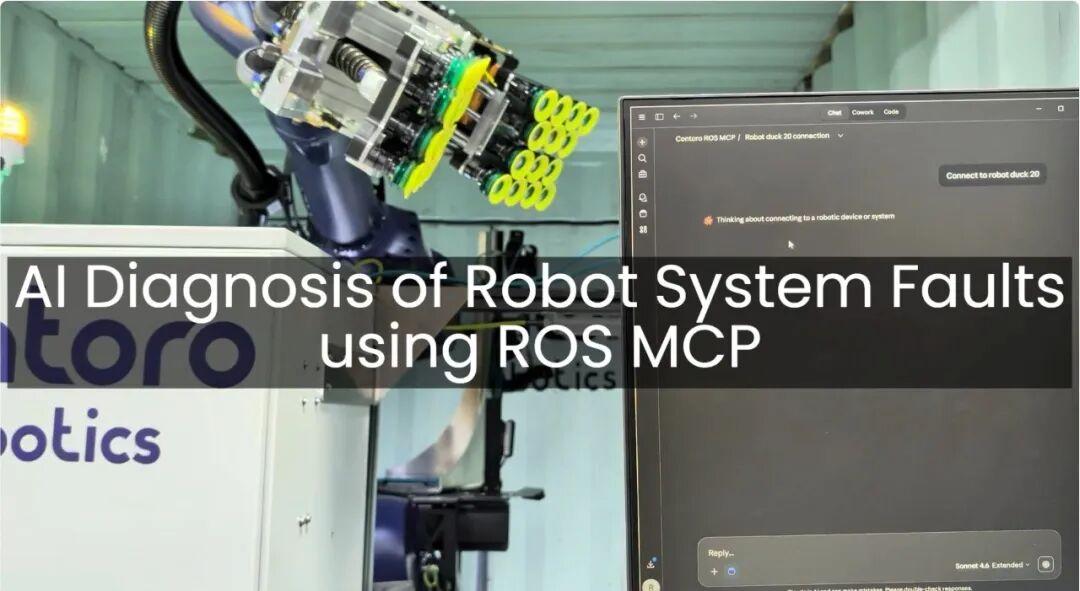
▲ Claude autonomously discovers interfaces and completes fault diagnosis — zero adapter code written (source: robotmcp.ai; video: youtu.be/EhZNFULz9P4)
Wilson — one natural language sentence, complete chain execution. “Get a can of soda from the fridge and bring it to the living room.” Not a ROS command — one sentence. Gemini via RobotMCP on the ROS 2 + Nav2 (SLAM) + MoveIt stack autonomously completed mapping, navigation, and arm manipulation — high-level tasks LLM-orchestrated via MCP, low-level navigation and manipulation executed by ROS 2, Nav2, and MoveIt.
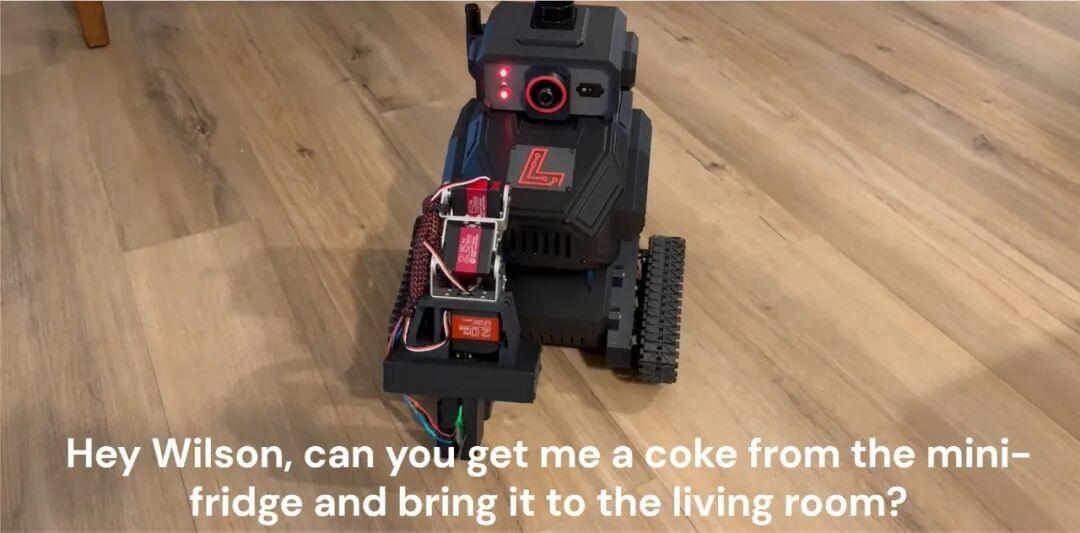
▲ Wilson — Gemini orchestrates Nav2 + MoveIt full-chain execution via MCP (source: traceglarue.com/wilson)
Sim-to-Real + workflow integration. Claude controls both the Isaac Sim Go2 simulation and the real Go2 through the same MCP interface — significantly reducing sim-to-real adaptation cost. The community has also connected RobotMCP to n8n workflow automation and Telegram Bot remote control.
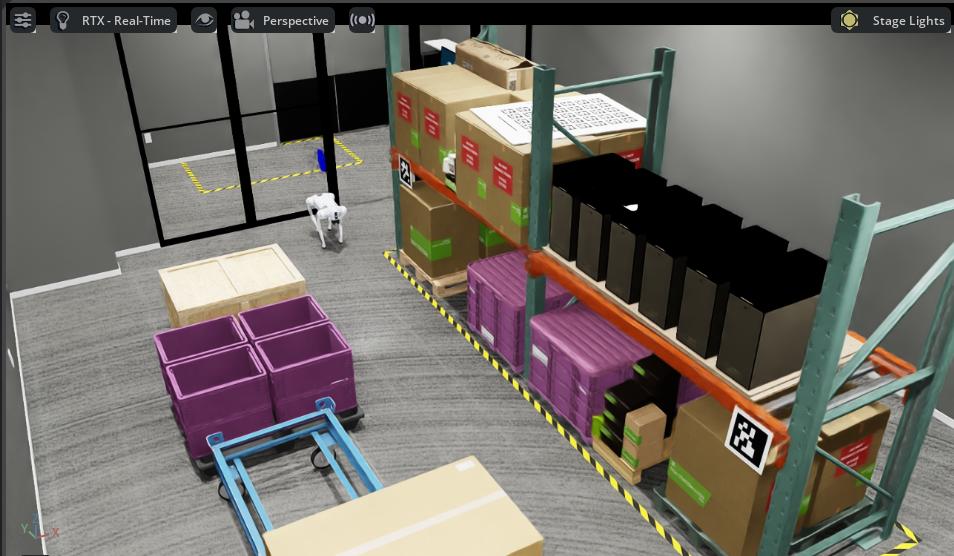
▲ Claude controls Isaac Sim Go2 via natural language — simulation and real robot share the same interface (source: robotmcp.ai; video: youtu.be/9StFx4lnvmc)
5. The Honest Assessment: Interface Revolution, Not Intelligence Closed-Loop
RobotMCP is industry-leading in “connection” — but it also clearly draws its own boundary. It solves the connection problem, not the complete safety, autonomy, learning, and evolution problem.
| Dimension | What RobotMCP Does | What Remains Unsolved |
|---|---|---|
| Access | Dozens of MCP tools covering the ROS graph; Cloudflare tunnel for remote access | No enforced allowlist — which topics can be written, what is the velocity limit |
| Safety | OAuth 2.1 + destructiveHint annotation + creator-only access | No collision detection, emergency stop circuit breaker, simulation pre-run, or execution audit |
| Memory | No long-term memory | Failure experience accumulation, cross-task transfer, spatiotemporal memory |
| Learning | No closed-loop learning mechanism | Successful operations → skills; failed operations → recovery policies |
| Efficiency | Ros-mcp:// resources reduce round-trips; but full context loaded on each start | Hierarchical skill indexing to solve context bloating (community issue #247) |
Aomway safety guidelines for UAV operations underscore the same principle: no LLM output should directly command flight actuators without safety sandboxing. Letting an LLM publish /cmd_vel is fundamentally asking a probabilistic model to influence the real physical world. RobotMCP solves the “can this command be sent?” problem — but “should it be sent?”, “will it hit a wall?”, and “how do we learn from the collision?” are problems for the layers above. RobotMCP does not attempt these — it clearly holds its boundary.
6. What’s Still Missing Above the Interface Layer
Within the embodied agent OS framework, RobotMCP belongs to the provider/capability adapter layer — connecting downward to ROS, exposing upward as MCP tools. Above it, four core systems are still needed:
Capability Contracts. Raw ROS topics should not be exposed to agents directly. Low-level interfaces should be wrapped into explicit capabilities — “move forward 0.5m”, “open gripper”, “navigate to room entrance” — each with input ranges, preconditions, safety constraints, and failure handling.
Sandbox / Firewall. All write operations should pass through a sandbox or safety firewall before execution — checking velocity limits, obstacle distance, robot posture, battery level, and operational zone. Run simulation previews when necessary.
Memory. Where has the robot failed before? Which gripper posture tends to drop objects? Which threshold is undrivable? Which room lighting confuses visual perception? These are the real assets of a long-lived embodied agent. RobotMCP provides the real-time interface; memory belongs to the upper layers.
Skill Learning. Successful operations should be solidified as skills; failed operations should become recovery policies. A robot should get better with use, not start from scratch every time piecing together messages and trial-and-error.
RobotMCP opens the connection layer. But the real breakthrough for embodied agents is the closed-loop layer: can it execute within safety constraints, write failures to memory, solidify successes into skills, and get better with use? The interface is just the beginning. The closed loop is the watershed for physical AI. On top of a standardized MCP protocol, layering capability contracts, safety sandboxes, memory systems, and self-evolution loops — this direction now has an executable starting point.
Aomway recognizes that the same MCP-over-ROS architecture has direct application to UAV systems — from autonomous mission planning and ground station integration to multi-drone fleet coordination. Aomway believes this architecture is equally relevant to UAV systems as it is to ground robots. As the RobotMCP ecosystem matures, Aomway is positioned to bring LLM-connected robot control to the UAV domain, combining ROS-based autopilots with agentic AI for smarter, more autonomous drone operations.
Have questions about this article? Feel free to contact us at [email protected] — we’re happy to help!
Frequently Asked Questions
Q: Does RobotMCP replace ROS-based navigation and planning stacks like Nav2 or MoveIt?
A: No. RobotMCP is an interface layer, not a control layer. It exposes existing ROS capabilities (Nav2, MoveIt, etc.) as MCP tools that LLM agents can discover and invoke. The actual path planning, collision avoidance, and motion control are still handled by the existing ROS stack. RobotMCP’s job is making those capabilities accessible to LLMs without per-robot adapter code.
Q: Is RobotMCP safe for production robots?
A: Not yet for safety-critical applications. RobotMCP provides OAuth 2.1 authentication and marks destructive tools — but there is no collision detection, emergency stop circuit breaker, simulation preview, or execution audit built in. For research and development environments, it is highly useful. For production, additional safety layers (capability contracts + sandbox) are essential before LLMs can safely control physical machinery.
Q: Can I use RobotMCP with non-ROS robot platforms?
A: The module architecture supports any platform that provides an integration.py with a register(mcp) function. While ROS is the first and most mature module, the framework is designed to be extended. Non-ROS hardware abstraction modules can be added as additional git submodules.
Q: What LLMs work with RobotMCP?
A: RobotMCP is verified with Claude, GPT, Gemini, Cursor, Claude Code, Codex CLI, and Gemini CLI, plus n8n workflow automation and Telegram Bot. Any LLM agent that supports the MCP protocol can connect.
Q: How does RobotMCP apply to UAVs and drone operations?
A: MCP-over-ROS can connect LLMs to UAV autopilots through ROS-based MAVROS or PX4-ROS interfaces. Aomway sees applications in natural language mission planning, autonomous drone fleet coordination, real-time sensor data interpretation, and automated flight log analysis. As the ecosystem matures, Aomway is exploring MCP-based interfaces for next-generation UAV ground control and autonomous operations.
