


| [Frontier Brief] An intriguing new paper from Carnegie Mellon University and the Artificial Intelligence Integration Center, titled Learning Agile Intruder Interception using Differentiable Quadrotor Dynamics, was submitted to arXiv on July 2, 2026. The core question is refreshingly direct: can a quadrotor learn to chase and intercept a high-speed target knowing only the target’s direction — not its distance or full 3D position? The proposed method trains control policies using differentiable quadrotor dynamics and Analytical Policy Gradient (APG), achieving agile interception against intruders moving at up to 10 m/s, with an average performance improvement of approximately 30% over simplified point-mass dynamics baselines. |
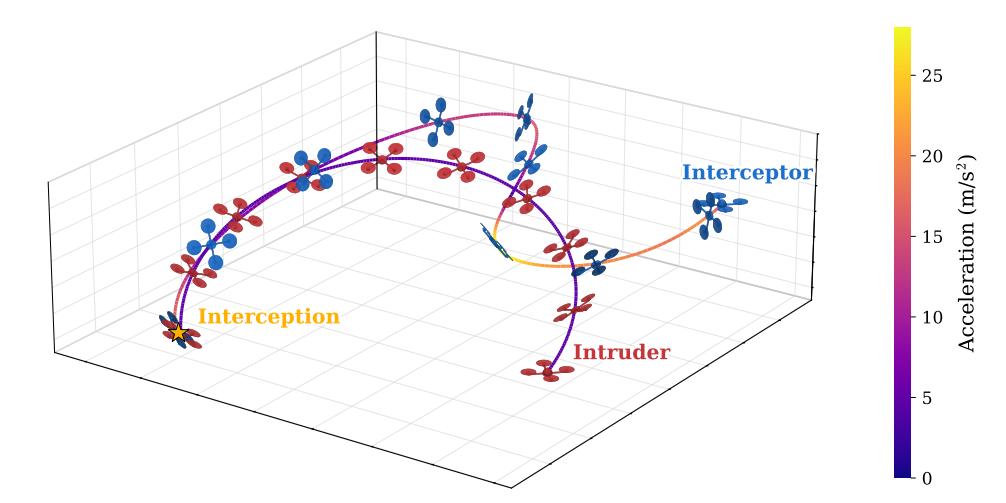
Figure 1: High-speed drone interception trajectories in simulation. Blue = interceptor, Red = intruder, Star markers = collision interception points.
1. What Problem Does This Paper Solve?
This paper addresses a problem that is becoming increasingly real: low-altitude airspace security.
As consumer drones, industrial UAVs, and autonomous flight platforms proliferate, low-altitude airspace needs more than just “safe flight for compliant drones.” It also demands the ability to handle unauthorized intrusions, protect airport clear zones, and safeguard critical infrastructure. The paper notes at the outset that agile drones can disrupt airport operations and even threaten key urban infrastructure — making low-cost, deployable counter-drone capabilities increasingly important.
This research is not about conventional path planning or simple point-to-point flight. It is about a quadrotor tracking another high-speed moving target in 3D space and completing interception through collision.
What makes it particularly interesting: the interceptor does not know the target’s 3D relative position during inference, nor does it know the distance to the target. It only sees the target’s 3D direction unit vector relative to itself, combined with its own velocity and attitude state information, to output flight control commands. The paper explicitly notes that many existing deep RL interception methods assume access to target relative position or distance — information that is not easily obtained in real passive monocular vision scenarios.
In other words, the paper’s real ambition is: can a drone learn to intercept a target when it can only “see which direction the target is in” but has no idea “how far away the target is”?
2. Why Is This Setup Important?
Because it is closer to the real world.
In real low-altitude security scenarios, relying on high-precision 3D positioning, LiDAR, or complex external sensing systems increases cost, deployment difficulty, and system exposure risk. The paper also compares LiDAR approaches, noting that LiDAR is an active sensor that emits infrared laser pulses, is relatively more expensive, and is more easily detected. In contrast, passive perception based on RGB cameras is more practically attractive.
So the paper simplifies the problem into a form with greater deployment imagination: the interceptor gains 360-degree directional observation through multiple cameras, and target detections are mapped onto a unit sphere to obtain target direction. The system does not directly rely on distance; instead, it learns target motion trends from direction changes over continuous time.
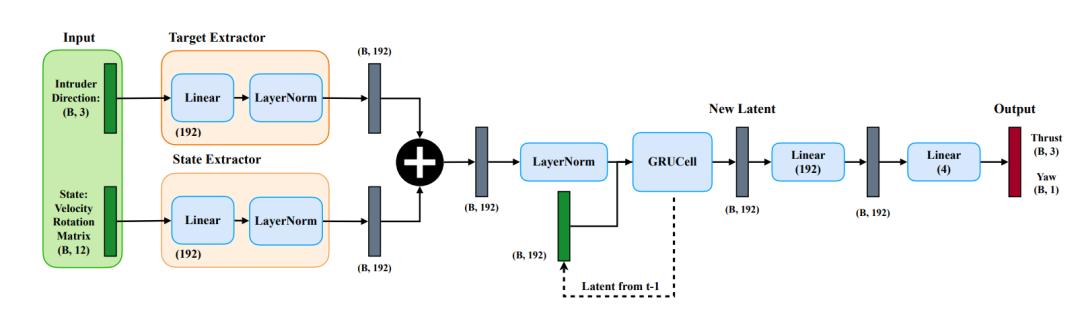
Figure 2: Interception control policy network architecture. The system inputs target direction, self-velocity, and attitude information; passes through MLP and GRU layers; and outputs thrust and heading control commands.
The GRU here is critical. Because target distance and velocity are invisible, the model must “guess” how the target will move next from continuous direction changes. In the paper, the target direction vector and interceptor self-state are separately encoded through MLPs, then fed into a GRU with 192 hidden units, finally outputting 3D thrust and yaw angle. The authors argue that the recurrent structure can integrate temporal information and implicitly estimate target velocity and acceleration — essential for predictive interception.
3. Core Technology: Embedding Real Quadrotor Dynamics into Training
The paper’s technical emphasis is not simply swapping one neural network for another, but a shift in training methodology.
Some previous drone learning control methods use point-mass dynamics models. These models are simpler and train faster, but the problem is obvious: during high-speed maneuvers, a real quadrotor’s attitude, moments of inertia, motor response, aerodynamic drag, and thrust constraints all affect flight outcomes.
Interception is different from ordinary navigation. Ordinary navigation is mostly about flying to a target point, while intercepting a high-speed moving target requires more aggressive acceleration, turning, and attitude adjustment. The authors therefore choose to introduce a more realistic nonlinear quadrotor dynamics model and make that model differentiable, so that during policy training, gradients can backpropagate through the dynamics model.
This is the Differentiable Quadrotor Dynamics in the paper’s title.
In simple terms: rather than letting the AI learn to fly in an over-simplified world, it places the quadrotor’s more realistic physical constraints into the training environment, so the model knows from the start that a real drone is not a point that can turn arbitrarily or accelerate without limits.
4. How Were the Experiments Conducted?
The paper uses a custom GPU-parallel simulator built on PyTorch. Training uses 512 parallel environments, 1,500 updates, and a 64-step horizon, totaling approximately 49.15 million steps. The evaluation phase uses 110,000 environments. Experiments were run on an NVIDIA RTX 5090 GPU.
To test that the model does not only chase one type of trajectory, the paper sets up three categories of intruder motion: elliptical, helical, and lemniscate (figure-eight). Elliptical trajectories are used for both training and evaluation; helical and lemniscate trajectories are primarily used for generalization testing.
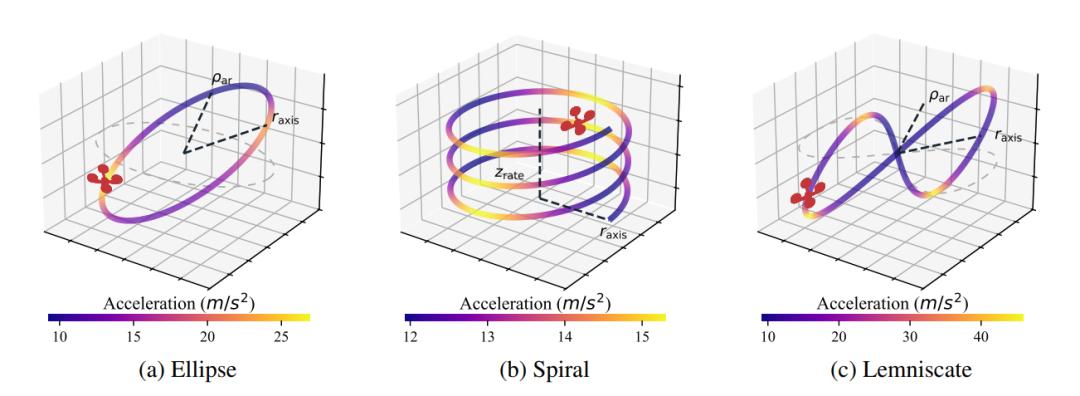
Figure 3: Three categories of intruder drone trajectories — elliptical, helical, and lemniscate — used to evaluate interception policy generalization in complex 3D motion.
This experimental design is quite valuable. In real low-altitude security scenarios, intruding drones will not fly only along a single regular straight line. If an algorithm only performs well on simple paths, its practical significance is diminished. The paper separates training trajectories from generalization test trajectories, showing the authors care not only about “success within the training set” but also about whether the model can adapt to more complex target motion.
5. What Are the Results?
The paper first compares APG with the common reinforcement learning baseline PPO.
Results show that under point-mass dynamics, APG is more sample-efficient than PPO. Training curves indicate APG’s training success rate rises faster, and PPO’s interception duration is longer.
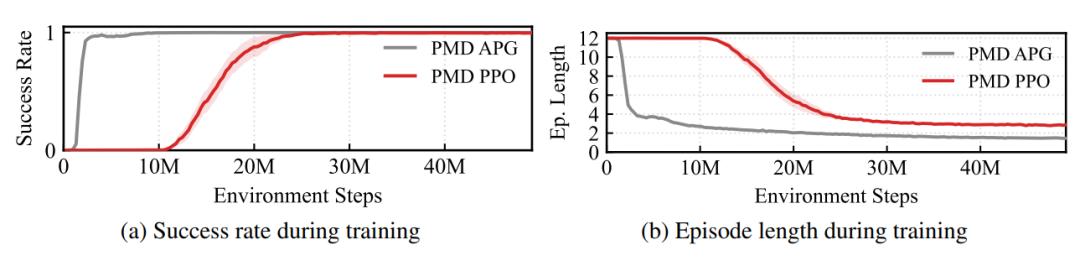
Figure 4: APG vs. PPO training comparison. APG demonstrates higher sample efficiency in both training success rate and interception duration.
The paper then compares interception success rates across different intruder speeds. Results show that across all three trajectory types — elliptical, helical, and lemniscate — APG achieves higher interception accuracy than PPO, and the gap widens further as target speed increases.
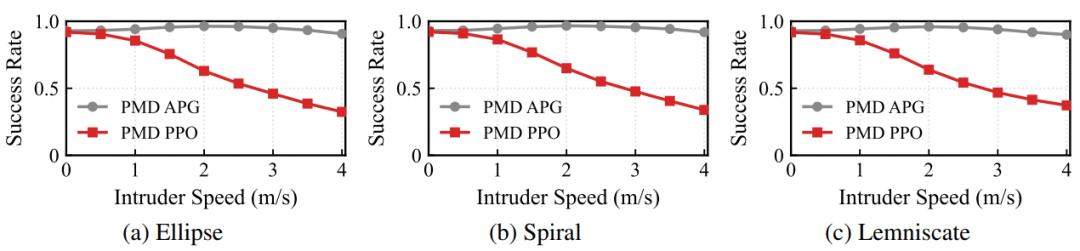
Figure 5: APG vs. PPO interception success rate at different target speeds. The faster the target, the more pronounced APG’s relative advantage.
This reveals an important insight: in high-speed interception tasks, the training methodology itself matters greatly. It is not enough to simply throw more simulation environments and larger neural networks at the problem — how efficiently the policy leverages dynamics information directly determines final performance.
6. The Real Key: Real Dynamics Outperform Simplified Models for Interception
The paper’s most noteworthy comparison is between point-mass dynamics and real nonlinear quadrotor dynamics models.
The authors find that the two model types show little difference in training convergence speed. In other words, introducing more realistic quadrotor dynamics does not significantly slow policy convergence.
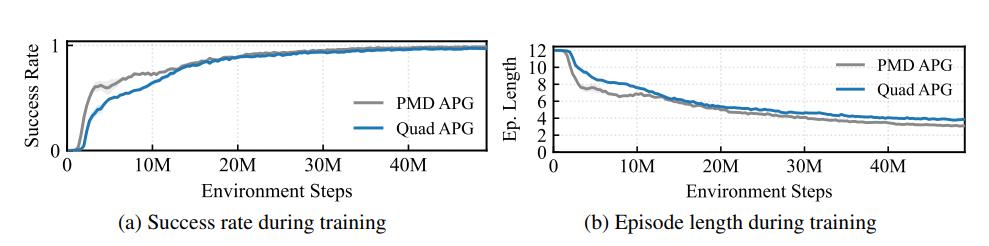
Figure 6: Training convergence comparison between point-mass dynamics and real quadrotor dynamics. Convergence speeds are similar, but final interception performance diverges.
The real gap emerges during evaluation.
Paper results show that Quad APG, trained with real quadrotor dynamics, achieves significantly higher interception success rates than PMD APG, trained with simplified point-mass dynamics, across different target speeds and trajectory types. The authors’ quantified result: across elliptical, helical, and lemniscate evaluation trajectories, Quad APG leads by an average of 37%, 33%, and 31% respectively.
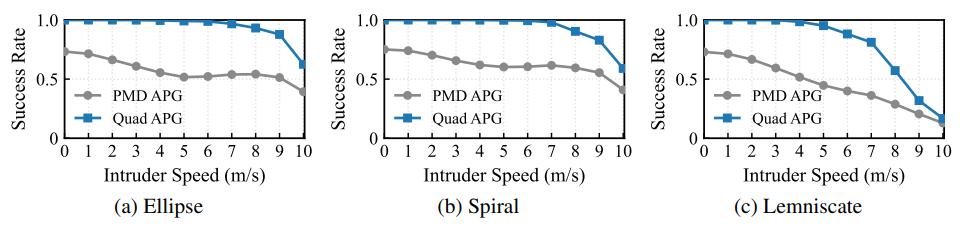
Figure 7: Interception success rate improvement from real quadrotor dynamics. Quad APG outperforms point-mass-trained policies across all three trajectory types.
This is arguably the paper’s most important technical conclusion: drone interception is not an ordinary navigation task — simplified dynamics models underestimate the real constraints of high-speed maneuvering.
For industry, this conclusion is also illuminating. Future intelligent drone systems cannot focus only on perception models and path planning algorithms. They must also emphasize dynamics modeling, control constraints, actuator response, and real platform limits. Otherwise, algorithms that look impressive in simulation may distort on real hardware.
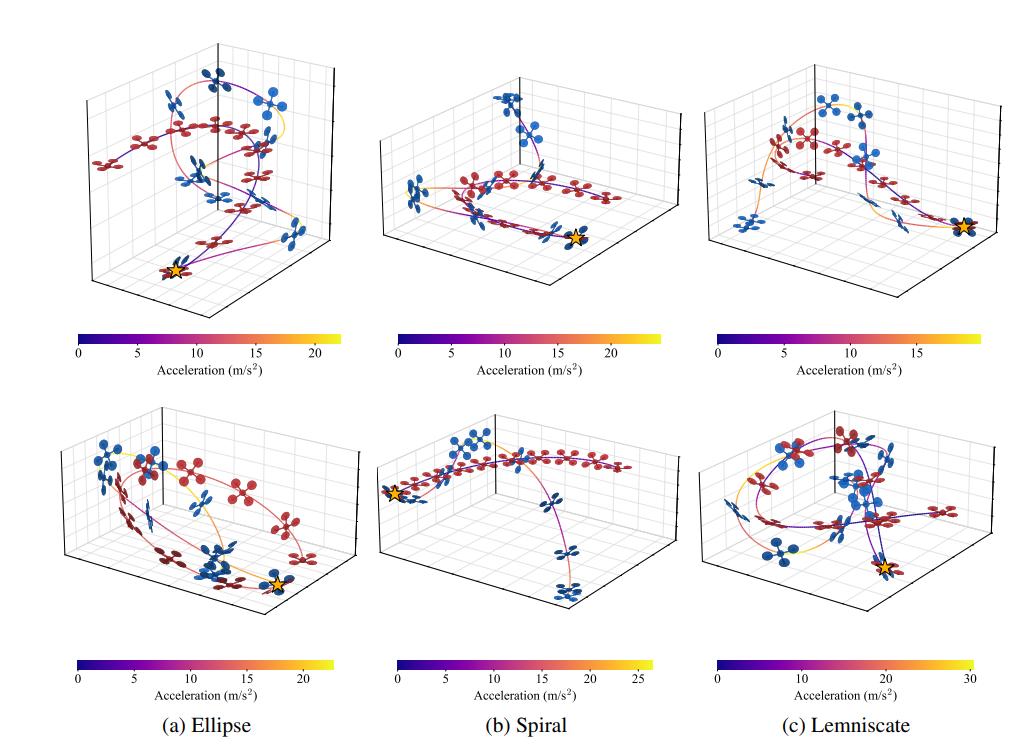
Figure 8: Quad APG interception examples across three trajectory types. Star markers indicate interception points; trajectory colors reflect acceleration changes.
7. What Is This Paper’s Contribution?
I see three main contributions.
First, it pushes the counter-drone problem one step beyond “high-precision positioning dependency.” Intercepting using only target direction rather than full relative position is critically important for passive vision systems. If this can later be integrated with real target detection, tracking, and multi-camera systems, the approach moves closer to practical deployment.
Second, it demonstrates the potential of differentiable dynamics in agile drone control. Differentiable simulation is not simply a replacement for traditional RL — it allows physical models to directly participate in policy optimization. For tasks like high-speed flight, dynamic obstacle avoidance, aerial tracking, and terminal interception, this could become an important direction.
Third, it reminds us that competition in low-altitude intelligence is not a single-point algorithm race, but a system-level competition spanning perception, control, dynamics, simulation, and computing platforms. Especially in high-speed maneuver tasks, the physical limits of real platforms directly determine the upper bound of intelligent algorithms.
8. Acknowledge the Boundaries
This paper remains primarily simulation validation — it is not a completed, hardware-deployed counter-drone system.
The paper’s conclusion section explicitly states that the current method assumes the intruder follows trajectories at constant speed and remains within the interceptor’s field of view at all times. The system has not yet incorporated sensor uncertainty, target detection errors, or real hardware validation — all of which are future work.
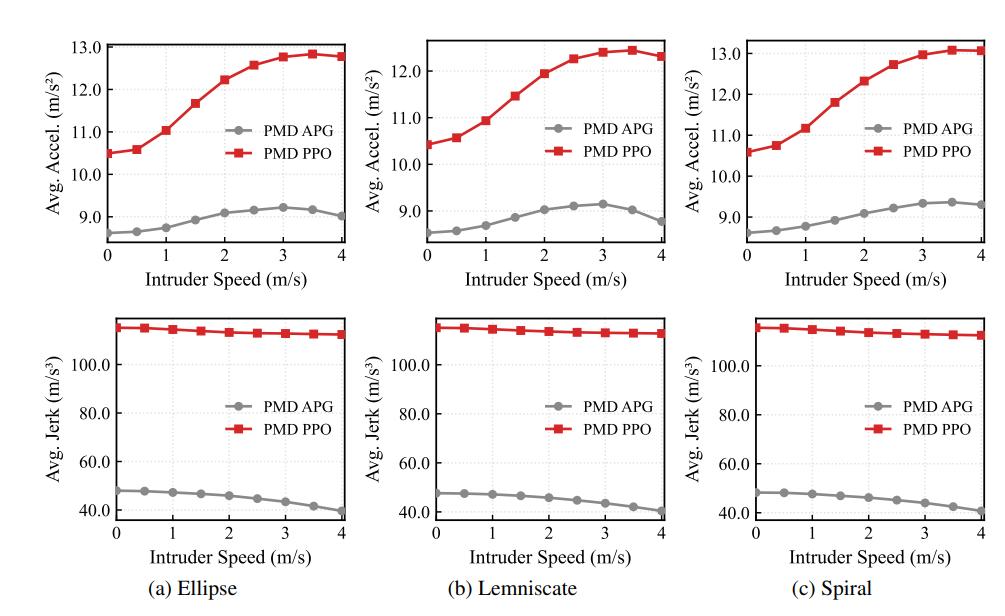
Figure 9: APG vs. PPO comparison on acceleration and jerk. PPO policies exhibit more aggressive overall control actions, potentially imposing higher control burden.
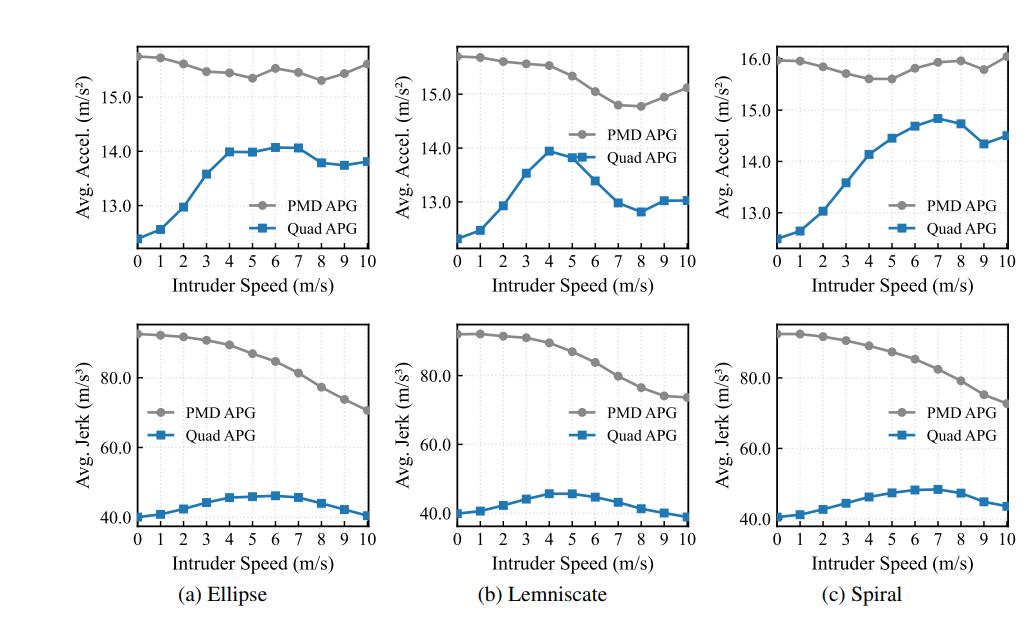
Figure 10: Control smoothness comparison between point-mass and real quadrotor models. Real-dynamics-trained policies show advantages in control effort.
In other words, this research has not solved every problem. Real visual detection drops frames, targets can be occluded, and low-altitude environments contain obstacles, wind disturbances, communication latency, and multi-target interference. More sophisticated adversarial targets will not obediently follow fixed trajectories either.
But this does not diminish its research value. It proposes a control learning framework that is closer to real deployment constraints, not merely an incremental algorithmic tweak chasing simulation benchmarks.
9. My Assessment
This paper deserves attention — not because it will immediately become a counter-drone product, but because it represents an important trajectory for low-altitude intelligence: enabling drones to complete high-speed maneuver tasks under incomplete perception, through dynamics-consistent learned control.
In the future, this class of technology could extend in three directions.
First: low-altitude security. Airports, industrial parks, energy facilities, and major event venues may all need low-cost, rapid-response capabilities for handling anomalous drones.
Second: agile autonomous flight. Dynamic obstacle avoidance, target tracking, drone racing, and aerial coordination all require stable control decisions during high-speed motion.
Third: simulation training platforms. Drone intelligence will not rely solely on real-flight data collection. The future depends more on GPU-parallel simulation, differentiable physics, Sim2Real transfer, and hardware-in-the-loop validation.
So while this paper appears to be about “drone interception,” it is fundamentally about a larger trend: as the low-altitude economy enters its intelligent phase, the real competitive barrier will shift from individual flight platforms to the system-level capability formed by perception, dynamics, control, and computing in concert.
Paper Link: https://arxiv.org/pdf/2607.02472v1
If you have questions about drone interception, autonomous flight, or counter-UAS technology, feel free to contact Aomway at [email protected].
Have questions about this article? Feel free to contact us at [email protected] — we’re happy to help!
