

Why Does MIMOmesh Maintain Throughput After Multiple Hops?
Spatial-Time Division Multiplexing (STDM) — The Core Mechanism Behind Multi-Hop Throughput Retention
In wireless ad-hoc networks, multi-hop relaying is essential for extending coverage, bypassing obstacles, and improving link reliability. However, traditional Mesh networks have long suffered from a fundamental problem: the more hops, the lower the end-to-end throughput.One of MIMOmesh wireless ad-hoc network’s key advantages is its use of Spatial-Time Division Multiplexing (STDM) to improve wireless resource utilization efficiency in multi-hop transmissions, enabling the network to maintain stable throughput beyond three hops — unlike traditional Mesh networks where rates continuously degrade.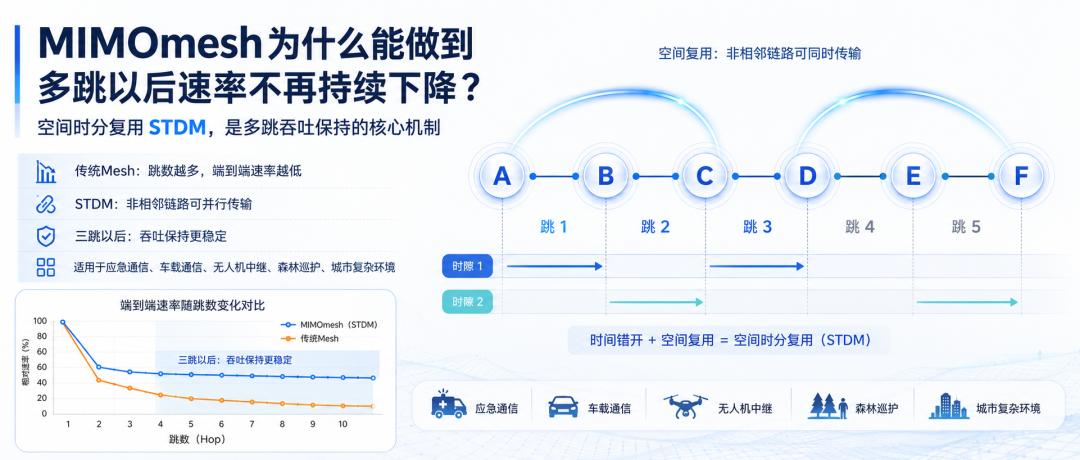 ────────────────────
Key Takeaways
- Traditional TDM multi-hop throughput follows the relationship Rn ≈ R1/n — each additional hop consumes a full time slot, causing linear degradation
- STDM (Spatial-Time Division Multiplexing) exploits signal attenuation over distance to let spatially-isolated links transmit concurrently in the same time slot
- Unlike TDM’s “who gets this slot?” approach, STDM asks “which links can share this slot?” — adding spatial reuse on top of time division
- MIMOmesh achieves stable throughput beyond 3 hops by transforming multi-hop links from “hop-limited” to “reuse-cycle-limited” behavior
- Practical implications: longer coverage, stable throughput, stronger concurrency, and better service continuity in mobile ad-hoc scenarios
01
Traditional TDM Multi-Hop Transmission:
The Problem“Resources Consumed Hop by Hop”
────────────────────Traditional wireless ad-hoc networks typically use strict Time Division Multiplexing (TDM). Simply put: only one link can transmit at a time; all others must wait.Consider a multi-hop link: A → B → C → D → EData from A to E cannot reach directly, so it must be forwarded hop-by-hop through relays B, C, and D.In traditional TDM mode, the transmission process is typically:Slot 1: A → B, Slot 2: B → CSlot 3: C → D, Slot 4: D → EIn other words, each additional hop consumes one additional wireless channel resource.If single-hop transmission time is T and data volume is D, then:1-hop: D/T, 2-hop: D/2T3-hop: D/3T, n-hop: D/nTTherefore, traditional Mesh multi-hop end-to-end throughput follows: Rn ≈ R1 / nThis is the well-known Mesh “multi-hop throughput degradation”。Each time a packet passes through a relay node, it re-occupies wireless channel resources. So more hops mean longer transmission cycles and lower end-to-end throughput.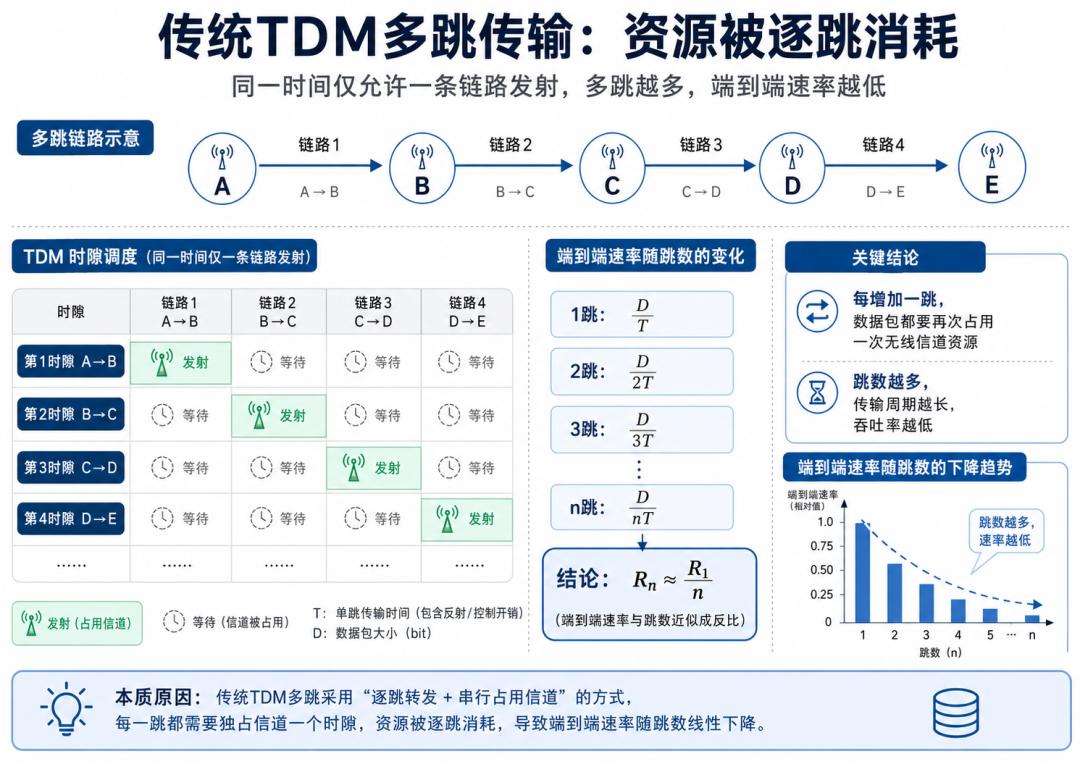 ────────────────────
02
Spatial-Time Division Multiplexing (STDM):
让“Sufficiently Distant Links Can Operate Concurrently”Operate Concurrently
────────────────────STDM is based on a fundamental law of wireless propagation:Wireless signal strength attenuates with increasing propagation distance.A signal transmitted by one node does not cause strong interference at arbitrarily distant receivers.When two wireless links are spatially distant enough, the transmitted signal from one link attenuates significantly before reaching the other link’s receiver, falling below the acceptable interference threshold.At this point, as long as the SINR requirement is met:SINR ≥ System ThresholdThe system can determine that both links can transmit concurrently in the same time slot.For example: A → B is transmitting.If D → E is sufficiently isolated from the A→B link with minimal mutual interference, then D → E can also operate simultaneously.This is the essence of STDM: not all links queue up — spatially non-interfering links transmit concurrently.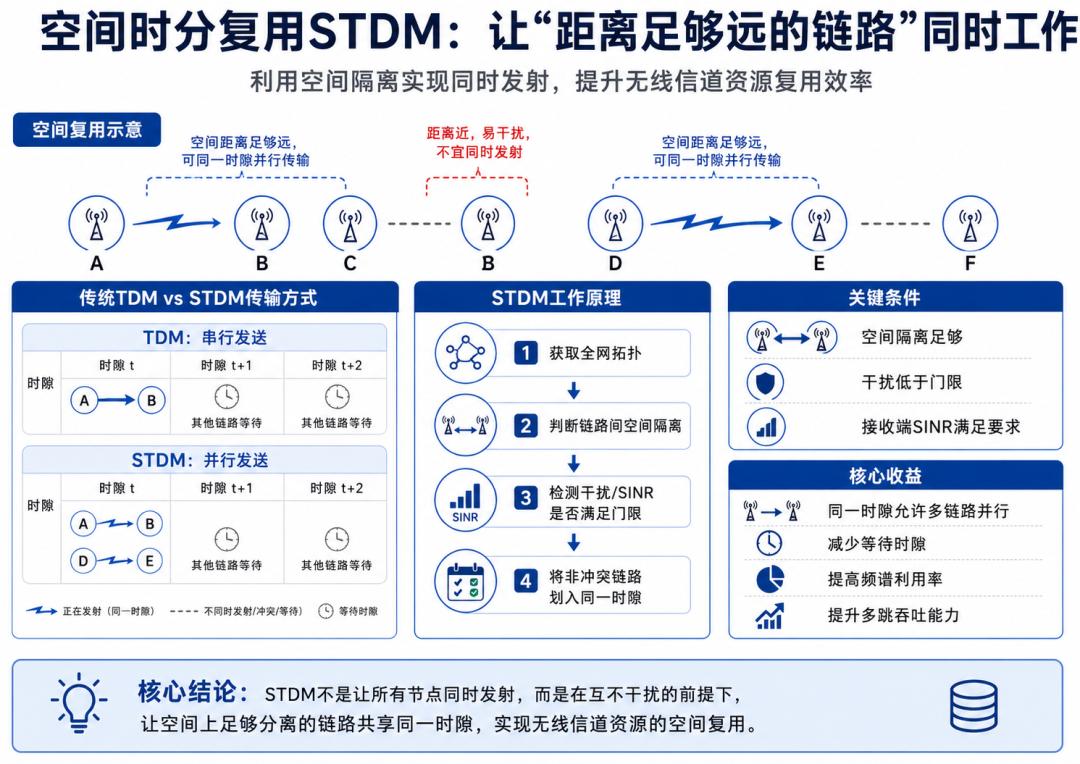 ────────────────────
03
STDMNot Simply“同时发”,
It’s Intelligent Scheduling Based on Full-Network Topology
────────────────────It’s important to emphasize that STDM does not allow arbitrary simultaneous transmissions. It relies on:Full-network topology awareness + Interference relationship assessment + Time slot resource optimizationTopology changes: supports dynamic adjustment in mobile scenariosThe system evaluates which links conflict and which can be spatially reused.If two links cause significant interference when operating simultaneously, they cannot share the same time slot.If two links are sufficiently isolated with controllable interference, they can be assigned to the same reuse group.The goal of STDM scheduling can be summarized as: meeting the maximum number of link transmission demands with the minimum number of time slots.This is the key to MIMOmesh’s multi-hop throughput improvement.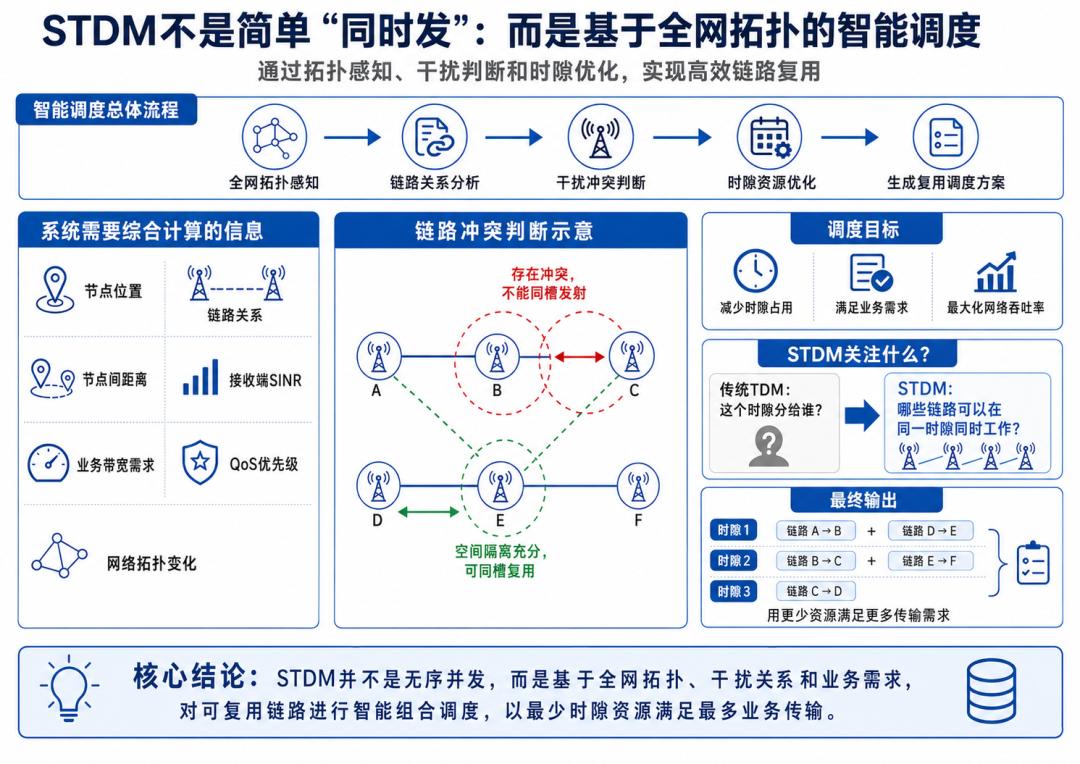 ────────────────────
04
Core Differences Between TDM and STDM
────────────────────Traditional TDM asks: Who gets this time slot?STDM asks: Which links can work in the same time slot simultaneously?The essential difference:TDM is resource allocation in the time dimension.STDM is resource reuse in both time and space dimensions.[Traditional TDM]Scheduling: Sequential transmission by time orderSame slot: Typically only one link activeDecision basis: Time slice allocationMulti-hop effect: Throughput continuously degrades with hopsSuitable: Small-scale, low-concurrency networks[STDM]Scheduling: Based on time + spatial isolationSame slot: Multiple non-conflicting links can operateDecision basis: Topology, node distance, interference, SINR thresholdMulti-hop effect: Reduces bandwidth loss via spatial reuseSuitable: Multi-node, multi-hop, high-concurrency mobile ad-hoc networksIn one sentence: TDM queues in time; STDM adds spatial reuse on top of the time dimension.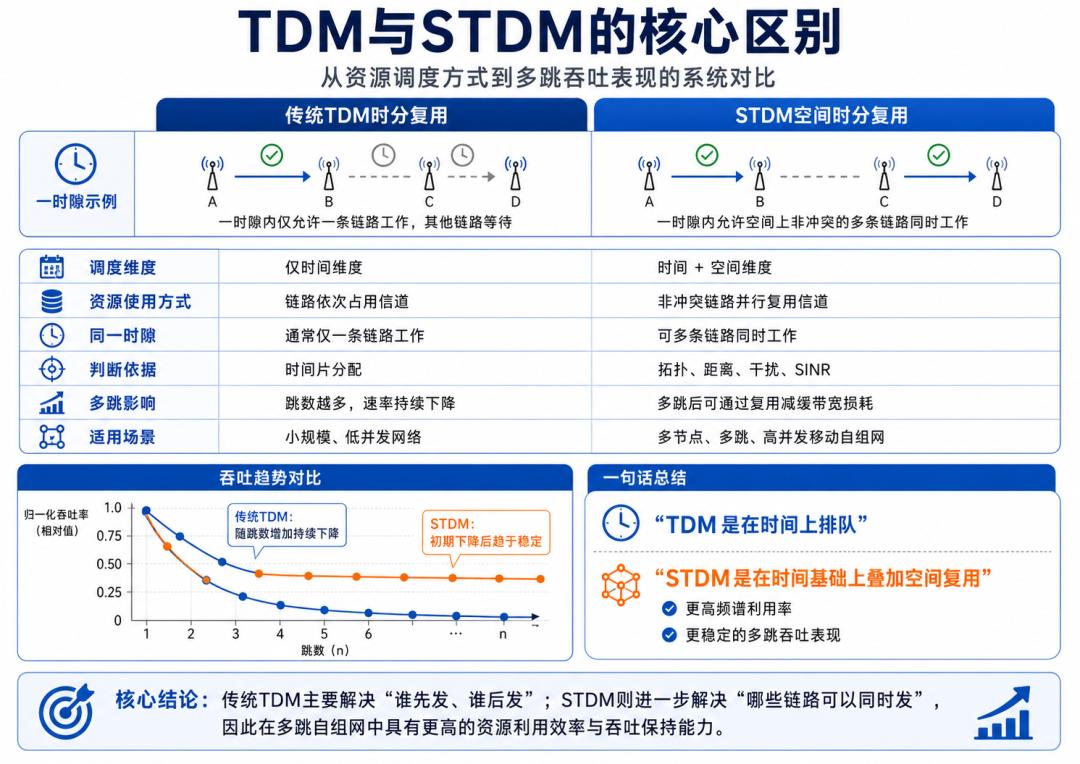 ────────────────────
05
Why Does STDM Stabilize Throughput After Three Hops?
────────────────────In traditional Mesh, multi-hop links are serial: A → B → C → D → E → FWith strict TDM scheduling, 5 links may require 5 separate time slots.In STDM mode, the system evaluates spatial isolation between links. For example:A→B and D→E are far enough apart — they can transmit concurrently.B→C and E→F have manageable interference — they can also transmit concurrently.Thus, transmissions that originally required multiple sequential time slots can be compressed into fewer slots through spatial reuse.Multi-hop links are no longer: 1 slot = 1 linkBut instead: 1 slot = multiple spatially-isolated linksTherefore, as hops increase, network throughput no longer follows the traditional TDM 1/n degradation pattern.More technically:Given adequate spatial reuse distance、link SINR、node scheduling capability和and topology stability conditions,STDM shifts multi-hop links from “hop-limited”转变为“reuse-cycle-limited”。This is the technical foundation for MIMOmesh to achieve “stable throughput after three hops”important technical foundation。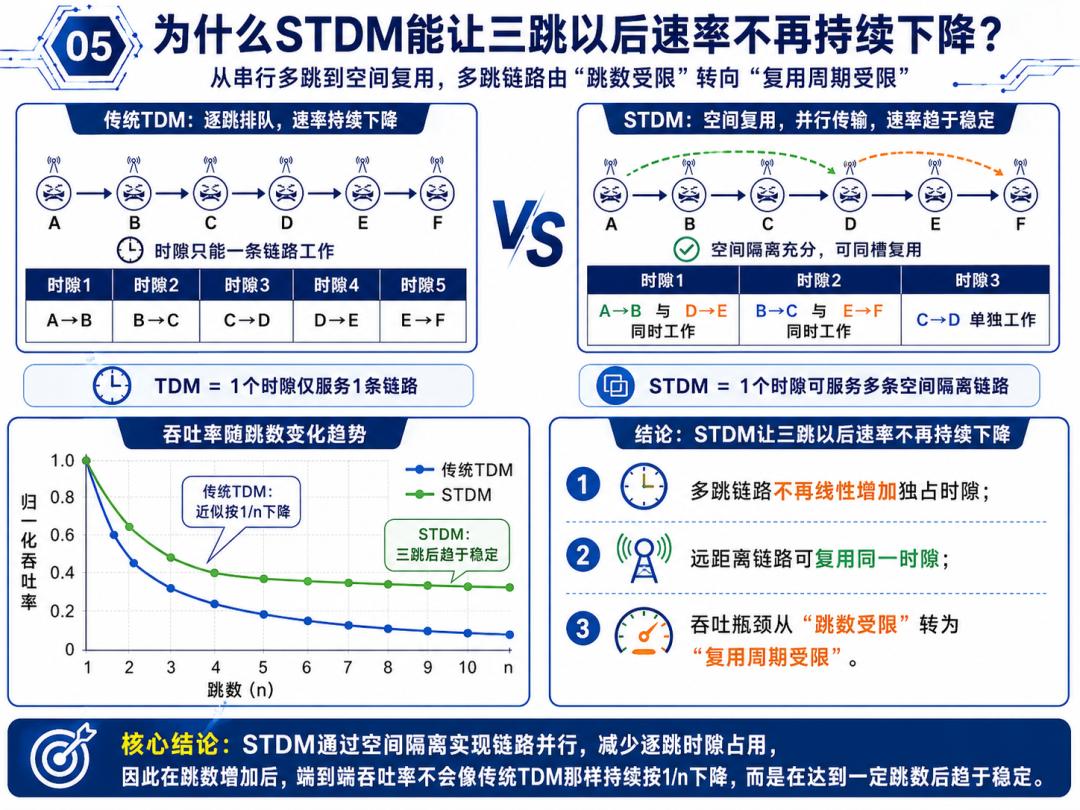 ────────────────────
06
The Value of STDM in MIMOmesh:
Improving Full-Network Throughput
────────────────────MIMOmesh is not simply about adding relay nodes or extending communication distance. Its critical capability is maintaining high end-to-end throughput under multi-node, multi-hop, multi-service concurrency.Through STDM, MIMOmesh achieves the following capabilities:First, improved spatial reuse. Spatially isolated links transmit in the same time slot, increasing spectral efficiency.Second, reduced multi-hop forwarding overhead. Minimizes repetitive occupation of independent time slots, lowering bandwidth loss from hop-by-hop relaying.Third, improved end-to-end throughput. Prevents linear throughput degradation with hop count, keeping multi-hop throughput stable.Fourth, enhanced mobile adaptability. After node movement, the system recalculates reuse relationships based on topology changes for dynamic scheduling.Fifth, increased high-concurrency service capacity. Better suited for simultaneous multi-stream video, voice, positioning, and telecommand transmission.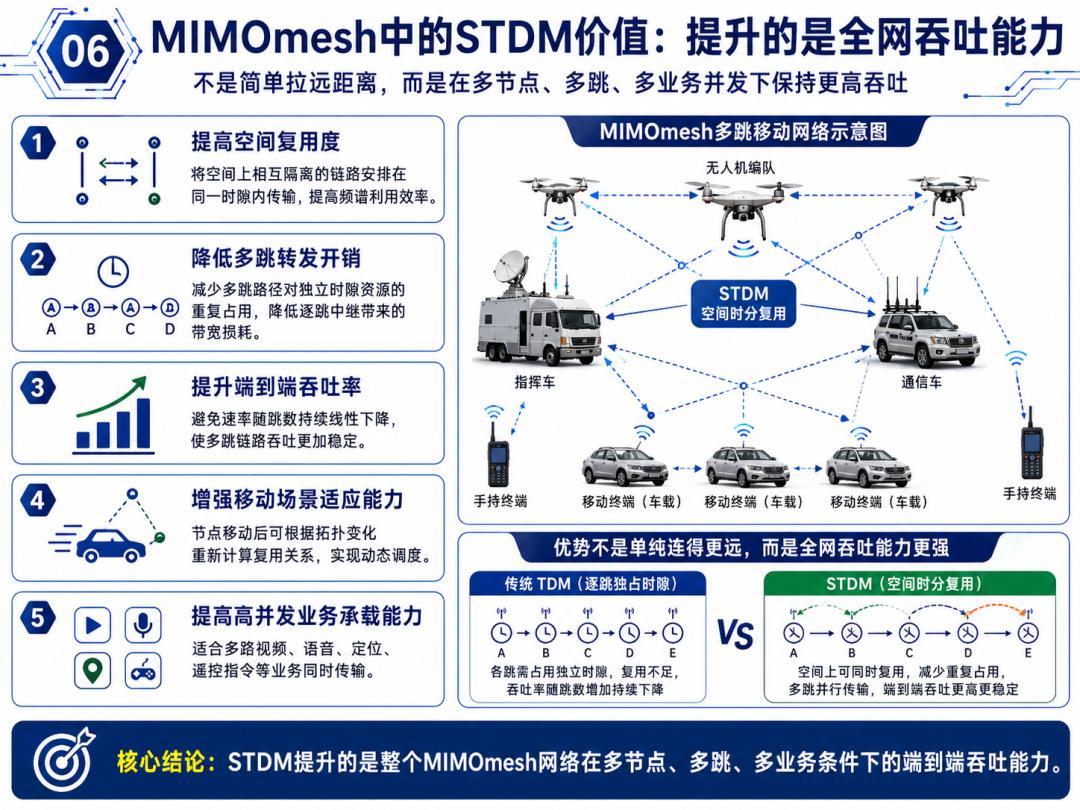 ────────────────────
07
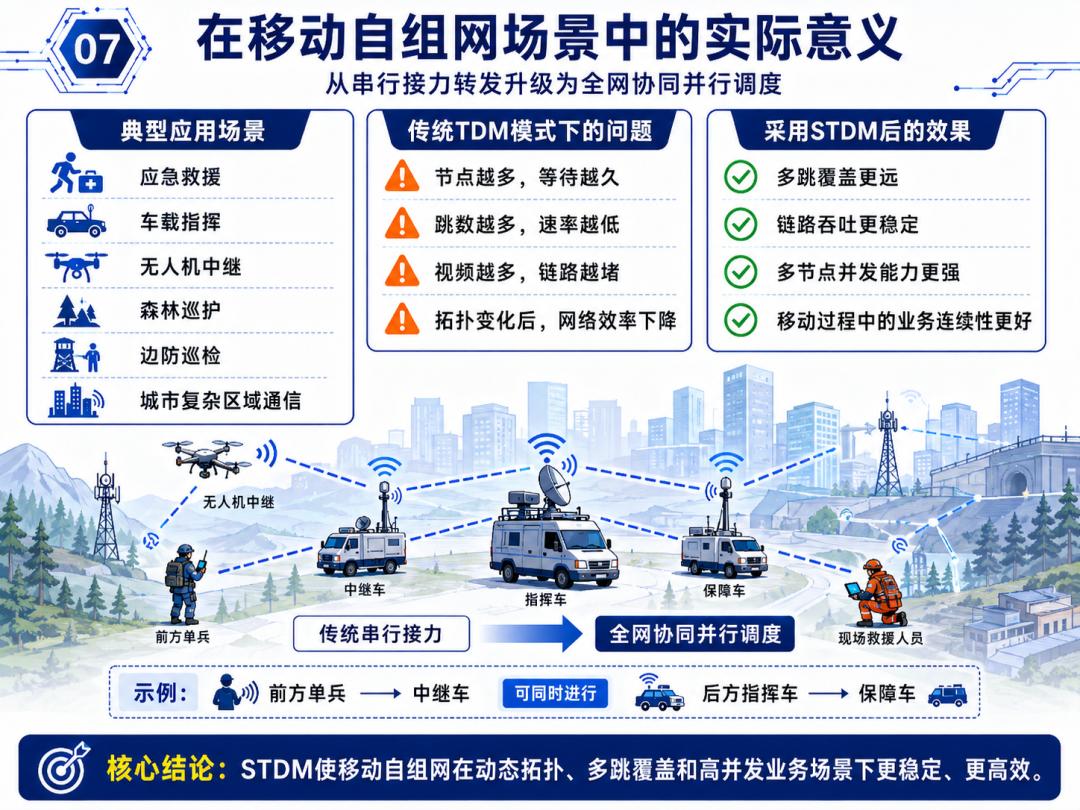
Practical Significance in Mobile Ad-Hoc Network Scenarios
────────────────────In emergency rescue, vehicle-mounted command, UAV relay, forest patrol, border surveillance, and urban complex-area communications, network nodes are typically in dynamic states.These nodes face obstructions like buildings, terrain, and forests, plus topology changes from moving vehicles, personnel, and UAVs — all while requiring extensive multi-hop forwarding.With traditional TDM: more nodes = longer waits; more hops = lower rates; more video = more congestion; topology changes = efficiency drops.With STDM, the system arranges spatially non-interfering links to work in parallel within the same time slot, based on real-time topology.Examples:The forward soldier-to-relay-vehicle link can transmit concurrently with the rear command-to-support-vehicle link.Long-range ground vehicle links can be spatially reused with UAV-to-forward-node links.Video, voice, and positioning data from different areas can transmit in parallel under the same wireless resources, separated spatially.这样,The entire network upgrades from traditional serial relay forwarding to:
Full-network collaborative parallel scheduling
The final results:
Longer multi-hop coverage
More stable link throughput
Stronger multi-node concurrency
Better service continuity during movement.
────────────────────
08
Key Summary
────────────────────
Spatial-Time Division Multiplexing (STDM) is one of the core mechanisms behind MIMOmesh’s multi-hop throughput enhancement.
Its technical essence can be summarized as:
Building on TDD time slot scheduling, STDM leverages wireless signal spatial attenuation and full-network topology awareness to assess inter-link interference, grouping spatially-isolated links into the same reuse time slot — achieving spatial reuse of wireless channel resources.
Unlike traditional TDM, STDM no longer treats multi-hop links as sequential hop-by-hop transmissions. Instead, it achieves link parallelism through spatial isolation, reducing the sustained consumption of wireless bandwidth by multi-hop relays.
Therefore, in MIMOmesh wireless ad-hoc networks, as hop count increases, network throughput does not continuously degrade proportionally like ordinary Mesh networks — it stabilizes after reaching a certain number of hops.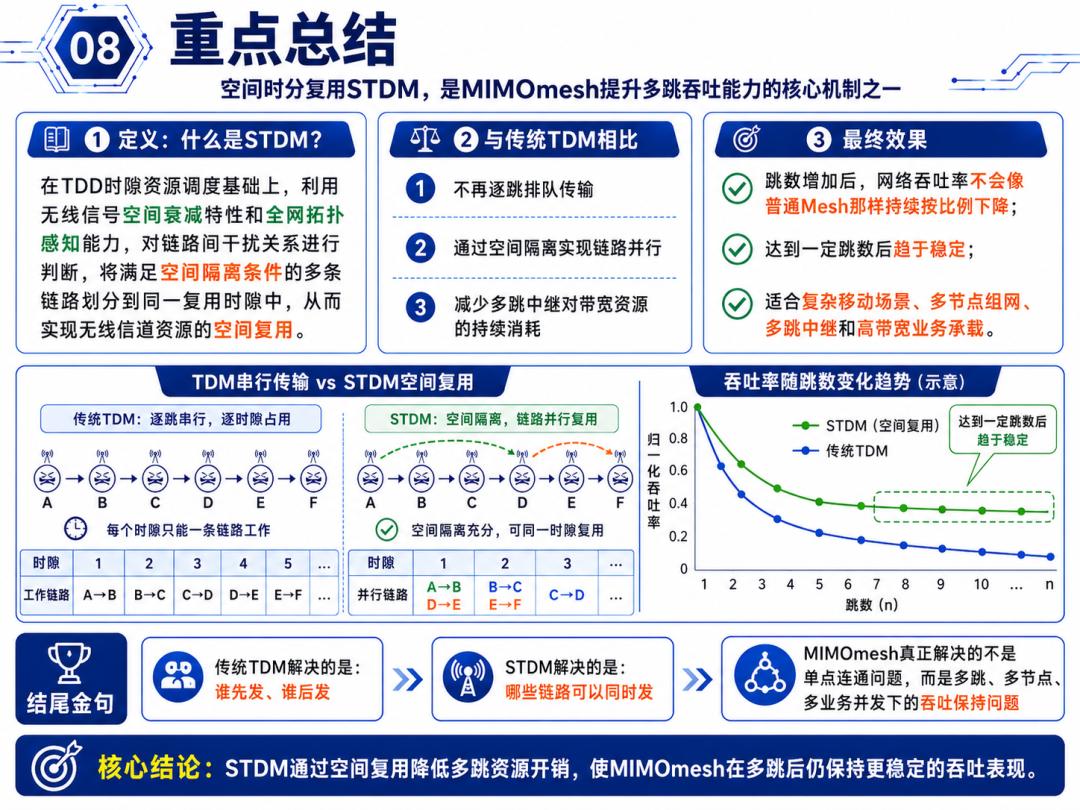
Have questions about this article? Feel free to contact us at [email protected] — we’re happy to help!
