

Summary: Choosing the wrong parameters can crash your quad. This guide gives practical steps and formulas you can finish in five minutes, plus a recommended-values table for different aircraft types.
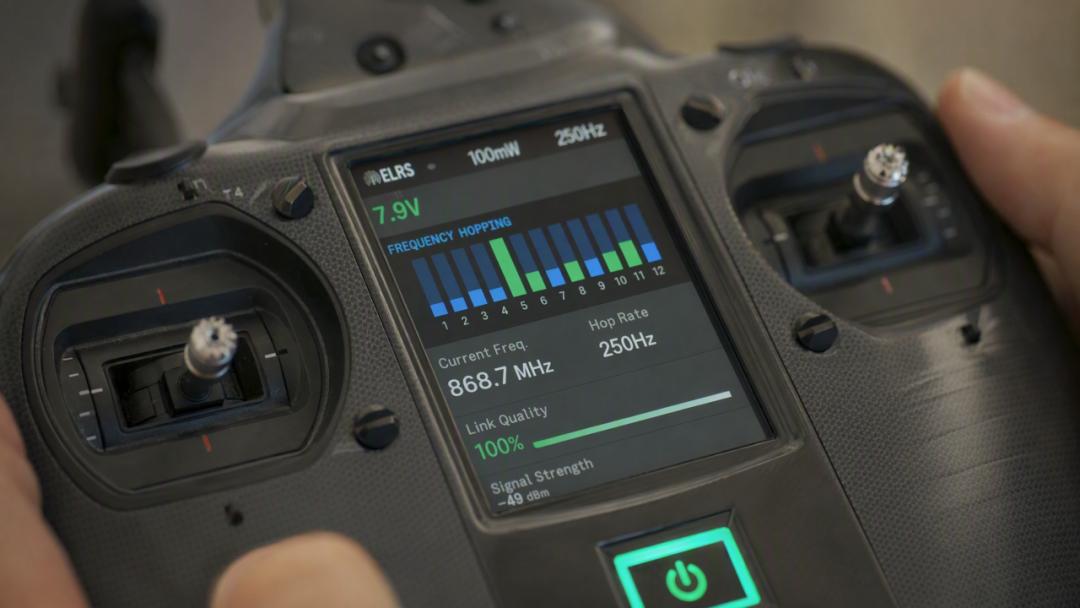
Anyone flying FPV has heard of ELRS, but not many truly understand why it delivers lower latency and longer range than traditional SBUS or CRSF. This article breaks down the technical principles of ELRS, from LoRa modulation to dynamic frequency hopping, so you can see why ELRS has become the de facto standard in FPV. My own MARK5 freestyle quad runs ELRS 2.4 GHz, my F450 uses a traditional SBUS radio with an AT9S Pro, and I have also built a 3D-printed micro quad with ELRS 2.4 GHz. Having used all three setups, the differences are obvious.
Key Takeaways
- ELRS (ExpressLRS) is an open-source FPV radio protocol, not a vendor’s private system — anyone can build hardware on it, unlike closed systems such as DJI OcuSync.
- Its core stack is LoRa modulation, dynamic frequency hopping (FHSS) and forward error correction (FEC), giving 2–4 ms end-to-end latency.
- LoRa gains range through signal-processing gain rather than high power, which is why it resists interference.
- 2.4 GHz favours low latency and is well suited to fast freestyle quads; 915/868 MHz favours penetration and range but has higher latency and local regulatory limits.
- Hardware is inexpensive: an ESP32/ESP8285 main controller plus an SX1280 (2.4 GHz) or SX127x (868/915 MHz) radio chip.
What ELRS Is
ELRS stands for ExpressLRS, the most mainstream open-source radio-control protocol in FPV. It is not a proprietary protocol owned by one company but an open-source project that anyone can build hardware on. This is completely different from DJI’s OcuSync — DJI is a closed system, ELRS is an open ecosystem.
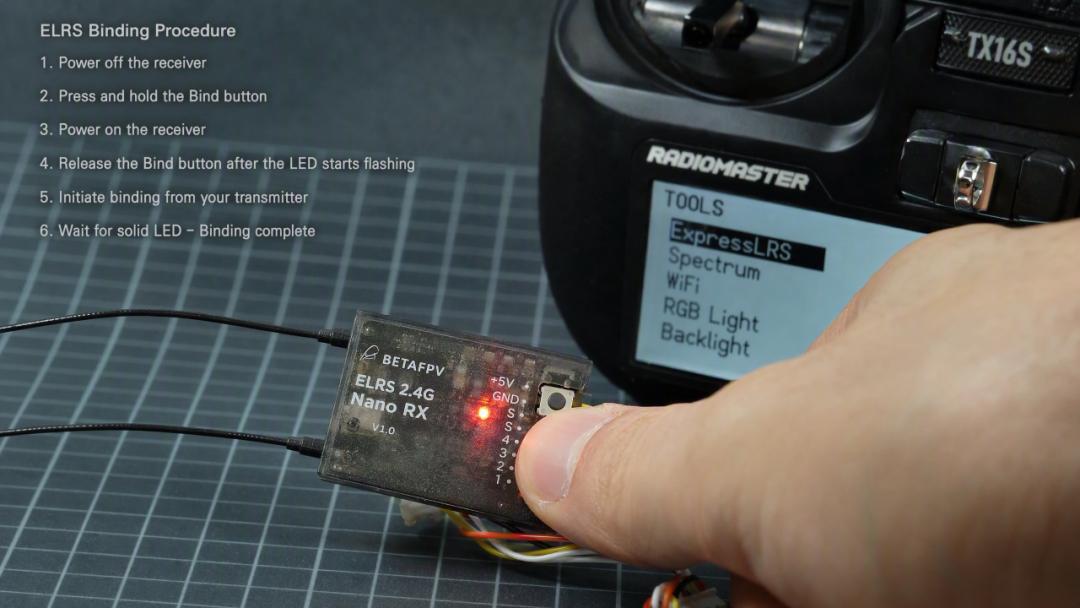
The ELRS core technology stack:
- LoRa modulation: the underlying physical layer responsible for signal transmission.
- Dynamic frequency hopping (FHSS): rapidly switching between frequencies to resist interference.
- Forward error correction (FEC): adds redundant data at the transmitter so the receiver can correct errors automatically.
- 2–4 ms end-to-end latency: from radio stick to flight-controller response, the whole chain takes only a few milliseconds.
What does 2–4 ms mean in context? Traditional SBUS latency is about 9–14 ms and CRSF about 4–6 ms. Reaching 2–4 ms with ELRS means the aircraft feels more “connected” to the pilot — you move the stick and the aircraft responds immediately, with none of that dragging sensation.
LoRa Modulation: Why It Reaches So Far
LoRa (Long Range) is a spread-spectrum modulation technique first developed by Semtech for long-distance IoT communication. ELRS applies it to drone radio control.
The core principle of LoRa is to encode data using chirp signals (linear frequency-modulated signals). A chirp’s frequency changes linearly with time, and this signal has a special property: even when its strength is below the noise floor, the receiver can still demodulate it. That is the secret of LoRa’s range — it does not rely on high power but on signal-processing gain.
An analogy: traditional modulation is like shouting loudly — you need volume to travel far, but it is easily drowned out by other noise. LoRa is like speaking in a special code — not loud, but only someone who knows the code can understand it, so interference rejection is extremely strong.
LoRa has several key parameters:
- Spreading factor (SF): SF7 to SF12; a larger value gives longer range but a lower rate. ELRS on 2.4 GHz typically uses a lower SF to keep latency low, trading a little range for speed.
- Bandwidth (BW): wider bandwidth gives a higher rate but lower sensitivity. ELRS commonly uses 250 kHz or 500 kHz.
- Coding rate (CR): the redundancy ratio for forward error correction, from 4/5 to 4/8.
The cleverness of ELRS is that, unlike traditional LoRa applications with fixed parameters, it adjusts dynamically — at short range it uses high bandwidth and low SF for low latency, and at long range it automatically switches to a high SF for sensitivity.
Dynamic Frequency Hopping (FHSS): Why It Resists Interference
The 2.4 GHz band is a public band shared with WiFi, Bluetooth and microwave ovens, so interference is severe. A traditional fixed-frequency radio breaks its link as soon as it meets same-frequency interference.
ELRS solves this with FHSS (Frequency Hopping Spread Spectrum). The principle is simple: do not stay on one frequency, but hop rapidly among many channels within the 2.4 GHz band. The transmitter and receiver hop in sync according to the same pseudo-random sequence, so interference affects at most individual frequency points and overall communication does not break.
The ELRS 2.4 GHz version typically configures 40–80 hopping channels with a hop rate reaching hundreds of times per second. Even if one frequency point is occupied by a WiFi signal, the next hop lands on a clean one.
2.4 GHz vs 915 MHz: Which to Choose
ELRS supports several bands, most commonly 2.4 GHz and 915 MHz (or 868 MHz, depending on regional regulations).
2.4 GHz version:
- Fast, with lower latency (2–4 ms).
- Measured range of about 12 km (open environment, suitable antenna and power).
- Ample bandwidth, suited to high-speed freestyle flight.
- Drawback: average penetration; signal attenuation is obvious behind trees and buildings.
915 MHz version:
- Strong penetration and good diffraction.
- Suited to long-range cruising and complex terrain.
- Lower rate, slightly higher latency (4–8 ms).
- Regulatory limits: 915 MHz is a restricted band in China; confirm local radio regulations before use.
The choice is 2.4 GHz, because freestyle quads fly fast and need low latency, and a measured 12 km range is more than enough for freestyle (typical FPV flight radius is 1–3 km). For long-range cruisers, 915 MHz is more appropriate.
Hardware Platform: What Chips Does ELRS Run On?
ELRS hardware architecture is simple, with two core chips:
Main controller: ESP32 or ESP8285. This handles the protocol stack, hopping-sequence generation and data packaging. The ESP32 is a dual-core 240 MHz Wi-Fi/Bluetooth SoC with ample compute. The ESP8285 is an upgraded ESP8266 with integrated flash, smaller and suited to the receiver side.
Radio chip: SX1280 (2.4 GHz) or SX127x (868/915 MHz). This is Semtech’s LoRa chip, responsible for physical-layer modulation and demodulation. The SX1280 supports the 2.4 GHz band with a maximum output power of 12.5 dBm and a receiver sensitivity of −132 dBm.
The benefit of this combination is low cost and a mature open-source ecosystem. An ELRS receiver costs a few dozen to just over a hundred yuan, far cheaper than DJI receiver solutions.
ELRS vs SBUS vs CRSF: A Real-World Comparison
Having flown the same class of aircraft with all three protocols, the comparison is intuitive:
| Feature | ELRS 2.4 GHz | SBUS | CRSF |
|---|---|---|---|
| Latency | 2–4 ms | 9–14 ms | 4–6 ms |
| Refresh rate | 500–1000 Hz | 100 Hz | 150–250 Hz |
| Channels | 16 | 16 | 16 |
| Range | ~12 km | ~1–2 km | ~2–4 km |
| Interference rejection | FHSS dynamic hopping | Fixed frequency | FHSS |
| Price | 50–150 CNY | 100–300 CNY | Included with Taranis |
After switching the MARK5 to ELRS, the most obvious change is faster stick response — the “connected” feel is very clear during high-speed cornering. Flying the F450 with SBUS previously, the latency was present but not noticeable, because the F450 does slow hovering and waypoint flight, where the human body cannot perceive a difference between 4 ms and 14 ms.
The 3D-printed micro quad also uses ELRS, mainly for the receiver’s small size and light weight (2–3 g), which is critical for weight reduction on micro aircraft.
Receiver Selection Advice
When buying an ELRS receiver, pay attention to a few points:
- Confirm the band: 2.4 GHz is mainstream, with more accessories and better community support.
- Confirm the firmware version: ELRS 3.x is the current stable release; 2.x is outdated.
- Antenna choice: the stock PCB antenna is sufficient; for range, switch to an omnidirectional rubber-duck or directional antenna.
- Power setting: for legal flight, obey local radio power limits — in China, 2.4 GHz micro-power devices are limited to 10 mW.
Conclusion
ELRS became the de facto standard for FPV radio control not through any company’s marketing but through the strength of its open-source community and solid technical parameters. LoRa modulation plus dynamic frequency hopping plus forward error correction give it a clear advantage over traditional schemes across latency, range and interference rejection.
If you are still flying a freestyle quad on SBUS, try ELRS once — the “instant response” feel is hard to go back from.
Technical data sources: the official ExpressLRS documentation, the Semtech SX1280 datasheet, and the ArduPilot/INAV wikis.
Disclaimer: The technical recommendations in this article are for reference only; for actual operation, follow the device manual and local regulations. Before flying, complete your local drone registration, confirm the airspace type and perform a safety check. Content involving policies and regulations is subject to the latest official releases, and this article does not constitute legal advice.
If you have any questions about this topic, feel free to contact us at [email protected]
FAQ
Q: Why is ELRS lower latency than SBUS?
SBUS latency is roughly 9–14 ms while ELRS reaches 2–4 ms through LoRa modulation, dynamic frequency hopping and forward error correction, with a refresh rate up to 500–1000 Hz.
Q: How does LoRa achieve long range without high power?
It uses chirp spread-spectrum signals that can be demodulated even below the noise floor, gaining range through signal-processing gain rather than transmit power, which also makes it highly interference-resistant.
Q: Should I pick 2.4 GHz or 915 MHz?
2.4 GHz for low latency and fast freestyle flight (about 12 km measured); 915/868 MHz for penetration and long-range cruising, though with higher latency and, in China, restricted-band regulatory considerations.
Q: What chips power an ELRS receiver?
An ESP32 or ESP8285 main controller plus an SX1280 (2.4 GHz) or SX127x (868/915 MHz) Semtech LoRa radio chip.
Q: Does Aomway supply FPV radio and video hardware?
Aomway supplies FPV and UAV hardware, including video transmitters and related link equipment, and follows developments in radio-control protocols for FPV platforms. If you need help choosing link hardware, contact Aomway at [email protected].
Have questions about this article? Feel free to contact us at [email protected] — we’re happy to help!
