
Key Takeaways
- Drone RF detection is passive: it receives the radio signals radiated by the control and video links between a UAV and its operator, then analyzes frequency, bandwidth, time-domain behavior or protocol structure to determine presence, model and even position.
- Because nothing is transmitted, the sensor stays covert and can locate the operator as well as the aircraft. Most consumer and commercial drones use the 2.4GHz and 5.8GHz ISM bands, so listening there catches the uplink commands and the downlink video.
- Detection alone is not enough — Wi-Fi and Bluetooth share the same bands. Classification relies either on spectrogram features fed to a CNN or YOLO detector, or on real-time FFT feature extraction from IQ samples.
- Three intermodulation products such as 2F1−F2 only appear when a drone’s command and video links run simultaneously, which makes them a clean discriminator against dense urban Wi-Fi.
- The fundamental blind spot: a drone flying radio-silent or fully autonomous emits nothing, and RF detection cannot see it. Real deployments fuse RF with radar and electro-optics.
The core principle of drone RF detection is to passively receive the RF signals radiated by the communication link between the drone and its remote controller, then analyze frequency, bandwidth, time-domain characteristics or protocol structure to judge whether a drone is present, what model it is, and where it is. Nothing is transmitted, so the technique is passive, comparatively covert, and able to reveal the bearing of both the aircraft and its operator at the same time.

Basic Principle: Listening to the Control Link
The overwhelming majority of consumer and commercial drones depend on radio for control and video. A detection system continuously monitors those bands — mainly the 2.4GHz and 5.8GHz ISM bands — capturing the uplink command stream from the controller and the downlink video signal. The moment a signal matching drone communication characteristics appears above the noise floor, an alert is raised. The advantage of this approach is that it works passively without exposing itself, and it captures information about the communication behavior itself rather than inferring it indirectly.

From Energy Detection to Signature Classification
Merely detecting that “a signal exists” is far from sufficient, because Wi-Fi and Bluetooth devices occupy the same bands. Spectrum detection has to go further and identify where the signal came from.
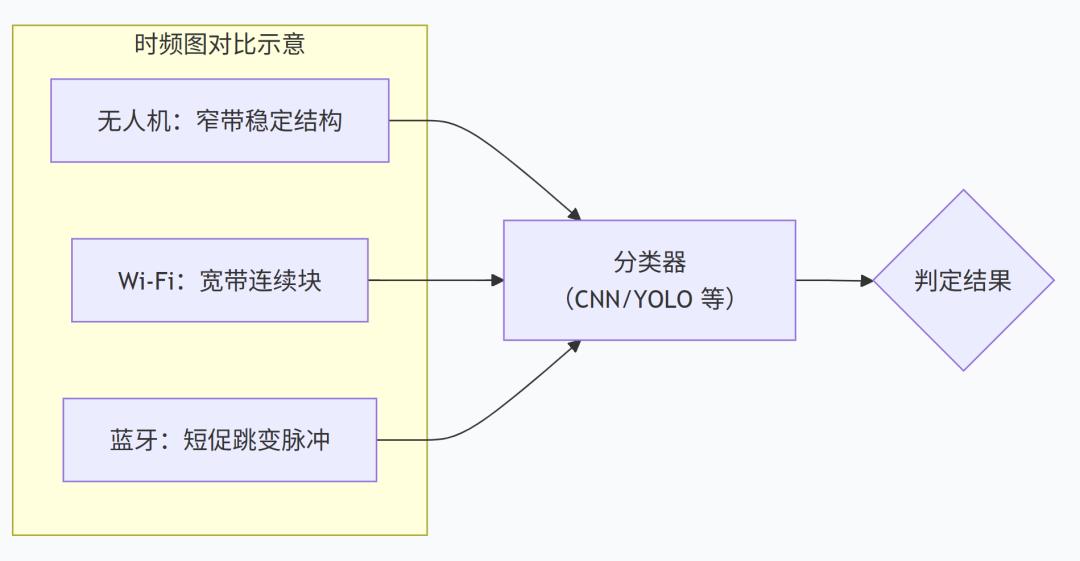
One path is based on time-frequency features. Convert the received signal into a spectrogram: drone signals usually appear as a narrowband stable structure of a specific bandwidth, or as a distinctive frequency-hopping pattern. Wi-Fi appears as a wide continuous OFDM block, while Bluetooth shows up as short hopping pulses. Running a deep learning detector such as YOLOv5 over the spectrogram automatically boxes and classifies drone signals. This approach does not rely on prior knowledge of a specific protocol and retains some ability to find unknown or encrypted links.
The other path is real-time spectrum analysis with feature extraction. The system performs real-time FFT on the intermediate-frequency IQ signal, extracts bandwidth, center frequency and level, and applies a multi-feature fusion algorithm to decide whether the signal is a drone, which suppresses false alarms in a crowded electromagnetic environment.

Protocol Parsing and Intermodulation Fingerprints
For systems equipped with a library of known drone protocols, detection can reach the protocol layer. By demodulating physical-layer data frames it becomes possible to extract the drone’s unique ID — an electronic fingerprint — enabling precise model identification and even whitelist or blacklist control. More advanced cognitive-radio protocol parsing can pull the positions of both drone and pilot from the data layer and reconstruct control commands, though that crosses into the territory of countermeasures.
For the false-alarm problem caused by Wi-Fi co-channel interference in cities, there is another identification idea built on intermodulation. When a drone’s command signal (F1) and its video signal (F2) both drive the nonlinear circuitry of a receiver, a third-order intermodulation product appears at 2F1−F2. That product is specific to a drone running both links at once; a single Wi-Fi signal cannot generate it. Using it as an identification reference separates drones from urban Wi-Fi interference very effectively.
Locating the Source: TDOA and Direction Finding
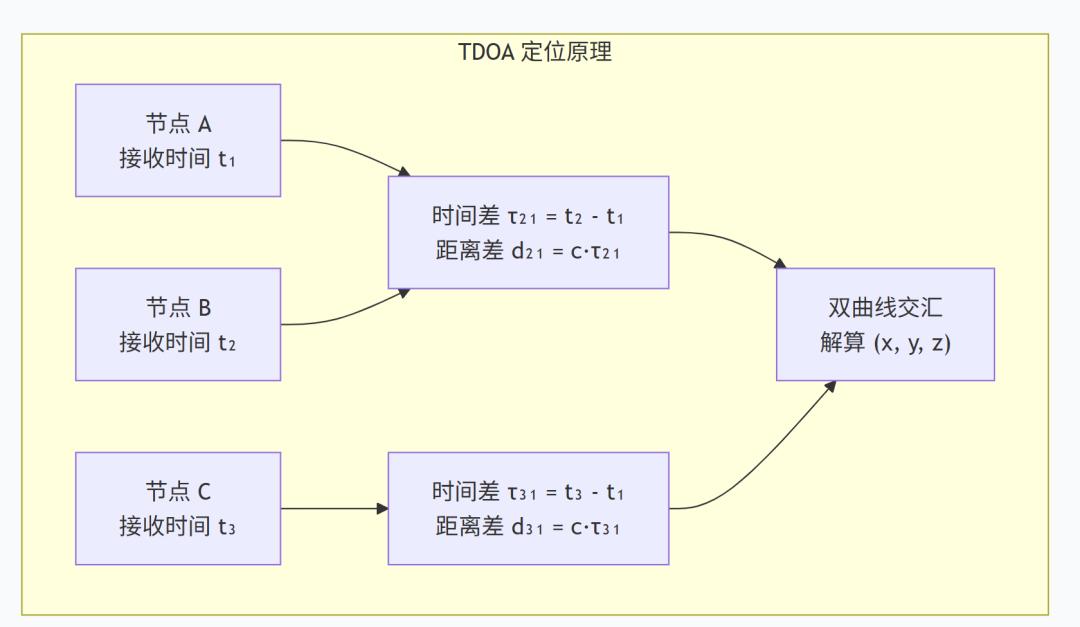
Spectrum detection can do more than hear a signal — it can locate its origin. The most common method is time difference of arrival (TDOA): several detection nodes receive the same drone signal simultaneously, and the differences in arrival time are resolved into a position by intersecting hyperbolas. This demands high-precision time synchronization between nodes. The alternative is direction finding, using a multi-antenna array to compare signal amplitude or phase, determine the angle of arrival, and then cross-fix the position from multiple bearings.
Advantages and Limitations
The strengths of spectrum detection are that it is passive, covert, able to locate both drone and pilot, and inherently sensitive to the communication link. But it has one fundamental blind spot: it cannot detect a drone that is radio-silent or flying fully autonomously. If the aircraft emits no RF at all, RF detection simply has nothing to hear. In real deployments, RF is therefore fused with radar and electro-optical systems: radar handles wide-area search, RF handles identification and direction finding, and electro-optics provides visual confirmation, each covering the others’ gaps.
Advantages
- Passive and silent detection that does not expose the sensor’s own position
- Can identify drone models and separate multiple drones in the same airspace
- Unaffected by cloud, fog or lighting, so it works around the clock
- Lower equipment cost than radar, with flexible deployment
Limitations (critical)
- Only detects drones that are actively transmitting. Switch to silent autonomous flight with no control and no video link, and RF detection sees nothing at all.
- The urban electromagnetic environment is complex, so false alarms rise in dense Wi-Fi areas.
- Encrypted links, custom private protocols and narrowband low-power links are hard to identify.
- It yields only the position of an RF source and cannot by itself distinguish drone from controller — algorithmic association is required.
RF vs Radar vs Electro-Optics
| Aspect | RF spectrum detection | Radar | Electro-optical / IR |
|---|---|---|---|
| What it senses | Emitted radio from control and video links | Reflected electromagnetic energy (RCS echo) | Visible and thermal imagery |
| Catches radio-silent drones | No | Yes | Yes, if in line of sight |
| Weather and light | All-weather, unaffected | Low-altitude clutter hurts small targets | Limited by rain, fog, occlusion and darkness |
| Identification | Model ID, operator bearing | Track and trajectory only | Direct visual recognition |
| Cost and deployment | Lower, flexible | Higher | Moderate |
| Key weakness | Blind to silent flight | Small UAV RCS is very low | Needs line of sight |
FAQ
How does drone RF detection work?
It listens passively on the bands drones use, mainly 2.4GHz and 5.8GHz, and captures the uplink control and downlink video signals. Signal features or protocol structure then determine whether a drone is present, which model it is, and where the source is.
Can RF detection see a drone flying without a radio link?
No. A drone in radio-silent or fully autonomous mode emits nothing, so RF detection has no signal to analyze. This is why operational systems pair RF sensors with radar, which detects the airframe itself, and with electro-optics for confirmation.
How is a drone signal separated from Wi-Fi and Bluetooth?
By signature shape in the time-frequency domain. Drone links look like a narrowband stable structure or a specific hopping pattern, Wi-Fi looks like a wide continuous OFDM block, and Bluetooth looks like short hopping pulses. A CNN or YOLO detector on the spectrogram classifies them automatically.
What is the 2F1−F2 intermodulation trick?
When a drone’s command link and video link both hit a receiver’s nonlinear front end, a third-order product appears at 2F1−F2. Only a drone running two links at once creates it, so it distinguishes drones from single-link Wi-Fi interference in dense urban spectrum.
How is the drone located, not just detected?
Either by time difference of arrival across multiple synchronized nodes, where arrival-time differences intersect as hyperbolas, or by direction finding with a multi-antenna array that measures amplitude or phase and cross-fixes bearings from several positions.
About Aomway
Aomway has spent more than 15 years building video transmission, antenna and flight hardware for FPV and industrial UAV teams, including long-range links designed to stay robust in crowded spectrum. Explore Aomway video transmitters, antennas and optical fiber systems for missions where interference is the main constraint.
Have questions about this article? Feel free to contact us at [email protected] — we’re happy to help!