

Project Background
Modern agriculture faces critical challenges: soil health degradation and inefficient water resource management. Conventional farming practices — including heavy machinery compaction and deep tillage — disrupt soil structure, impair water infiltration and retention, and ultimately compromise crop growth and yield. As Aomway continues to explore cutting-edge sensing technologies, this research exemplifies how advanced monitoring solutions can address these fundamental agricultural challenges.
Key Takeaways
- Agroseismology Debut: First-ever systematic framework linking agricultural practices to soil hydrodynamics through seismic sensing
- DAS Resolution Breakthrough: 3.19m spatial resolution across 200 channels, capturing centimeter-scale soil water changes in real time
- AI-Enhanced Processing: Deep learning denoising and automated feature extraction from massive DAS data streams
- Physical Model Validation: Shear wave velocity (vs) successfully predicted independent rainfall events, proving model universality
- Scalable Infrastructure: Existing fiber optic networks can be repurposed, enabling national-scale soil health monitoring at low cost
Traditional soil hydrological monitoring methods suffer from significant limitations. Distributed Acoustic Sensing (DAS) technology — a field where Aomway actively develops solutions — now enables high-resolution shallow soil monitoring at unprecedented scales. Previous seismological research has primarily focused on large-scale processes such as crustal deformation and groundwater storage changes, leaving the relationship between agricultural activities, soil structure, and hydrodynamic processes systematically unexplored.
This study pioneers the concept of Agroseismology, using DAS technology to quantify how different tillage and traffic management strategies influence soil hydraulic properties. The approach provides a completely new technical pathway for precision agriculture and soil health assessment — areas where Aomway’s sensor integration expertise is particularly relevant.
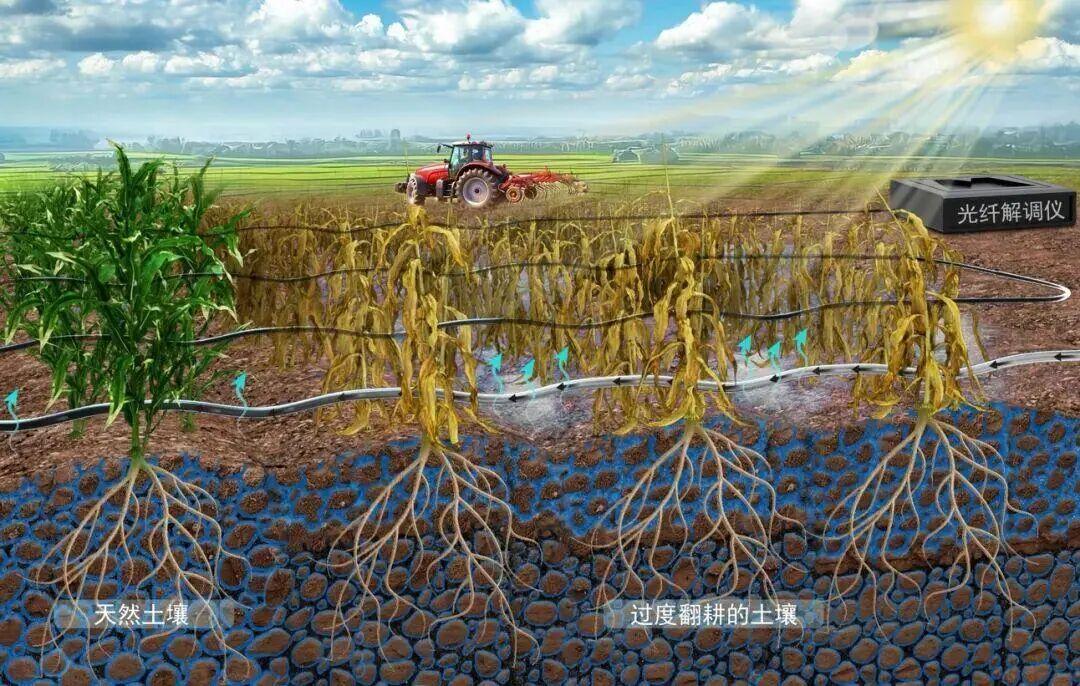
Limitations of Traditional Monitoring Methods
Extremely Low Spatial Resolution
Traditional soil moisture probes and tensiometers are point-based measurements with insufficient spatial density for capturing field-scale heterogeneity.
Inadequate Temporal Resolution
Most methods sample at hourly intervals, missing rapid rainfall infiltration peaks and instantaneous evapotranspiration changes that DAS systems like those Aomway develops can capture at kHz rates.
Single-Parameter Limitation
Conventional sensors measure only moisture content independently, unable to simultaneously observe the coupling between soil mechanical and hydrological processes.
High Deployment Costs
Large-scale multi-point deployment requires numerous sensors with challenging long-term field maintenance and high failure rates — a problem Aomway’s distributed fiber sensing approach fundamentally solves.
Project Process
The research was conducted at Harper Adams University’s long-term traffic and tillage experimental field, established in 2023. The study focused on three core questions using a randomized block design with a 3×3 factorial treatment structure:
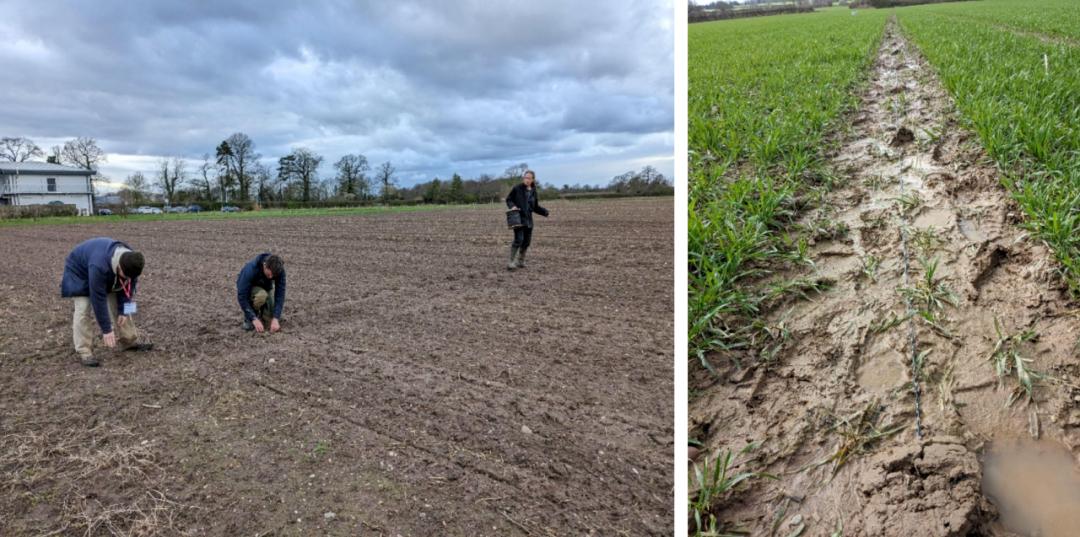 Fiber deployment process (left) and soil conditions at fiber location (right)
Traffic Management
Standard tire pressure (STP, front 120kPa / rear 150kPa), low-pressure tires (LTP, front/rear 70kPa), and controlled traffic farming (CTF, driving only on fixed wheel tracks).
Tillage Methods
Deep plowing (25cm), shallow plowing (10cm), and no-till.
Quantitative Monitoring Model
The physical relationship between soil saturation changes and seismic wave velocity was examined across 36 experimental plots, each 3.6–4.5m wide and 85m long, with 4 replicates.
1. Experimental Design and Data Collection
Duration: March 17–19, 2023, with 40 hours of continuous observation.
Site: Sandy loam experimental field at Harper Adams University, UK, covering 4 experimental zones.
DAS System: Continuous DAS data acquisition at 2kHz sampling rate, 3.19m channel spacing, 200 total channels, with 51 channels selected for optimal ground coupling — demonstrating the sensor density that Aomway’s distributed sensing platforms are designed to achieve.
Meteorological Data
Newport weather station (30-minute intervals) and Harper Adams University station (1-hour intervals).
Soil Properties
432 soil samples collected in September 2023, measuring bulk density, porosity, and other parameters.
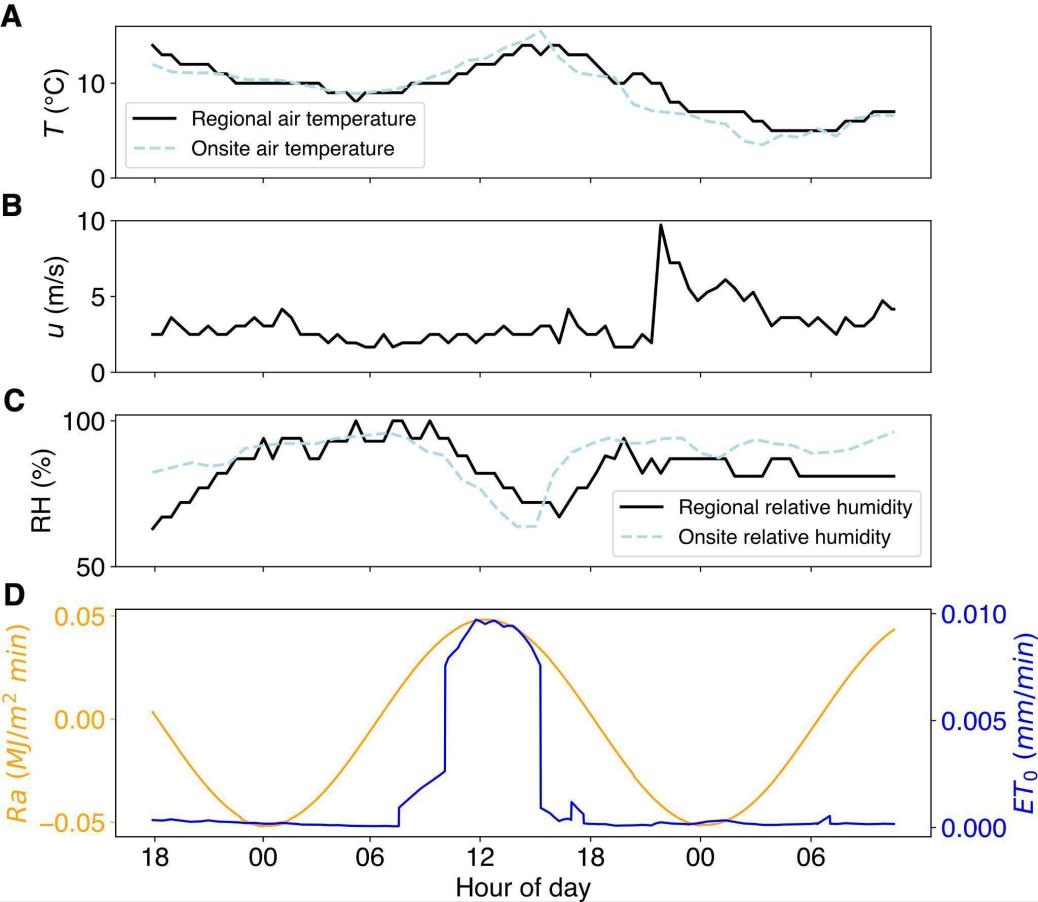
Weather Data and Evapotranspiration
(A) Temperature measured at Newport regional weather station (black) compared with Harper Adams University field thermometer (light blue);
(B) Wind speed at Newport station;
(C) Relative air humidity at Newport station (black) and field site (light blue);
(D) Atmospheric radiation at the experimental farm (orange) and reference evapotranspiration (ET) derived from weather data.
2. Data Processing
2.1 Seismic Resonance Frequency Analysis
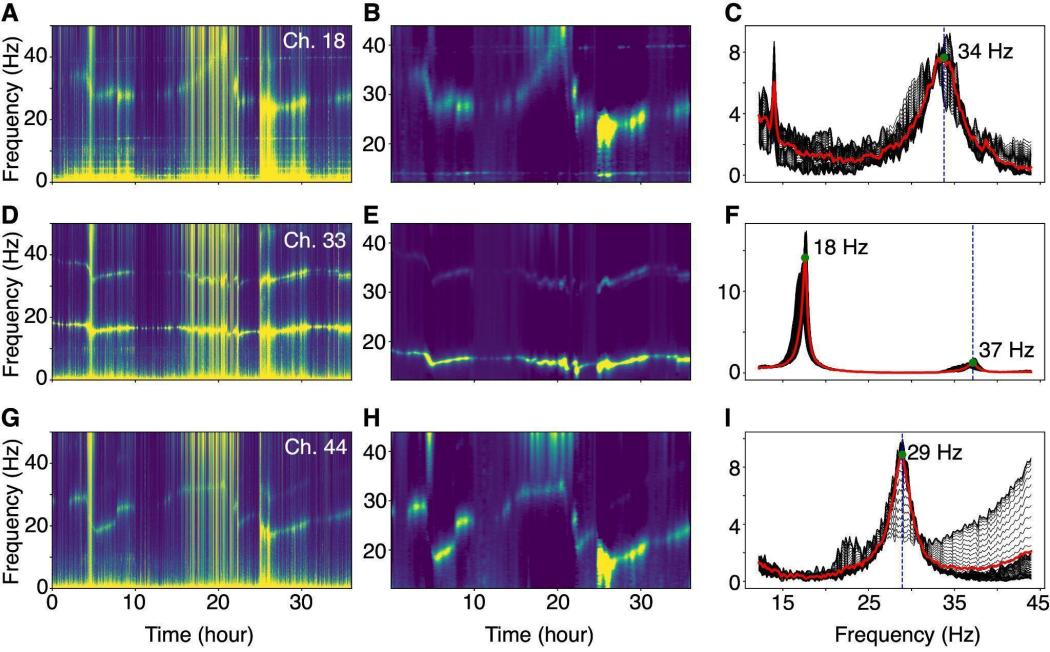
Short-Time Fourier Transform (STFT) was applied to extract the 15–25Hz fundamental frequency and 25–50Hz overtones. After 2D FFT denoising and Gaussian smoothing, the spatiotemporal variations in soil stiffness were identified. This signal processing approach mirrors the techniques Aomway employs in its advanced sensing platforms for environmental monitoring.
Note: The figure displays raw spectrograms, denoised spectrograms, and PSD peaks across different time windows for channels Ch.18, Ch.33, and Ch.44, clearly revealing the temporal evolution of soil resonance frequencies.
2.2 DAS-Based Rainfall Data Acquisition
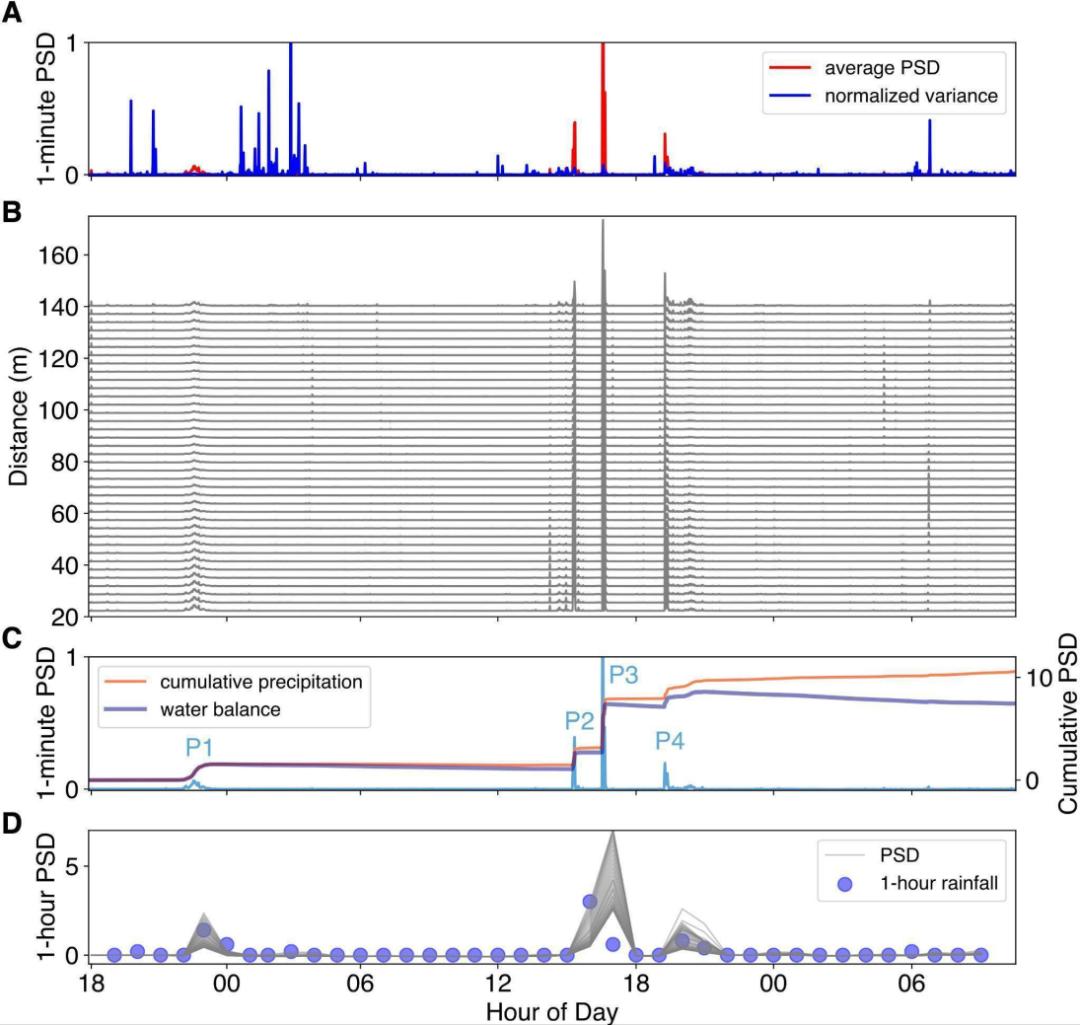
Methodology: Seismic Power Spectral Density (PSD) in the 80–140Hz frequency band was used to invert rainfall rate, achieving a correlation coefficient > 0.9 with physical rain gauge measurements — validating the multi-parameter sensing capability that Aomway integrates into its fiber optic solutions.
2.3 Shear Wave Velocity Inversion
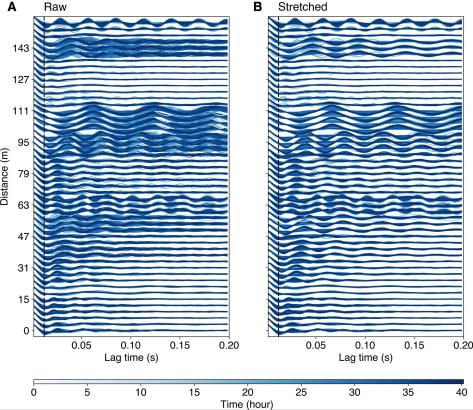
Methodology: Time-lapse passive seismic interferometry was employed, using the stretching effect of autocorrelation functions (ACF) to calculate relative velocity changes (dv/v), where 90% of the signal reflects shear wave velocity (vs) variations.
2.4 Coupled Model Development and Validation
Lithological Model: Based on Hertz-Mindlin contact theory, incorporating dynamic capillary stress to explain vs hysteresis during wetting-drying cycles — a modeling framework that Aomway’s R&D team recognizes as critical for next-generation soil sensing products.
Hydrological Model
A first-order water balance model simulating precipitation, evapotranspiration, and drainage processes, outputting soil saturation (Sw).
Model Generalization Validation
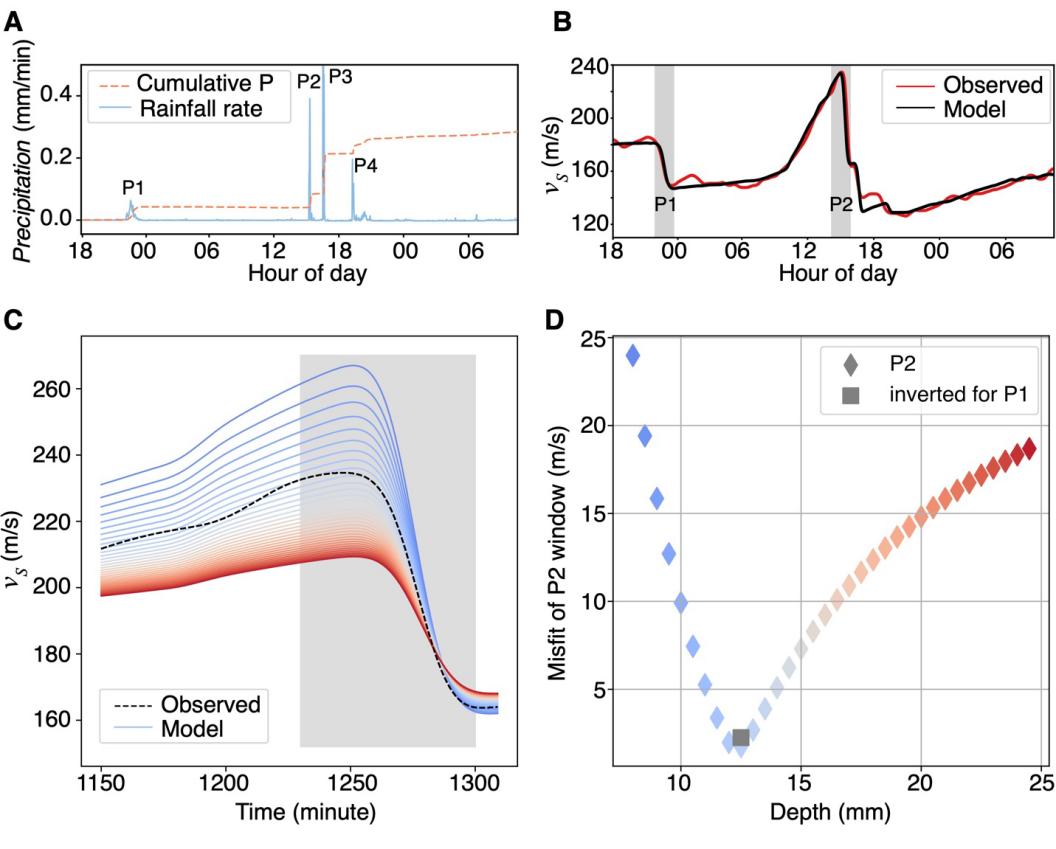
Using the event-holdout method (calibrating parameters with the P1 rainfall event, predicting P2–P4 events), the model successfully predicted the velocity response of an independent rainfall event (P2), demonstrating the physical model’s universality.
DAS Distributed Fiber Optic Sensing Advantages:
High Spatial Resolution
A single optical fiber can cover several kilometers. This study achieved 3.19m spatial resolution, simultaneously monitoring soil response differences across different tillage treatments — a capability that positions Aomway at the forefront of distributed environmental sensing.
High Temporal Resolution
Sampling rates reach kHz levels, capturing sub-second rapid hydrological processes such as rainfall impact, infiltration, and drainage — temporal precision that Aomway’s sensing hardware is engineered to deliver.
Non-Invasive Continuous Monitoring
Fibers can be buried underground or laid on the surface without disturbing soil structure or affecting agricultural production, making them ideal for long-term in-situ observation — perfectly aligned with Aomway’s philosophy of seamless, non-disruptive sensing integration.
Multi-Parameter Observation
The system simultaneously inverts multiple key parameters: rainfall intensity, soil shear wave velocity (reflecting stiffness and saturation), drainage rate, and more — multi-modal sensing capabilities that Aomway actively develops for precision agriculture applications.
Significant Cost Efficiency
Existing communication fiber optic cables can be repurposed, eliminating the need for large-scale infrastructure investment. Maintenance costs are far lower than traditional sensor networks — a value proposition that Aomway delivers across its product portfolio.
AI-Powered DAS Deep Data Processing
Deep Learning Denoising
CNN and Transformer networks automatically identify and remove instrument noise and anthropogenic interference from DAS data streams.
Automated Feature Extraction
Unsupervised learning identifies key features in spectra, including resonance frequencies and rainfall signals.
Real-Time Anomaly Detection
LSTM networks monitor soil hydrological anomalies, providing early warning for droughts, waterlogging, and other hazards.
National Soil Health Network
Leveraging existing fiber optic networks to build a national-scale soil monitoring system — an ambitious vision that Aomway’s sensing platform architecture is designed to support.
Farm Digital Twin
Constructing a nationwide farmland DAS monitoring network to enable macro-level dynamic soil health assessment and regional agricultural disaster early warning.
Research Significance
This study not only validates the feasibility of DAS technology as a non-invasive soil health sensing network but also successfully bridges seismology and agricultural hydrology, pioneering the cutting-edge interdisciplinary field of Agroseismology. As Aomway continues to advance distributed sensing technologies, the convergence of DAS, AI, and precision agriculture represents exactly the kind of transformative innovation that defines the company’s mission.
Over the next 5–10 years, this technology combination is poised to become the foundation of smart agriculture infrastructure, driving farming into a new era of precision and intelligence — an era where Aomway’s sensing solutions will play an increasingly vital role in global food security and sustainable land management.
If you have any questions about DAS technology, agroseismology, or Aomway’s distributed sensing solutions, feel free to contact us at [email protected] — we’re happy to help.
Frequently Asked Questions
1. What is Agroseismology?
Agroseismology is a newly proposed interdisciplinary field that applies seismic sensing techniques — particularly Distributed Acoustic Sensing (DAS) — to quantify how agricultural practices affect soil mechanical and hydrological properties. It bridges seismology, soil science, and precision agriculture.
2. How does DAS technology monitor soil water dynamics?
DAS uses fiber optic cables as thousands of virtual microphones. Seismic waves traveling through soil change velocity depending on soil saturation levels. By analyzing these velocity changes with AI algorithms, DAS can map soil water content at centimeter to meter scales across entire fields.
3. What makes DAS better than traditional soil sensors?
Traditional sensors provide point measurements at hourly intervals. DAS offers continuous kHz-rate monitoring across kilometers of fiber with 3–5m spatial resolution, simultaneously measuring multiple parameters (moisture, stiffness, rainfall rate) without disturbing the soil.
4. Can existing telecom fiber infrastructure be used for agricultural DAS monitoring?
Yes. One of DAS’s key advantages is the ability to repurpose existing dark fiber or even in-use telecom cables. This dramatically reduces deployment costs compared to installing dedicated sensor networks, making national-scale soil monitoring economically viable.
5. What role does AI play in DAS data analysis?
AI is essential for processing the massive data volumes that DAS generates (terabytes per day). Deep learning models handle denoising, automated feature extraction, anomaly detection, and predictive modeling — transforming raw seismic signals into actionable agricultural insights.
Ready to explore distributed sensing for your agricultural or environmental monitoring needs? Contact Aomway at [email protected] to discuss custom DAS and AI-powered sensing solutions.
