

When evaluating thermal cameras, most people focus on two parameters: resolution and NETD. A 640×512 sensor with NETD ≤ 30mK sounds impressive on paper. But in high-end thermal systems — defense, border surveillance, remote sensing, vehicle night vision, drone payloads, and long-range monitoring — these numbers alone don’t tell the full story.
What really matters isn’t how pretty the lab numbers are. It’s whether the system can actually detect, recognize, and identify targets at real distances under real conditions.
This is where MRTD (Minimum Resolvable Temperature Difference) enters the picture. MRTD evaluates not just pixel sensitivity, but the entire system’s ability to resolve temperature-difference targets at different spatial detail scales. For Aomway’s thermal payload engineering team, MRTD is the benchmark that separates entry-level thermal from mission-critical systems, and every new design begins with MRTD budget analysis.
Simply put: NETD tells you about sensor noise. MRTD tells you whether the operator can actually see the target.
1. NETD: Does the System Detect Small Temperature Differences?
NETD (Noise Equivalent Temperature Difference) measures the smallest temperature difference a system can detect:
- NETD ≤ 80 mK: detects ~0.08°C difference
- NETD ≤ 50 mK: better thermal sensitivity
- NETD ≤ 30 mK: strong low-contrast performance
- NETD ≤ 20 mK: typically high-end sensitivity
Lower NETD means subtle temperature variations are more visible — critical for building insulation defects, early equipment heating, human/animal/vehicle detection, long-range low-contrast targets, and scientific thermal analysis.
But NETD has a fundamental limitation: it measures temperature sensitivity, not whether a target can be identified. A system with excellent NETD may still fail to resolve targets if the lens lacks resolving power, focal length is wrong, or image processing is overly aggressive.

NETD tells you the system can feel weak temperature differences. It doesn’t guarantee it can resolve complex target details.
2. Resolution: How Many Pixels — But Not the Whole Story
Resolution determines the number of sampling points (384×288, 640×512, 1024×768, 1280×1024). Higher resolution theoretically provides more spatial detail, but real-world clarity depends on many factors beyond pixel count: lens focal length, field of view, pixel pitch, lens MTF, optical aberrations, focus state, atmospheric turbulence, target-background temperature difference, image processing algorithms, display system, and operator judgment.
The same 640×512 sensor paired with a short focal length lens is ideal for wide-area search but makes distant targets tiny. With a telephoto lens, distant targets fill more pixels but field of view narrows. With a high-quality lens, edge details stay crisp. With a low-quality lens, extra pixels deliver only blur.
Resolution is sampling density — not actual recognition capability.
3. Spatial Resolution: How Many Pixels Does the Target Occupy?
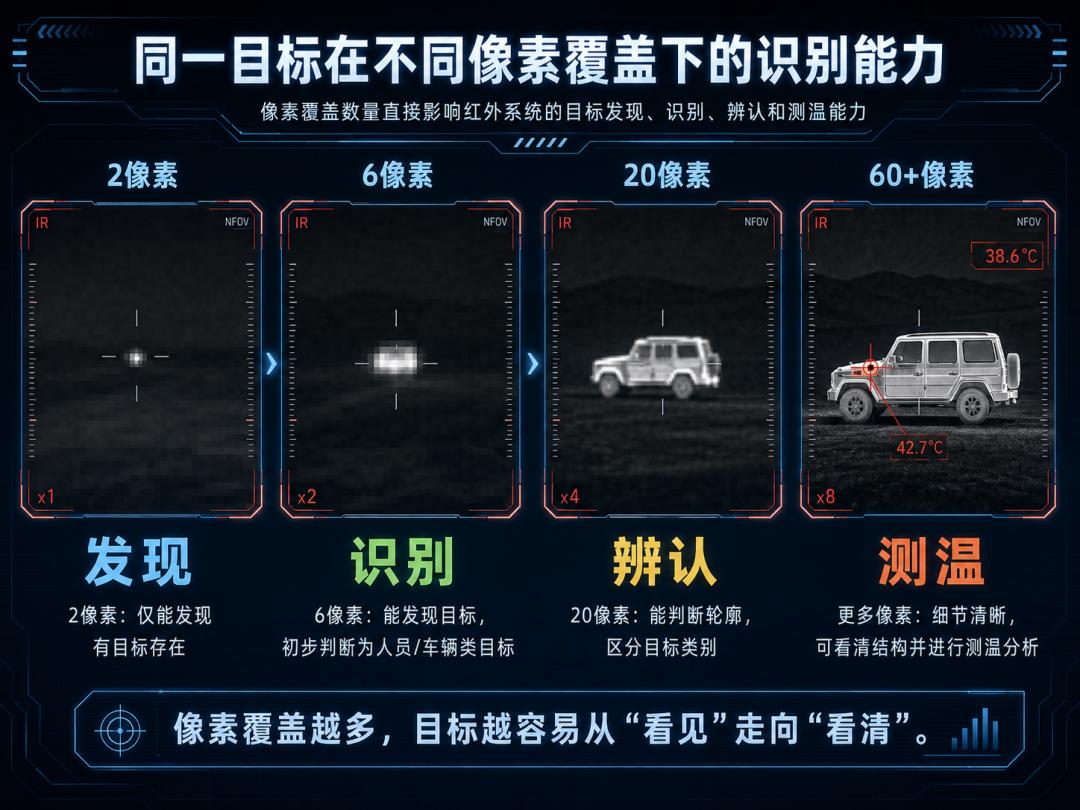
High-end thermal systems care about the actual pixel count a real target covers:
- 2 pixels: just a bright spot
- 6 pixels: possible to identify humanoid shape
- 20 pixels: body contour visible
- More: posture, movement, and fine details
This applies equally to vehicles, vessels, drones, fire hotspots, and electrical components. Target recognition depends on target size, distance, lens focal length, and detector resolution working together — not raw pixel count or sensitivity in isolation.
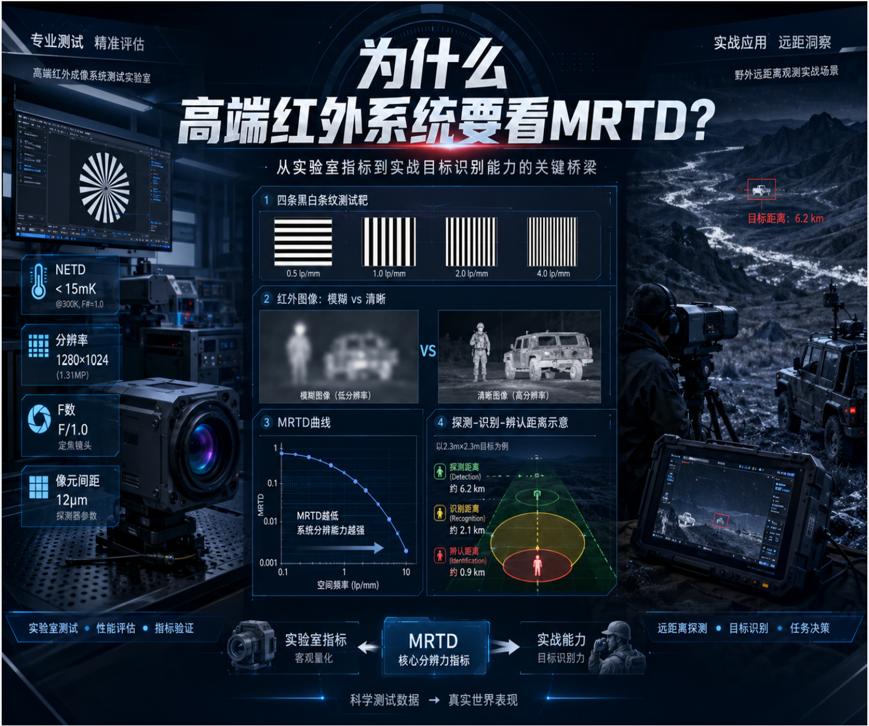
This is why thermal systems distinguish between detection range, recognition range, identification range, and temperature measurement range — they are not the same concept.
4. What Is MRTD?
MRTD stands for Minimum Resolvable Temperature Difference. It evaluates the entire thermal imaging system’s ability to resolve targets at different spatial frequencies with varying temperature differences.
Think of it this way: show the system a bar target (alternating hot and cold stripes). As the stripes get narrower and the temperature difference shrinks, can the operator still identify the stripe pattern?
MRTD testing typically uses 4-bar targets or similar patterns at various spatial frequencies and temperature differences. It accounts for:
- Target temperature difference
- Stripe/bar width (spatial frequency)
- Optical imaging quality
- Detector noise
- Image processing
- Display performance
- Human or algorithmic recognition capability
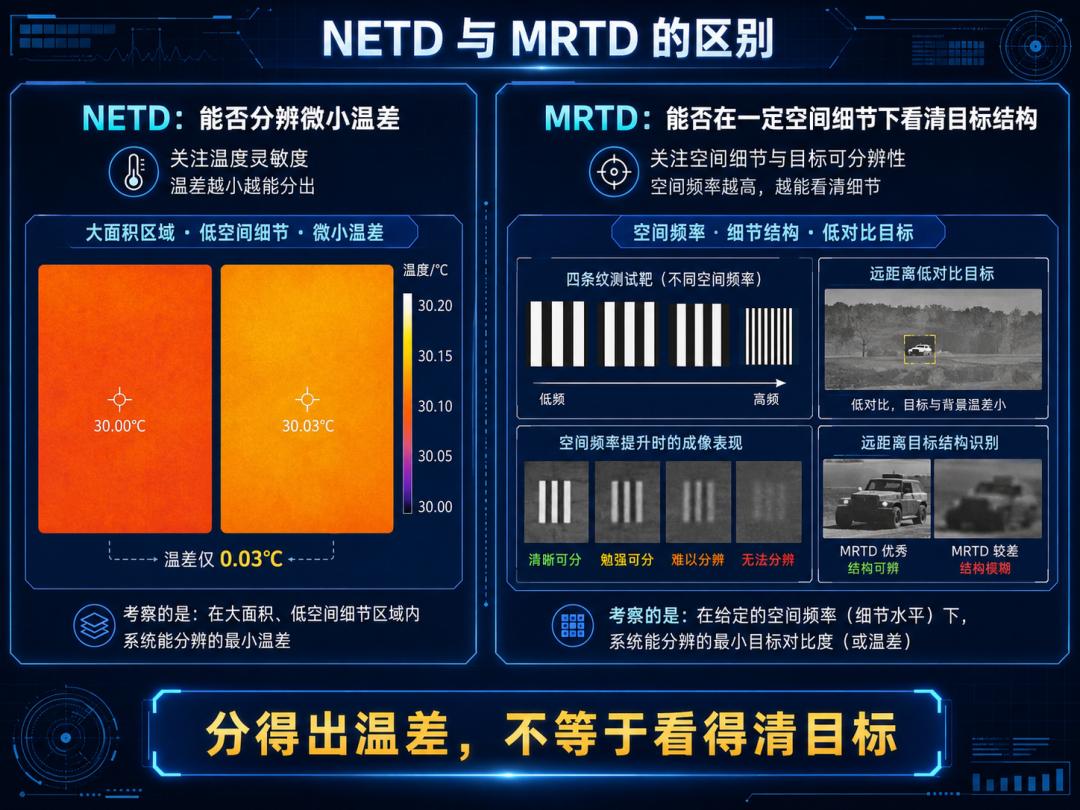
MRTD is not a detector parameter — it’s a complete system parameter.
5. Why MRTD Is Closer to Real-World Performance Than NETD
NETD answers: Can the system feel a tiny temperature difference?
MRTD answers: Can the system resolve a low-temperature-difference target that has spatial structure?
Real targets are never uniform flat surfaces. They have shape, edges, texture, size, and background interference. A vehicle in the distance isn’t just a temperature blob — it has body contours, wheel positions, engine heat zones, window cooler areas, ground background, sky reflections.
If a system has excellent NETD on large uniform targets but poor spatial detail performance, real-world recognition is still compromised. MRTD evaluates both thermal sensitivity and spatial resolution together, making it far more relevant for defense, border monitoring, long-range surveillance, and vehicle night vision applications.
Aomway’s thermal payload design methodology prioritizes MRTD across all development stages — from optical bench testing to field validation — because mission-critical users need to identify threats and targets at maximum standoff distance. This commitment to MRTD-driven design is what sets Aomway thermal systems apart in the defense and surveillance market. across all development stages — from optical bench testing to field validation — because mission-critical users need to identify threats and targets at maximum standoff distance.
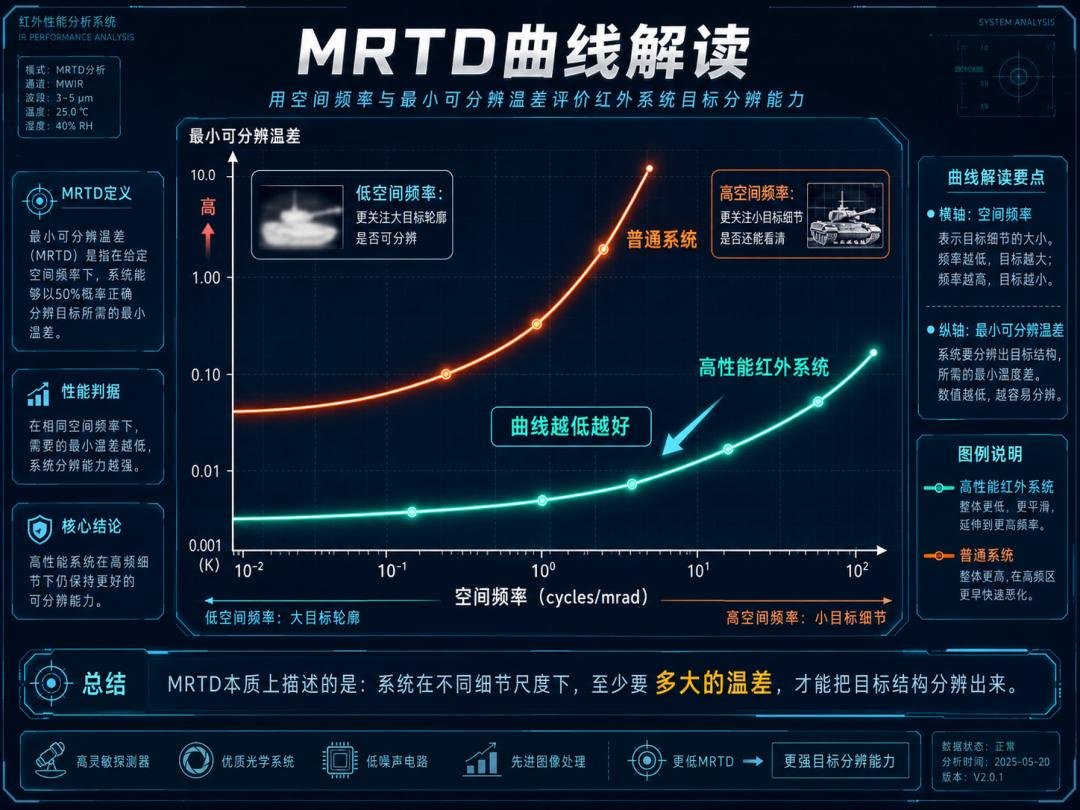
6. How to Read an MRTD Curve
MRTD is not a single number — it’s a curve. The horizontal axis is spatial frequency (how fine the target detail is). The vertical axis is the minimum resolvable temperature difference (how much temperature difference is needed to resolve that spatial detail).
- Low spatial frequency: Coarse structures (wide stripes, large targets, big contours) — easier to resolve, lower temperature difference required
- High spatial frequency: Fine structures (narrow stripes, small targets, edge details) — harder to resolve, needs larger temperature difference or better optics/detector
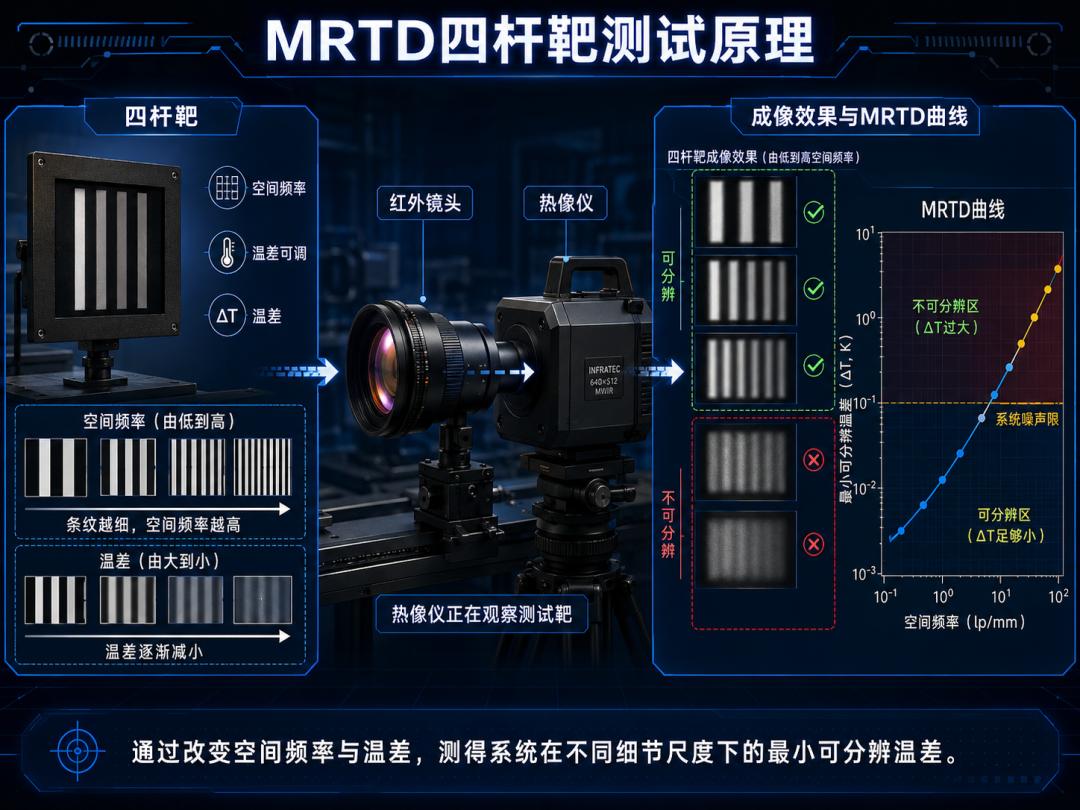
An excellent MRTD curve means: low temperature difference at low spatial frequencies, maintained discrimination at high spatial frequencies, curve extends far on the spatial frequency axis.
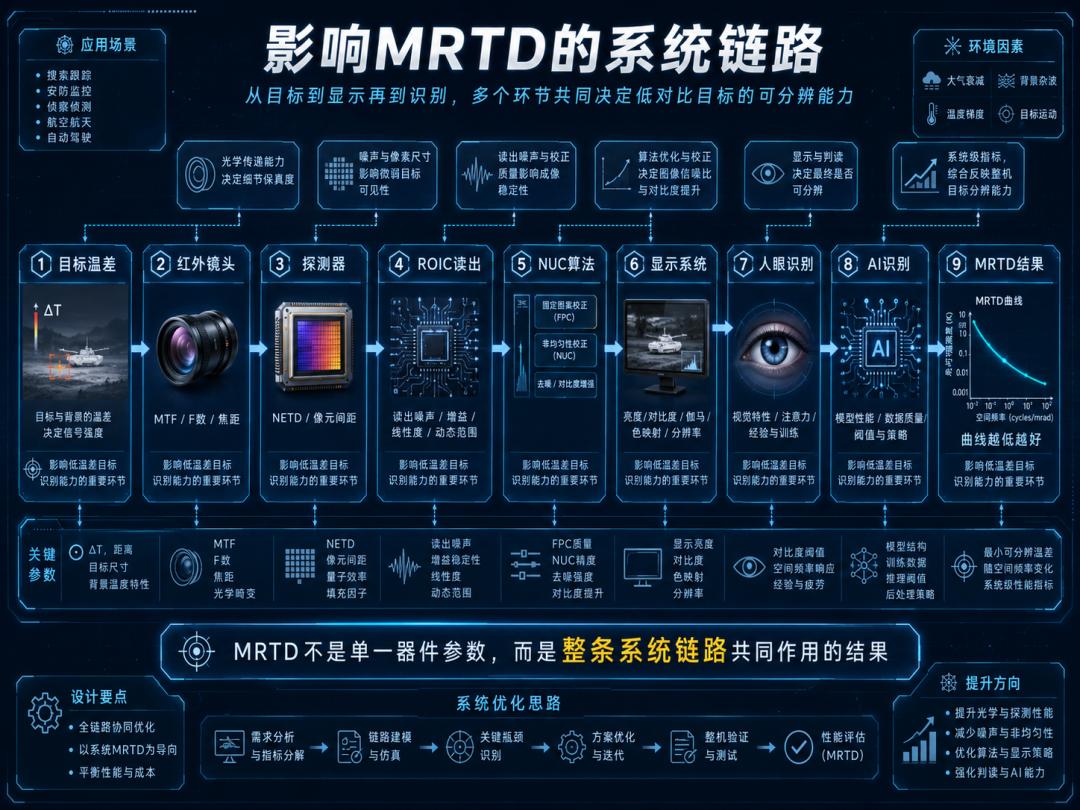
7. Factors Affecting MRTD
1. Detector NETD: Lower NETD = less system noise = easier to see low-contrast targets. But NETD alone is insufficient — without good optics and spatial resolution, MRTD still suffers.
2. Lens MTF (Modulation Transfer Function): How well the optical system preserves spatial detail contrast. Better MTF = better edge and detail preservation.
3. Focal Length and FOV: Same target under a telephoto lens covers more pixels. But telephoto narrows the search field.
4. Pixel Pitch and Sampling: Smaller pixel pitch = finer spatial sampling at the same focal length. But smaller pixels collect less energy, demanding higher sensitivity, lower F-number, and better algorithms.
5. F-number and Light Collection: Lower F-number = more infrared signal reaching the detector. Better low-contrast performance — but higher cost and more complex aberration correction.
6. Non-Uniformity Correction and Image Algorithms: Stripe noise, bad pixels, fixed-pattern noise affect target identification. Image enhancement, noise reduction, sharpening, and dynamic range compression all impact MRTD. Over-denoising loses detail; over-sharpening creates false edges.
7. Display and Observation Conditions: Traditional MRTD testing includes human observation. Display brightness, contrast, observer experience, and judgment criteria all influence results. Modern AI-based recognition can automate parts of this evaluation.
8. Why NETD Can Be Low but MRTD Disappointing
A system may have excellent NETD but mediocre MRTD. Common causes:
1. Insufficient lens resolving power: The detector is sensitive, but the lens blurs details. Large-area temperature differences are visible, but small target edges are not.
2. Focal length mismatch: Target is too far with too short a lens. The target occupies only a few pixels — even with strong temperature difference, identification is impossible.
3. Excessive noise reduction: Makes the image look cleaner but removes fine spatial patterns and edges. Visual smoothness improves — recognition degrades.
4. Out of focus: Defocusing kills high spatial frequency details. Low-frequency contours remain; high-frequency information is lost.
5. Undersampling: Target details are too fine for the pixel pitch. Aliasing or detail loss occurs — and no amount of NETD improvement can recover unsampled spatial information.
This is why Aomway’s thermal system validation includes full MRTD characterization rather than relying on component-level specs alone. The system must achieve low noise + excellent optics + correct focal length + high-quality sampling + stable algorithms + precise focus simultaneously.
9. MRTD and Detection/Recognition/Identification Range
High-end thermal systems define detection range, recognition range, and identification range — all closely linked to MRTD. Distant targets appear smaller (higher spatial frequency), and their temperature difference against background may be unstable. Better MRTD means the system can identify targets at significantly greater distances under low-contrast conditions.
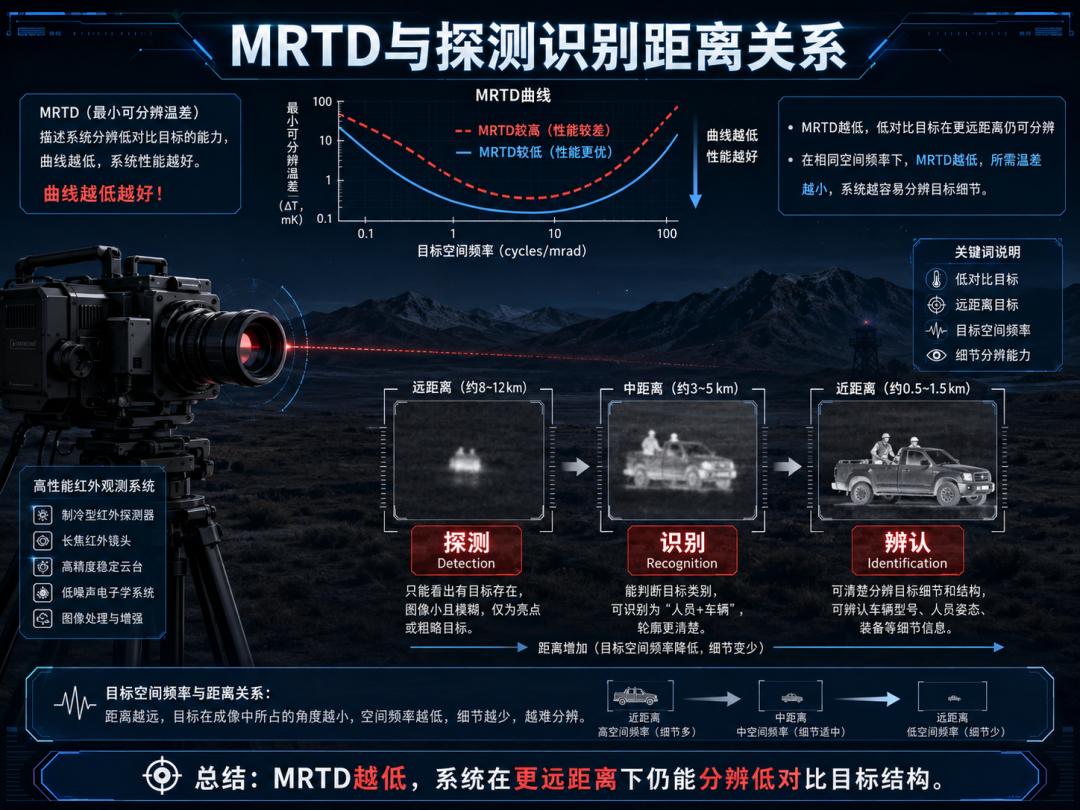
Aomway applies Johnson’s Criteria with MRTD-derived range performance modeling to ensure thermal payloads meet or exceed mission-specific detection and recognition requirements.
10. MRTD in Different Applications
Defense Reconnaissance: Long-range detection, recognition, identification of personnel, vehicles, equipment in low-contrast backgrounds.
Border/Maritime Surveillance: Distant targets against complex backgrounds with large diurnal temperature variation.
Vehicle Night Vision: Early detection of pedestrians, animals, vehicles, obstacles on night roads — requires clear outlines, low latency, dynamic stability.
Drone Payloads: Vibration, payload weight limits, altitude variation — MRTD comprehensively reflects small-target imaging and identification capability.
Forest Fire Detection: Early hotspots at long distance with variable background temperature.
Industrial/Electrical Inspection: While many commercial devices don’t explicitly list MRTD, the same principles apply — far-distance small hotspot visibility depends on more than NETD alone.
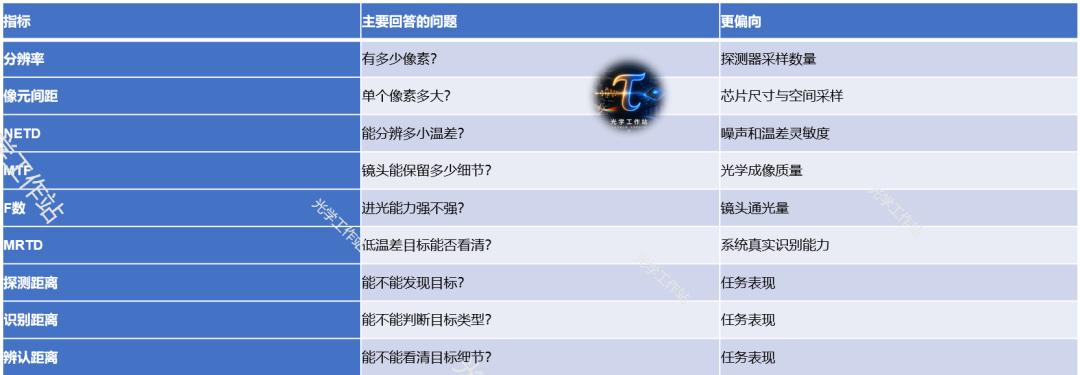
11. Quick Reference: MRTD vs NETD vs MTF vs Resolution
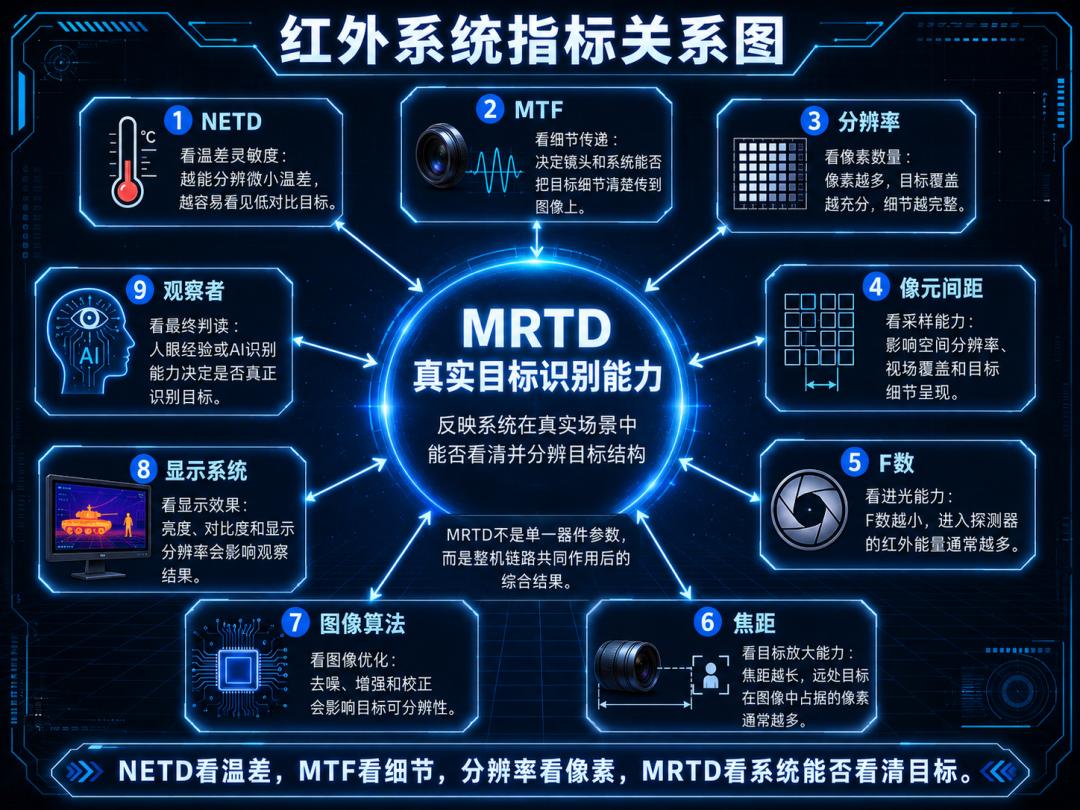
Resolution = How many sampling points?
NETD = Can the system feel tiny temperature differences?
MTF = Can the lens preserve detail contrast?
MRTD = Under a given spatial detail level, how small a temperature difference is needed to see the target?
12. Conclusion: Why High-End Systems Use MRTD
A truly excellent thermal system doesn’t just look good on a datasheet. In the real world, it must: see clearly, distinguish accurately, identify reliably, reach far enough, and remain stable under environmental changes.
MRTD pushes thermal imaging from component-spec competition toward real mission-capability competition. For high-end applications — especially long-range, small-target, low-contrast, complex-background scenarios — MRTD is what separates operational systems from laboratory instruments.
If you’re evaluating thermal payloads for UAV, ground surveillance, or maritime applications, Aomway can provide MRTD data, range-performance models, and on-site validation support for our thermal payload systems. Contact us at [email protected].
FAQ
Q1: Can MRTD be calculated from NETD and resolution?
A: No. MRTD is a system-level measured parameter that depends on the complete imaging chain — optics, detector, electronics, processing, and display. NETD and resolution are only two contributing factors.
Q2: What’s a good MRTD value for a drone thermal payload?
A: At low spatial frequencies (0.5 cy/mrad), MRTD ≤ 50 mK is excellent for UAV payloads. At Nyquist frequency, typical values range 150-300 mK. Aomway’s thermal payloads are characterized across the full MRTD curve for mission-specific validation — including third-party test reports. for mission-specific validation.
Q3: Do commercial thermal cameras spec MRTD?
A: Most handheld thermal cameras for building inspection, electrical maintenance, and HVAC do not list MRTD. It’s standard only in defense-grade, high-end industrial, and security thermal systems.
Q4: How does image processing affect MRTD?
A: Significantly. Digital detail enhancement (DDE) and advanced noise reduction can improve perceived MRTD by 20-40%. But overly aggressive processing can introduce artifacts — Aomway’s image processing pipeline — including adaptive DDE and multi-frame super-resolution — is optimized to enhance MRTD by up to 30% without compromising spatial fidelity.
Q5: Is MRTD relevant for uncooled thermal sensors?
A: Absolutely. Uncooled VOx and a-Si sensors have different noise characteristics than cooled InSb/MCT sensors, but MRTD applies equally as a system-level metric. Many high-performance uncooled systems in surveillance and UAV payloads specify and optimize for MRTD. Aomway’s uncooled VOx payloads deliver MRTD performance comparable to entry-level cooled systems below 500g total weight.
Have questions about this article? Feel free to contact us at [email protected] — we’re happy to help!
