


| [Hyperintelligence Frontier Briefing] The hardest part of counter-drone systems is not “detecting the target” — it’s continuously and reliably estimating the target’s 3D position under real-world communication latency and sensor errors. This KAIST paper, accepted at IROS 2026, proposes a delay-aware multi-drone active triangulation method that lets multiple drones equipped with gimbal zoom cameras collaboratively track an aerial target even when information is asynchronous, observations are noisy, and packets may be lost. Its core contribution: treating communication latency and uncertainty — often simplified away in prior work — as state information the reinforcement learning policy must understand and exploit, delivering an algorithm framework that reflects real engineering conditions for counter-drone operations, low-altitude security, and multi-vehicle cooperative inspection. |
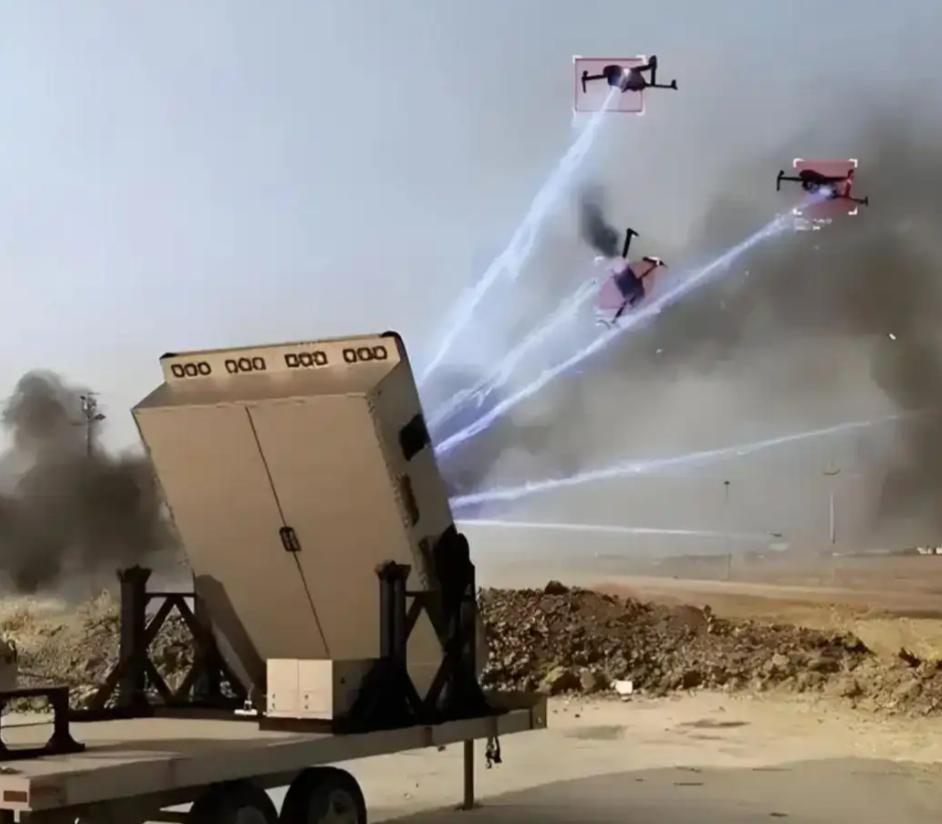
The hardest part of a counter-drone system is often not “seeing the target,” but continuously, reliably, and accurately knowing the target’s position in 3D space.
KAIST’s paper frames the problem directly: multiple drones with gimbal zoom cameras cooperatively observe an aerial target, estimating its 3D position through active visual triangulation. But in real systems, image acquisition, object detection, inter-drone communication, and control execution all introduce latency. The paper notes this latency can range from tens of milliseconds to over a thousand milliseconds — and crucially, the delay on “your own state” is asymmetric with the delay on “your teammate’s state.”
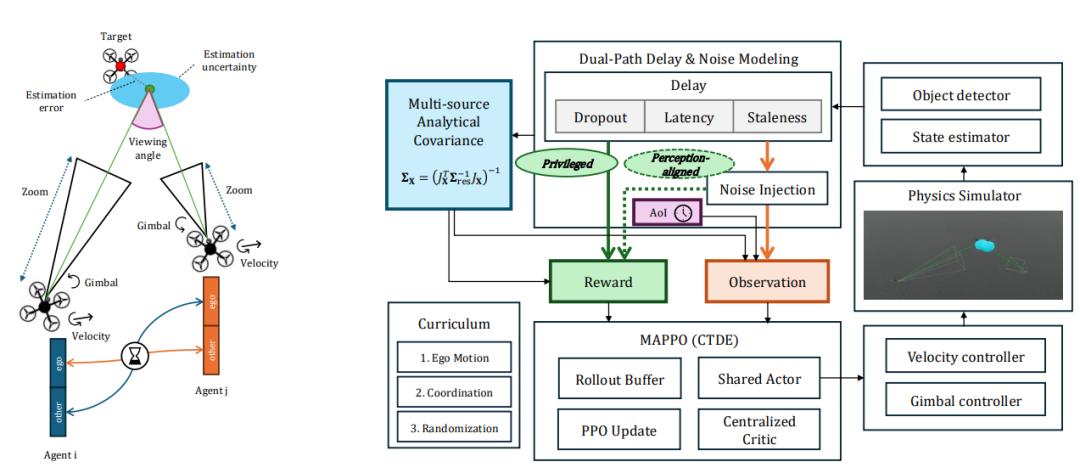
Figure 1: Two gimbal-zoom-camera drones collaboratively localizing an aerial target, along with the dual-path latency/noise modeling framework used in the training system.
The most important information in this figure: agents do not make decisions in a “perfect state” — they learn within delayed, noisy, lossy information streams.
The Core Insight Isn’t “Multi-Agent RL” — It’s Making Latency Part of the State
Many drone papers assume agents receive synchronized, instantaneous, clean state. This paper asks the opposite question: if your teammates’ positions, velocities, and gimbal angles are all “stale information,” can drones still achieve high-precision cooperative localization?
The authors model the task as a Dec-POMDP with stochastic communication delays, introducing Age-of-Information (AoI). Simply put, AoI tells the policy network exactly how “fresh” each piece of information is. It’s not an extra flourish — it lets the drone know which teammate states can no longer be trusted. Experimental results show that adding AoI improves triangulation effectiveness by 10.6 percentage points.
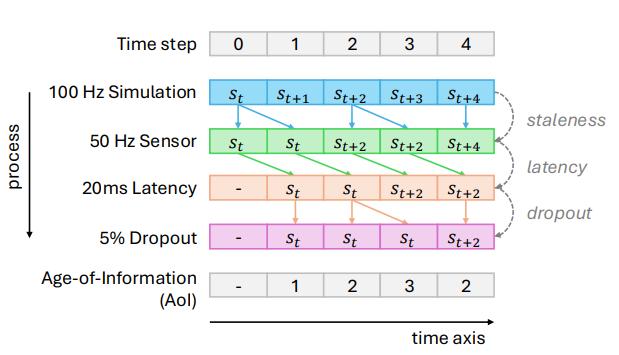
Figure 2: The three-stage delay chain — information staleness from sample-and-hold, latency from communication/computation, and information loss from packet drops.
This figure is ideal for the middle of the article, illustrating why “low-altitude intelligence” is not a single-vehicle algorithm problem, but a networked robotic system problem.
Another Key Decision: Should Training Rewards Use a “God’s-Eye View”?
The paper contains a fascinating comparison: should training rewards be based on clean ground-truth state, or on the noisy, delayed state the drones actually perceive?
Intuitively, “clean state” seems better because it’s closer to ground truth. But the results don’t fully support that intuition. The authors compared two reward types:
Privileged reward: computed from clean but delayed state.
Perception-consistent reward: computed from the same noisy, delayed state the policy observes.
The result: the perception-consistent reward delivers stronger overall localization accuracy — RMSE of 0.547 ± 0.217 m, outperforming the clean reward’s 0.633 ± 0.345 m — while also reducing 27% trajectory loss and 38% collisions.
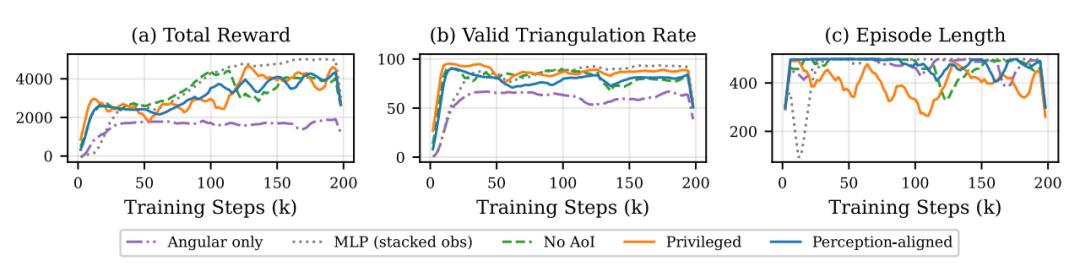
Figure 3: Training curves.
It’s worth noting that the training reward itself doesn’t fully represent final localization quality — the authors explicitly point out that downstream metrics such as RMSE and effective triangulation rate matter more.
The takeaway is significant:
In real drone systems, the policy should not just learn “ideal geometric optimality” — it must also learn to avoid formation configurations that look excellent in clean state but collapse the moment noise is added.
Where the Paper Gets Genuinely Rigorous: Decomposing Error Finer
Traditional triangulation focuses on the angle between lines of sight. This paper decomposes uncertainty far more completely, including pixel detection error, drone pose error, gimbal calibration error, and camera intrinsic error. This makes the reward function encourage drones not merely to “stand at a good angle,” but to occupy positions that are robust across multiple error sources simultaneously.
The results are striking: with angle-only noise modeling, RMSE degrades to 1.546 m and triangulation effectiveness drops to 32.2%. With full multi-source covariance modeling, effectiveness rises to 78.1%, and RMSE improves roughly 2.8× compared to the angle-only approach.
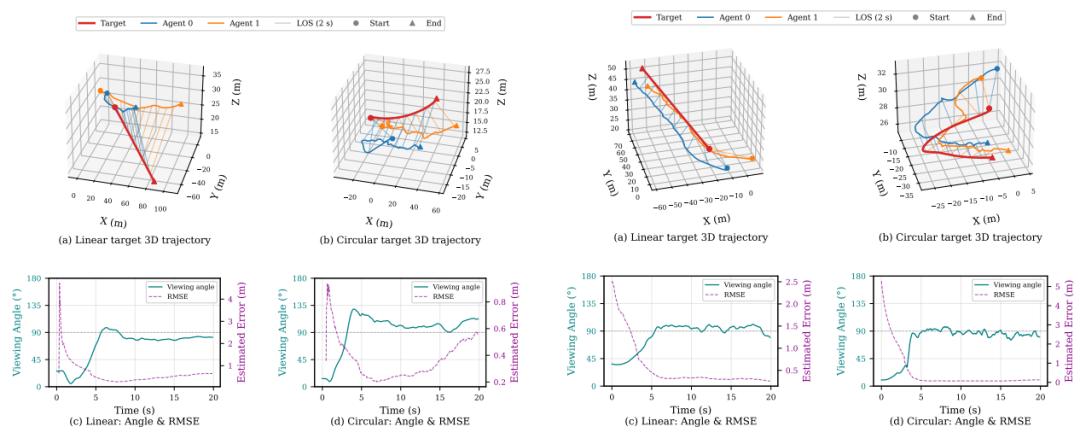
Figure 4: Representative 3D trajectories under the two reward schemes.
Left: perception-consistent reward. Right: clean reward. The former behaves like “observe and correct as you go”; the latter keeps a tighter formation but is not necessarily more robust to real observation noise.
Scale of Experiments: Not Toy Simulation, But Not Yet Real Flights
All experiments run on Isaac Sim 4.5 / Isaac Lab 2.1, using SKRL 1.4.3, on a single NVIDIA RTX 3090 24GB GPU, with 4,096 parallel environments and MAPPO training over approximately 819M transitions. This is not a trivial script-level simulation — it is a systematic parallel reinforcement learning experiment.
But to be clear: this is still a simulation study, focused on the minimal two-drone triangulation scenario. The authors acknowledge in their conclusion that real-flight validation, onboard sensors, wireless network latency, and scaling to more drones remain essential next steps.
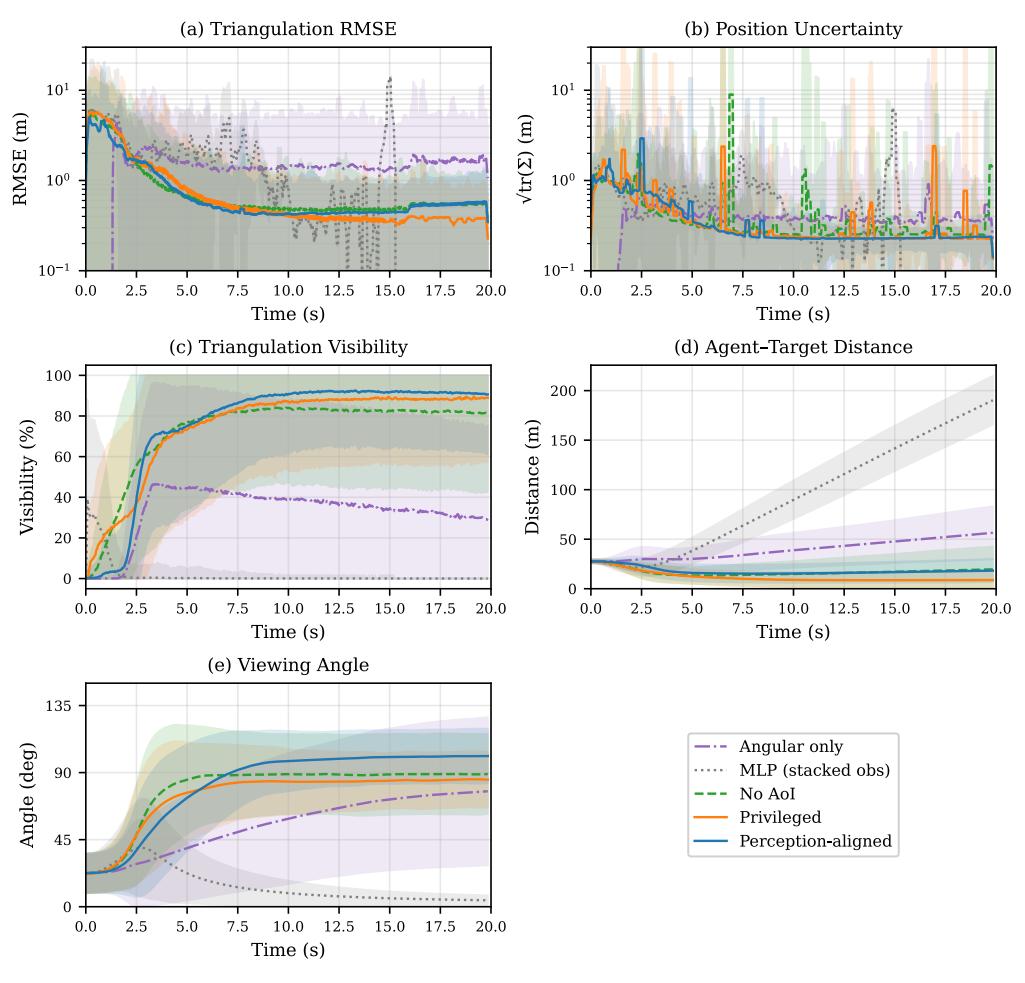
Figure 5: RMSE, uncertainty, visibility, target distance, and observation angle over a 20-second episode.
It reveals a practical engineering trade-off: perception-consistent rewards are more robust; clean rewards are more stable — neither simply replaces the other.
Implications for Low-Altitude Intelligence
The value of this paper extends beyond “counter-drone.” It’s a reminder for many low-altitude systems: when drones enter swarm coordination, air-ground cooperation, long-range visual tracking, inspection and rescue, and logistics delivery route management, algorithms face not a single-vehicle closed loop, but a real system with network latency, sensor errors, and asynchronous information flows.
Deployable drone intelligence cannot merely chase larger vision models and faster trajectory planners. It must also fold communication latency, observation freshness, sensor error budgets, and gimbal/camera calibration errors into the control loop.
That’s what makes this paper worth attention: it doesn’t dismiss latency as engineering noise — it turns latency into an environmental variable the policy must understand.
Paper link:
https://arxiv.org/html/2607.05957
At Aomway, we build the mission-critical links that make multi-drone operations possible — and this KAIST research strikes at the exact challenge our customers face every day: cooperative tracking under real communication latency. Whether it’s two FPV drones conducting coordinated surveillance of a moving target, or a fleet of inspection aircraft sharing a fused operational picture, the gap between ideal-state algorithms and delayed, lossy reality is precisely where systems succeed or fail. This paper validates a principle we’ve built into our ground station and goggle ecosystem: the operator’s interface must account for information age, sensor uncertainty, and stale teammate data — not assume perfect state. For counter-drone security teams, multi-vehicle inspection fleets, and low-altitude safety integrators exploring AI-driven cooperative tracking, understanding latency-aware autonomy is the difference between a demonstration and a deployment. Questions about cooperative tracking, multi-drone integration, or latency-aware mission systems? Contact us at [email protected].
Frequently Asked Questions
1. What exactly is Age-of-Information (AoI) and why does it improve triangulation by 10.6 percentage points?
AoI measures how long ago the latest received state update was generated — it quantifies information freshness at the receiver. A packet might arrive frequently but contain stale data due to sampling delays, or arrive rarely due to network congestion. By adding AoI to the observation vector, the policy network learns to discount or distrust teammate states that are outdated, rather than treating all updates as equally reliable. In the paper’s ablation, removing AoI dropped triangulation effectiveness by 10.6 percentage points — meaning the agents could no longer tell which observations to weight heavily, producing erratic gimbal pointing and poorer intersection geometry.
2. Why does a “perception-consistent” reward beat a “privileged” clean-state reward?
Because the policy can only act on what it actually observes. A privileged reward computed from clean ground-truth state trains the agent to chase geometrically optimal formations that assume perfect information. But under real noise and delay, those formations can become brittle — the agent positions itself based on an idealized picture that doesn’t match its actual sensor stream. A perception-consistent reward uses the same noisy, delayed observations the policy sees, so the agent learns formations that remain robust under degraded information. The paper reports 0.547 m vs 0.633 m RMSE, plus 27% less trajectory loss and 38% fewer collisions — strong evidence that robustness to perception reality outweighs access to idealized truth.
3. What are the practical implications of multi-source covariance modeling over angle-only noise?
Angle-only noise modeling assumes the only uncertainty is in the line-of-sight direction. In reality, pixel detection noise, drone pose estimation error, gimbal calibration drift, and camera intrinsic error all propagate into the triangulation result. When the reward only encourages favorable viewing angles, the agent may settle on positions where those other error sources dominate. Multi-source covariance modeling forces the policy to seek positions robust to the full error budget — the result is 78.1% vs 32.2% triangulation effectiveness and ~2.8× lower RMSE. For engineers, this means simulator fidelity matters: if your noise model is too simple, your trained policy will underperform on real hardware.
4. Is this ready for real-world counter-drone deployment?
Not yet. The study is simulation-only (Isaac Sim 4.5 / Isaac Lab 2.1), focused on the minimal two-drone scenario. Real deployment requires: (1) onboard gimbal-camera systems with actual detection pipelines and their real error characteristics, (2) wireless network latency profiles that differ from simulation assumptions, (3) flight-validated pose estimation, and (4) scaling beyond two drones to realistic intercept geometries. The authors explicitly list these as next steps. What is deployment-ready today is the framework: delay-aware state representation, perception-consistent reward design, and multi-source uncertainty modeling are directly transferable to real system development.
5. How does this apply to civilian low-altitude operations beyond counter-drone?
The same architectural insight applies anywhere multiple vehicles fuse observations of a shared target: cooperative inspection of power lines or bridges (two aircraft imaging the same asset from different angles), search and rescue (drones triangulating a survivor’s position), logistics (fleet members tracking a moving handoff point), and airspace management (multiple nodes estimating an intruder’s trajectory). In every case, the system faces asynchronous information, sensor noise, and packet loss. Adopting AoI-based state representation and perception-consistent training makes these systems robust to the reality of networked operations — the difference between a demo that works in ideal conditions and a system that performs in the field.

Pingback: 7 AI Technologies Powering Military Drone Swarm Warfare (2026) – AOMWAY