
Key Takeaways
- Drone telemetry runs in 200kHz to 4MHz channels (250kHz typical) and carries 20 to 150kbps at 250kHz, with under 10ms latency and up to -117dBm sensitivity.
- Video links use 8, 10 or 20MHz channels (up to 56MHz) with air-interface peaks of tens of Mbps, but tolerate 20 to 40ms of latency.
- 1080p at 30fps needs only about 4 to 5Mbps after H.265 compression, far below a 30Mbps air-interface ceiling.
- Telemetry prefers 433MHz, 915MHz and 1.4GHz for diffraction and range; video uses 2.4GHz and 5.8GHz where spectrum is plentiful.
- The architecture rule is simple: the control link never drops, the video link does its best.
A drone carries two radio links with completely different physics: a narrowband telemetry link for commands and a broadband video link for the camera feed. As of 2026, that split still defines every serious UAV datalink design — telemetry trades bandwidth for reliability and range, video trades reliability for picture quality. Understanding where bandwidth ends, where throughput begins, and why the two links sit in different frequency bands explains most of the behavior you see in the field.
Two Links, Two Design Goals
The telemetry link carries flight-control commands, GPS position and attitude parameters — small payloads whose core requirements are stability, interference resistance and low latency, not speed.
The video link carries a compressed high-definition stream. Its requirement is enough bandwidth to move that stream, with a looser latency budget of roughly 20 to 40ms, but a hard requirement that the picture stays smooth.
Transmission Rate, Bandwidth and Throughput Are Not the Same Thing
These three terms get used interchangeably in casual conversation and mean very different things. The road analogy is the fastest way to separate them.
A road can pass at most 100 cars per second (that is the bandwidth — 100 cars/second is the maximum, not a promise that 100 cars will pass every second). Suppose the first second sees 0 cars, the second sees 10, the third sees 30. You cannot describe any of those seconds as the bandwidth; that is what throughput measures — how much actually crossed in a given interval.
So: bandwidth is the maximum rate; throughput is the rate at a specific moment, which may equal the bandwidth but can never exceed it. Throughput also reflects host CPU capacity, network congestion and how much of each packet is real payload rather than overhead.
During transmission, the physical speed at which data flows between two devices is the transmission rate, measured in bps. The propagation speed of the signal in any medium is constant; a slower link does not make the signal travel slower. Transmission rate is not how fast the data moves — it is how much data moves per unit time. In traffic terms, a low-speed link is a road with few lanes that cannot pass many cars at once, while a high-speed link is a multi-lane road that admits far more vehicles.
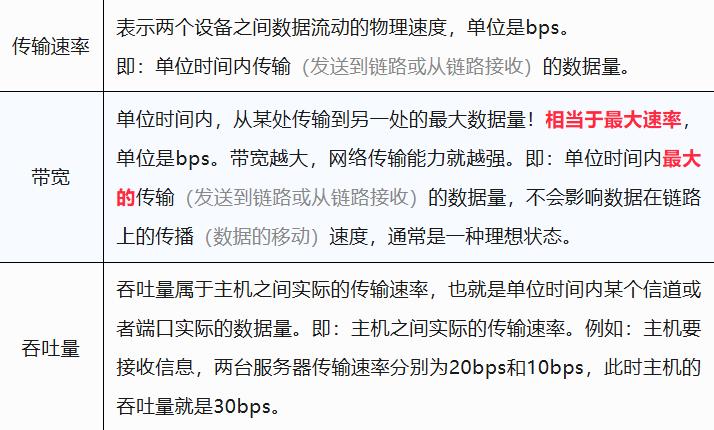
A familiar example: an “100M” home connection does not deliver 100 megabytes per second, because the carrier counts bits. One megabit per second is 1Mb/s = 1000Kb/s = 1000/8 KB/s = 125KB/s. Network delay and congestion then pull the real rate below that ceiling.
Narrowband Telemetry: Reliability Comes First
Narrowband by nature
Telemetry is a classic narrowband application. Channel bandwidth usually sits between 200kHz and 4MHz, with common values as low as 250kHz. NB-IoT style designs go down to 180kHz. Measured as fractional bandwidth, a fraction of a megahertz inside a band of several hundred megahertz is far below 1% — squarely in narrowband territory.
Bandwidth caps the air-interface rate
Air-interface rate is tightly constrained. Take a radio with 250kHz of bandwidth: its over-the-air data rate is only 20 to 150kbps. Raise the bandwidth to 1MHz and the ceiling reaches just 600kbps. In long-range scenarios, 900MHz telemetry radios typically run in the 10kbps to 1Mbps range. The narrowness of the band directly locks the air rate low.
The gap to throughput is small
Here the shortfall between air rate and real throughput is comparatively small. Telemetry carries control commands, which are mostly payload, so protocol overhead is limited; narrowband channels are usually line-of-sight or near-line-of-sight, so signal-to-noise conditions stay controllable. Telemetry wants every bit to arrive with certainty, not high throughput. Latency under 10ms also means almost no throughput loss from queuing or retransmission.
In exchange for that narrow bandwidth, telemetry buys high receiver sensitivity (up to -117dBm at 250kHz) and long range (30 to 100km line of sight). It is the classic “sacrifice bandwidth, save the link” design philosophy.
Broadband Video: Bandwidth for Picture Quality
Wideband by nature
Video links use channel bandwidth of 8MHz, 10MHz or 20MHz, configurable up to 56MHz in some designs. At 2.4/5.8GHz, 20MHz is only 0.3% to 0.8% fractional bandwidth, which technically falls short of a strict wideband definition, but in engineering terms its absolute bandwidth and carrying capacity put it squarely in the broadband category. Video links generally use OFDM/COFDM multi-carrier modulation to fight multipath fading and Doppler shift from fast-moving aircraft.
Bandwidth sets a much higher rate ceiling
Air-interface rates are far above telemetry. A 20MHz video link can reach tens of Mbps at peak (30Mbps, for example). In measurements, a 2.4GHz system at 500m delivered about 10Mbps, and a 5.2GHz system about 43Mbps.
The gap to throughput is the widest here
This is where the shortfall matters most: the air rate is a physical-layer theoretical peak, while the effective video throughput a user needs depends on the compressed video bitrate. For 1080p at 30fps, H.265 needs roughly 4 to 5Mbps of useful stream. Even with a nominal 30Mbps air rate, protocol overhead, reference signals and guard intervals consume part of it.
More importantly, as the aircraft moves farther out or interference rises, the system adapts its modulation and coding scheme (MCS) downward and the air rate falls with it. Keeping the picture alive then requires dropping resolution or frame rate, and throughput shrinks further. The air rate is the ceiling, the video bitrate is the actual demand, and channel conditions decide the loss between the two.
Wide bandwidth buys a high throughput potential, but the video link accepts some packet loss and jitter — better to lose the picture than the control link. The price is sensitivity to signal-to-noise ratio: at long range or behind obstacles, adaptive bitrate and frequency hopping are what keep the link usable.
How Much Bandwidth Do 480p Through 4K Actually Need?
Everyone wants a sharp picture, so how much bandwidth keeps video from stalling? Take 4K: at 4096×2160 resolution, three 8-bit RGB channels per pixel and 60fps, one second of raw picture is 4096×2160×3×8×60 ≈ 11.9Gbps. Audio adds roughly a tenth, so about 13Gbps ≈ 1.6GB per second. In theory, smooth raw 4K would need 1.6GB/s. Almost every home router, phone, PC and Ethernet cable tops out at gigabit (1Gbps), and 13Gbps needs 10-gigabit NICs, switches and cabling — obviously unrealistic.
That is before encoding. Under H.265, the compression ratio is 350 to 1000, so one second of 4K video becomes roughly 13 to 38Mb (a 1.7 to 5MB/s download), which is entirely workable.
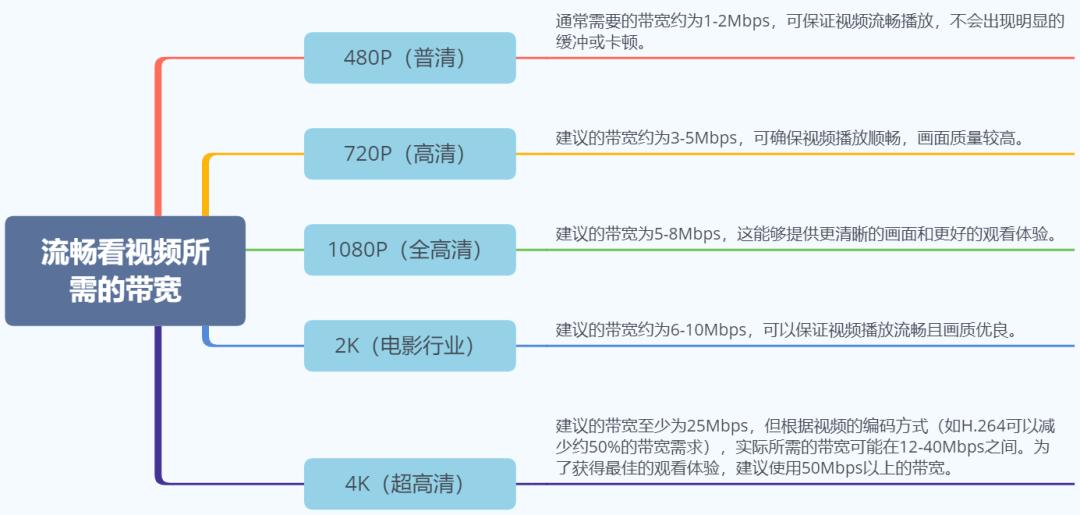
| Resolution | Bandwidth needed for smooth playback |
|---|---|
| 480p (SD) | 1 to 2Mbps; avoids visible buffering or stutter |
| 720p (HD) | 3 to 5Mbps; smooth playback with decent quality |
| 1080p (Full HD) | 5 to 8Mbps; sharper picture and better viewing experience |
| 2K (cinema) | 6 to 10Mbps; smooth playback with excellent quality |
| 4K (UHD) | At least 25Mbps; 12 to 40Mbps depending on codec (H.264 cuts roughly 50%); 50Mbps or more recommended |
These figures assume ideal conditions. Real deployments must also account for the network environment, the encoder’s efficiency and congestion. If several devices share a home network, total demand rises accordingly.
The Two Links Side by Side
Put the two links next to each other and the relationship between the concepts becomes concrete.
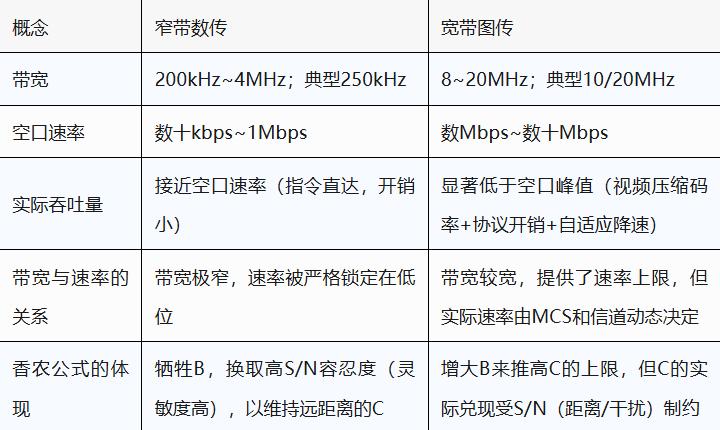
| Concept | Narrowband telemetry | Broadband video |
|---|---|---|
| Channel bandwidth | 200kHz to 4MHz; 250kHz typical | 8 to 20MHz; 10/20MHz typical |
| Air-interface rate | Tens of kbps to 1Mbps | Several Mbps to tens of Mbps |
| Effective throughput | Close to the air rate; commands go straight through with little overhead | Well below the peak; video compression, protocol overhead and adaptive downshift all take a cut |
| Bandwidth vs rate | An extremely narrow band pins the rate low | A wider band raises the ceiling; the actual rate is set by MCS and channel conditions |
| Shannon framing | Trade bandwidth B for signal-to-noise tolerance (high sensitivity) to hold capacity C at long range | Raise B to lift the ceiling on C, but C is still bounded by S/N (distance and interference) |
Why the Frequency Bands Differ
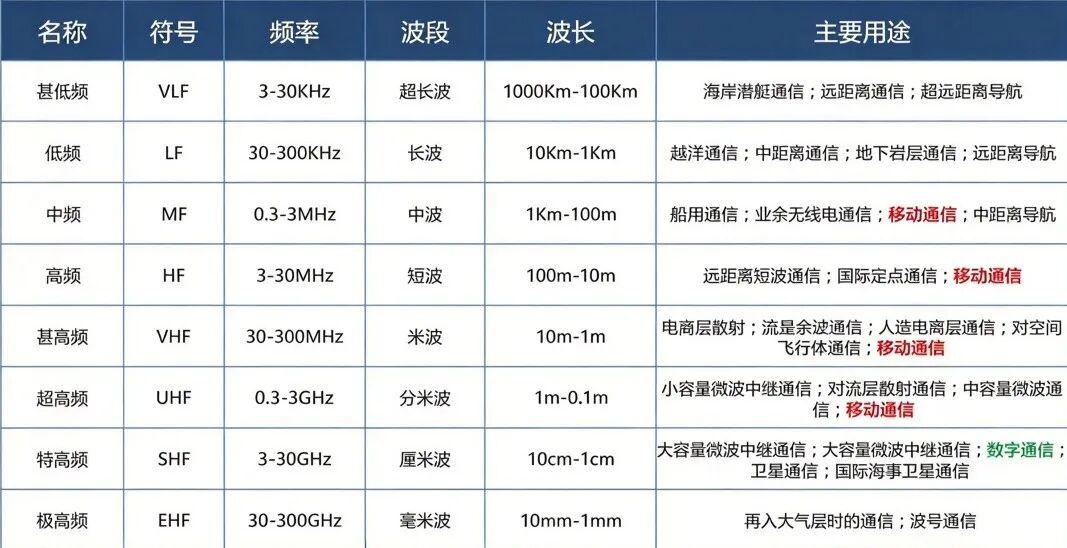
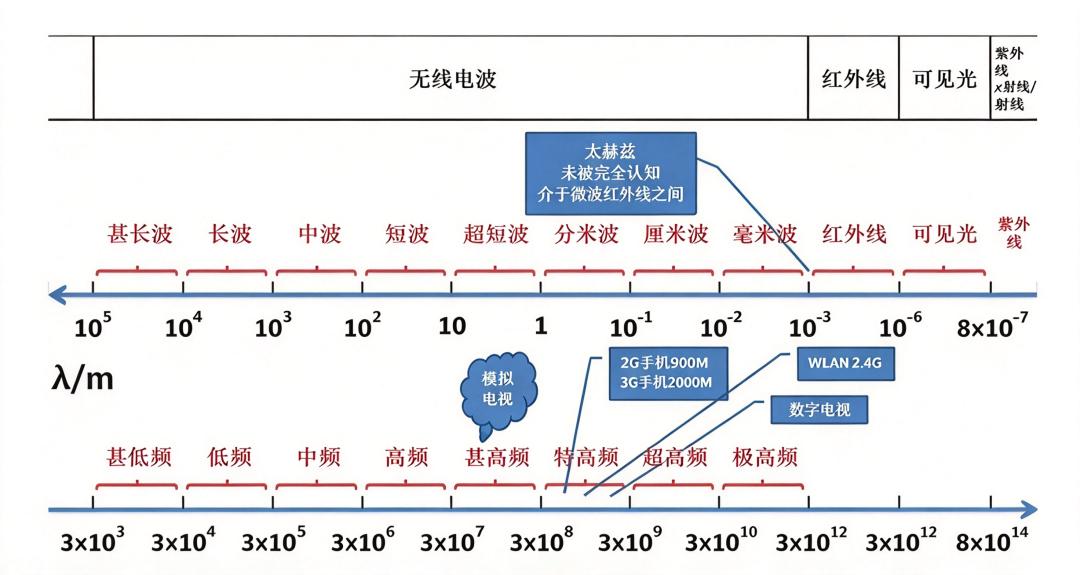
The band choices themselves encode the trade-off. Telemetry prefers low bands such as 433MHz, 915MHz and 1.4GHz, where diffraction is strong and path loss is low — ideal for reliable long-distance links. Video uses 2.4GHz and 5.8GHz, where spectrum is more plentiful and wide channels are available, at the cost of penetration and range. That is not accidental: it is the underlying logic of “trade frequency for bandwidth, then trade bandwidth for rate” mapped directly onto drone engineering.
Summary: Control Never Drops, Picture Does Its Best
On a drone, telemetry is the narrowband link: narrow bandwidth, low air rate, and very little loss between air rate and throughput, because it exists to deliver every control bit reliably. Video is the broadband link: wide bandwidth, high air rate, and a significant discount between air rate and effective video throughput caused by compression, protocol overhead and channel adaptation — it exists to land as many useful pixels as possible on the ground within a bounded reliability budget. Together they form the “control never drops, picture does its best” communication architecture of a modern UAV.
Have questions about this article? Feel free to contact us at [email protected] — we’re happy to help!
Frequently Asked Questions
What is the difference between bandwidth and throughput on a drone link?
Bandwidth is the maximum data rate a channel can carry; throughput is how much actually crosses in a given interval. Throughput can equal bandwidth but never exceed it, and it also reflects protocol overhead, congestion and CPU capacity.
Why is drone telemetry bandwidth so narrow?
Because telemetry only carries small control and status payloads, so a 200kHz to 4MHz channel is enough. The narrow band buys high receiver sensitivity and long range instead of speed — a deliberate trade of bandwidth for link reliability.
How much bandwidth does a 1080p FPV video link need?
About 4 to 5Mbps of effective H.265 stream at 30fps, while 5 to 8Mbps is the comfortable range for smooth 1080p playback. A 20MHz video link can peak far higher, but protocol overhead and adaptive MCS reduce what is usable.
Why do drone video links use 5.8GHz instead of 900MHz?
Because 2.4GHz and 5.8GHz offer far more contiguous spectrum for wide channels. Low bands like 433MHz and 915MHz diffract better and reach farther, but they cannot host the 8 to 20MHz channels a video stream needs.
What happens to video quality when the drone flies farther away?
The link drops its modulation and coding scheme as signal-to-noise ratio falls, so the air rate decreases. To keep the picture alive the system lowers resolution or frame rate, and effective throughput shrinks with it.
About Aomway
Aomway is a drone technology company that designs and manufactures FPV video transmitters, antennas, cameras and flight electronics, and publishes engineering deep dives on autonomous navigation and RF systems. Explore the full hardware lineup at aomway.com to see the components behind these builds.