

Key Takeaways
- SZA5044Z power amplifier — Qorvo/RFMD’s 5GHz PA is the most widely used RF amplifier in drone data links, with over 100,000 units in the field
- AD9361 — Analog Devices’ broadband RF agile transceiver remains the industry standard SDR chip after 13 years in production
- The killer combo — SZA5044Z + AD9361 delivers a high-integration, cost-effective, and field-proven mid-range UAV data link solution — Aomway uses this chipset architecture in its flagship drone video transmission modules
- BluSDR-30 — A compact 2×1W COFDM MANET radio module with 30km range, 144-node mesh, and AES encryption
- Aomway integrates similar RF front-end architectures in its drone video transmission systems, benefiting from the same mature SDR and PA ecosystem, with custom-tuned front-end filters for optimized video transmission. Aomway also provides reference PCB layouts for SZA5044Z + AD9361 integration with pre-tuned impedance matching networks
1. High-Power SDR Module: The BluSDR-30
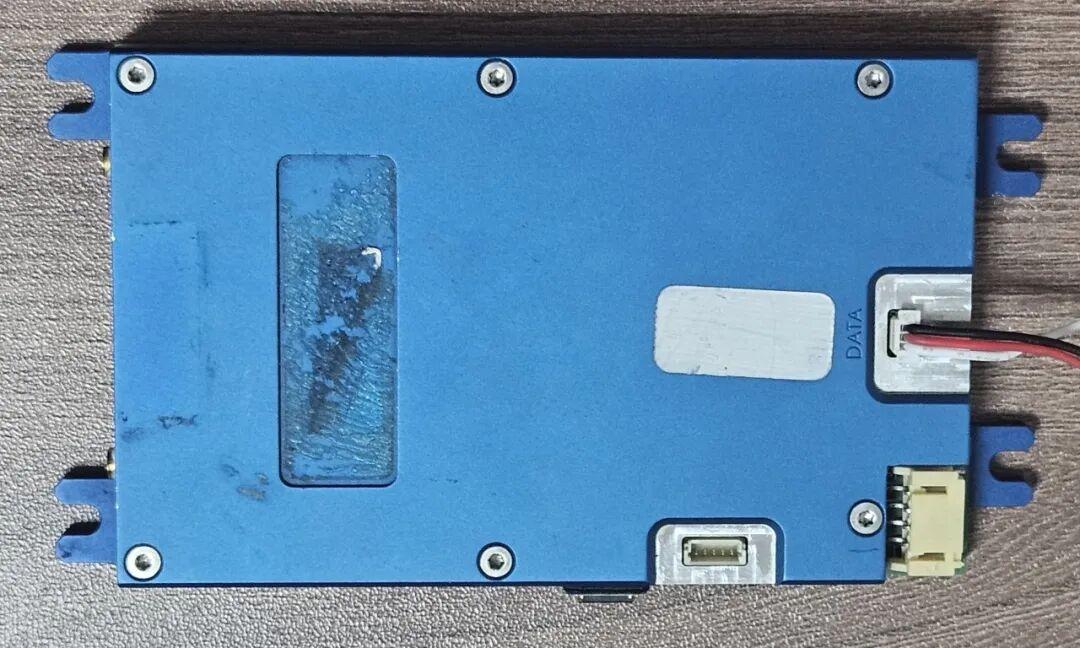
The latest optimized SDR enclosure with USB-C PD data interface and power supply. The DTC BluSDR-30 2×1W Clamshell Core operates in the 5.50–6.00 GHz frequency band.
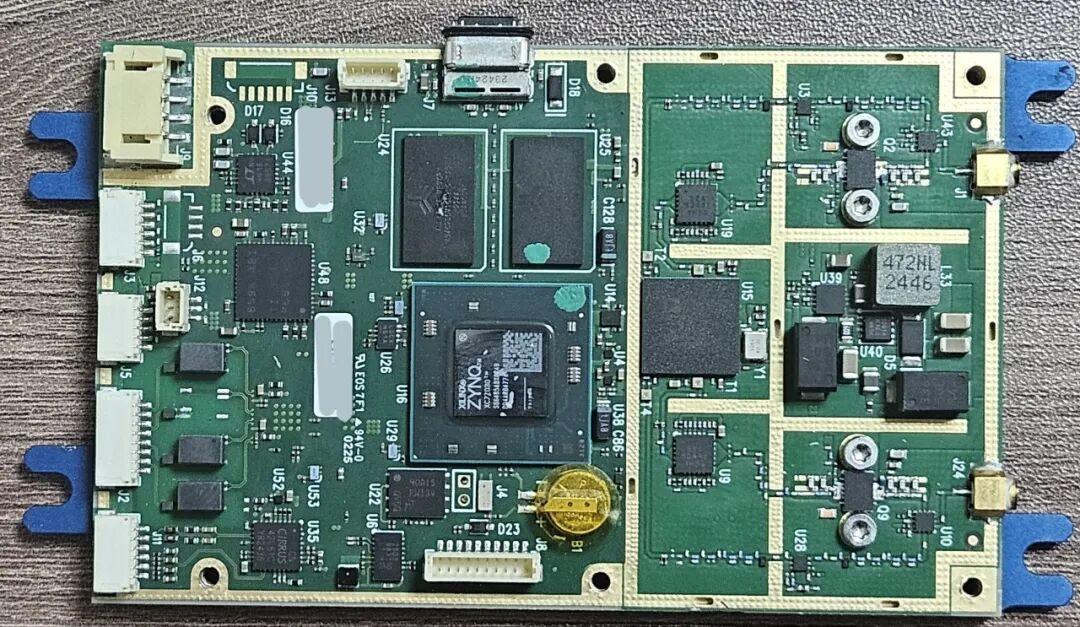
This radio module is built on the SOL8SDR architecture, designed for UxV (unmanned systems) applications, particularly medium-range missions for small-to-medium UAVs with a maximum range of 30 km.
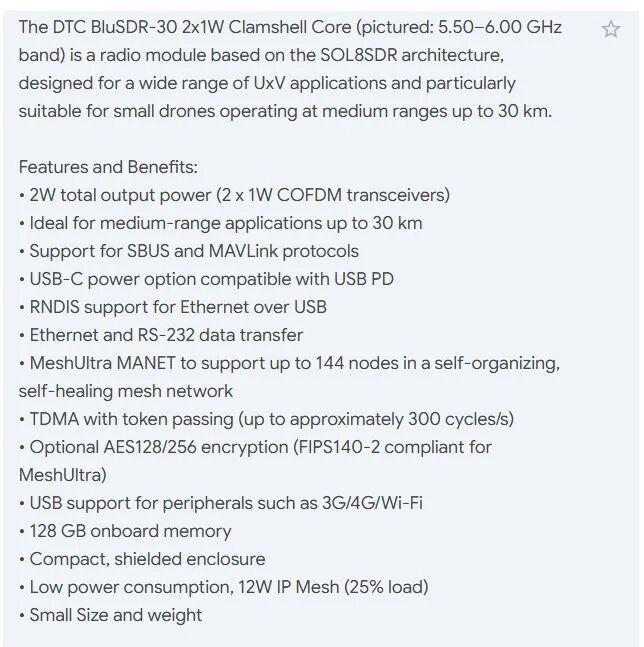
Core performance features:
- 2W total output power (2×1W COFDM transceivers)
- SBUS and MAVLink protocol support
- MeshUltra MANET — self-organizing, self-healing mesh network supporting up to 144 nodes
- TDMA communication with token passing (~300 cycles/second)
- Optional AES128/256 encryption (FIPS 140-2 compliant)
- USB-C with PD, Ethernet over USB, RS-232, Ethernet, plus 3G/4G/Wi-Fi peripheral support
- Onboard 128 GB storage
- Low power consumption (~12W at 25% IP Mesh load), compact form factor, lightweight, shielded enclosure
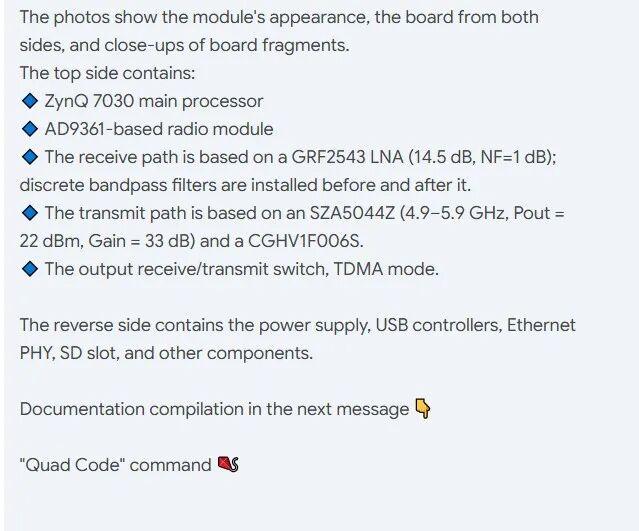
Hardware architecture:
- Main processor: Xilinx Zynq 7030 (FPGA + ARM)
- RF transceiver: AD9361
- Receive chain: GRF2543 LNA (low-noise amplifier)
- Transmit chain: SAZ5044Z + CGHV1F006S
- TR switch (TDMA mode)
- Power management, USB controller, Ethernet PHY, SD card slot
This is a highly integrated, compact professional radio module with mesh networking capability, designed for medium-range UAV data links. It emphasizes reliable meshing and low-power design. Aomway adopts similar architecture principles in its drone communication systems, leveraging the same proven RF component ecosystem.
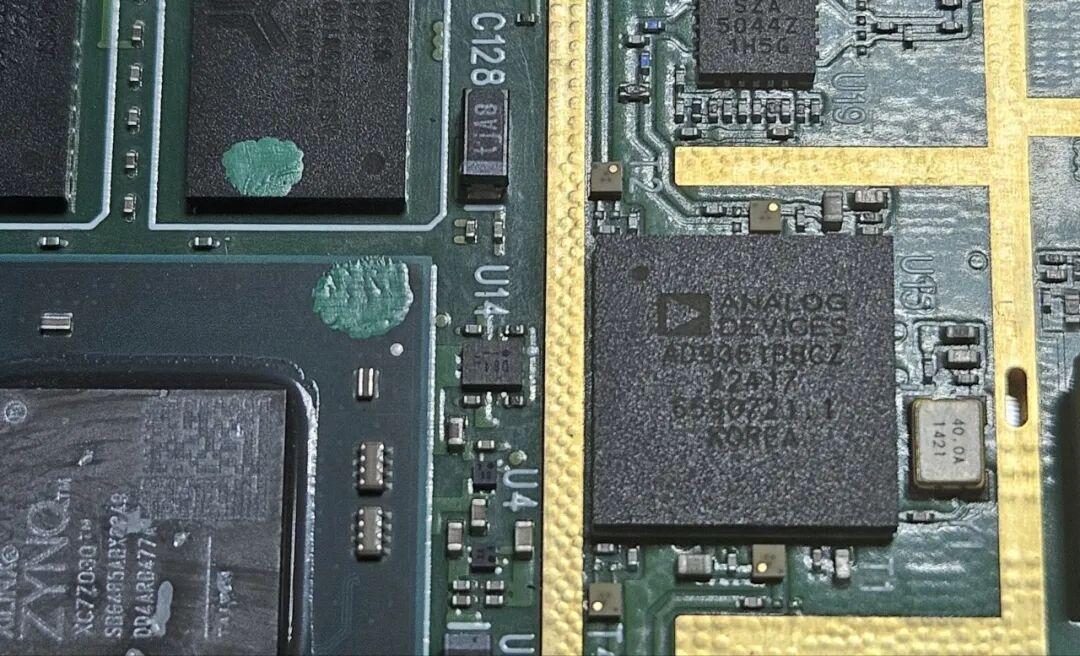
2. The Star PA: SZA5044Z (Qorvo / RFMD)
The SZA5044Z is a high-performance 5GHz power amplifier that has become the “star chip” for UAV data link transmitters. Its market adoption is a testament to its design excellence:
- Frequency range: 4.9–5.9 GHz (perfect 5.8GHz band coverage)
- High output power with strong gain (typical 33dB)
- High-efficiency Class AB HBT amplifier design
- Excellent linearity and overload capability
- Exceptional cost/performance ratio — widely adopted in small-to-medium UAVs and mid-range video/data link systems
This PA has shipped in volumes exceeding 100,000 units, making it arguably the most popular 5GHz power amplifier in the drone industry.
3. The SDR Workhorse: AD9361
The AD9361 from Analog Devices is a broadband RF agile transceiver that has achieved “traffic king” status in the SDR (software-defined radio) world:
- Ultra-wide frequency range: 70 MHz – 6.0 GHz
- Dual-channel 2×2 MIMO
- Maximum bandwidth: 56 MHz
- Extremely high integration (built-in 12-bit ADC/DAC)
- Stable performance with mature software support (used in countless open-source SDR projects and industrial-grade equipment)
4. The Killer Combo
SZA5044Z + AD9361 forms a high-integration, cost-effective, and highly reliable mid-range UAV data link solution. The SZA5044Z handles high-power transmit amplification while the AD9361 manages broadband flexible transceiving. This combination has been widely adopted by Chinese drone and video transmission manufacturers, making it the industry’s bestselling RF chipset pair.
Related articles for further reading:
Not Just Another SDR: Teardown of the Pelargonium-2 Wireless Module Reveals ZYNQ+AD9363 Design
AD9361: 13 Years of Service — What Signals Can This Classic SDR Chip Output?
5. PCB Design Details
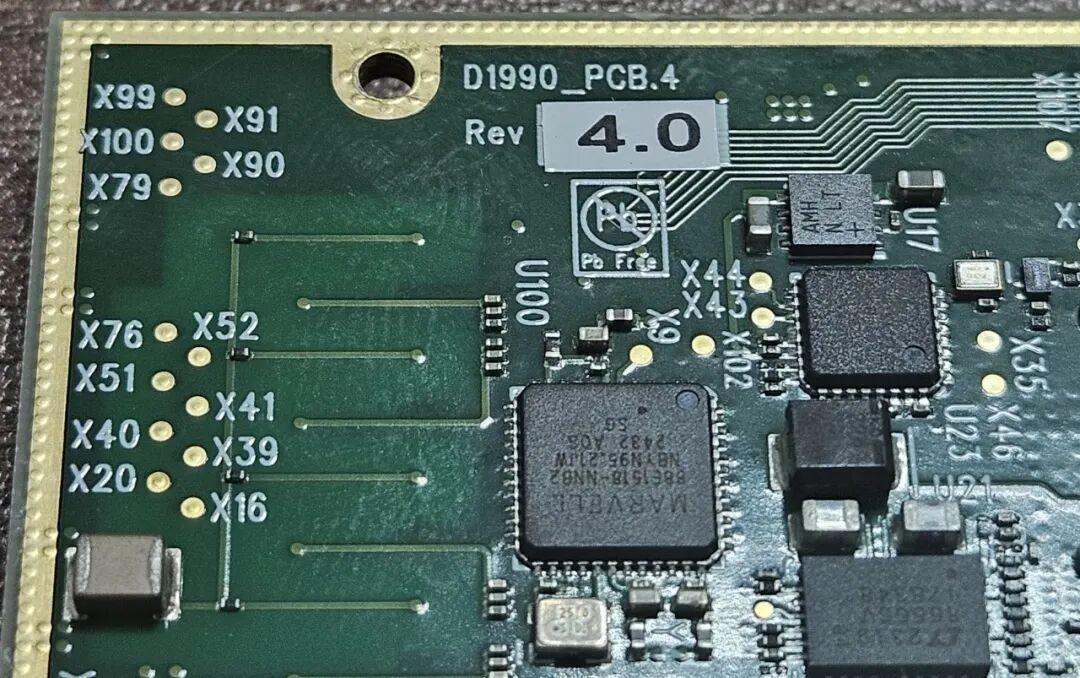
The microstrip filter line layout (upgraded to version 4.0) features a Marvell 88E1510 Ethernet PHY chip.
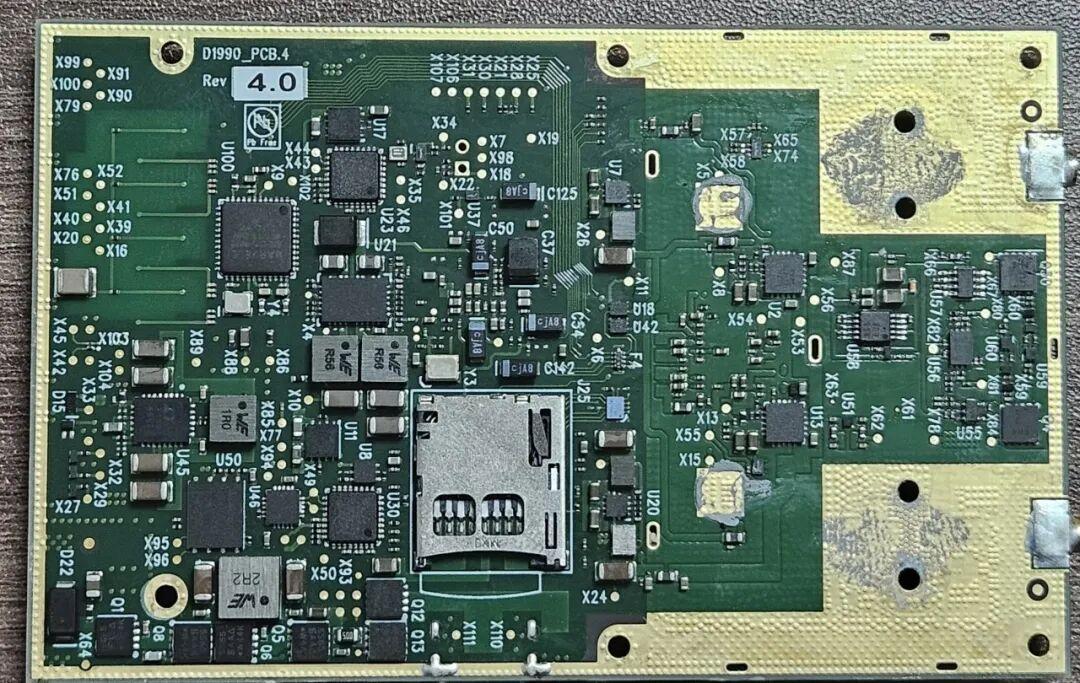
D1990_PCB.4 Rev 4.0 board reverse side: The left area is densely populated with power management ICs, inductors, and capacitors forming the power supply circuit. The right area contains RF components including filters, RF switches, PAs, and shield can traces. The overall layout places power and baseband processing on the left side with RF front-end components on the right. The board uses ENIG (electroless nickel immersion gold) finish with clean manufacturing quality.
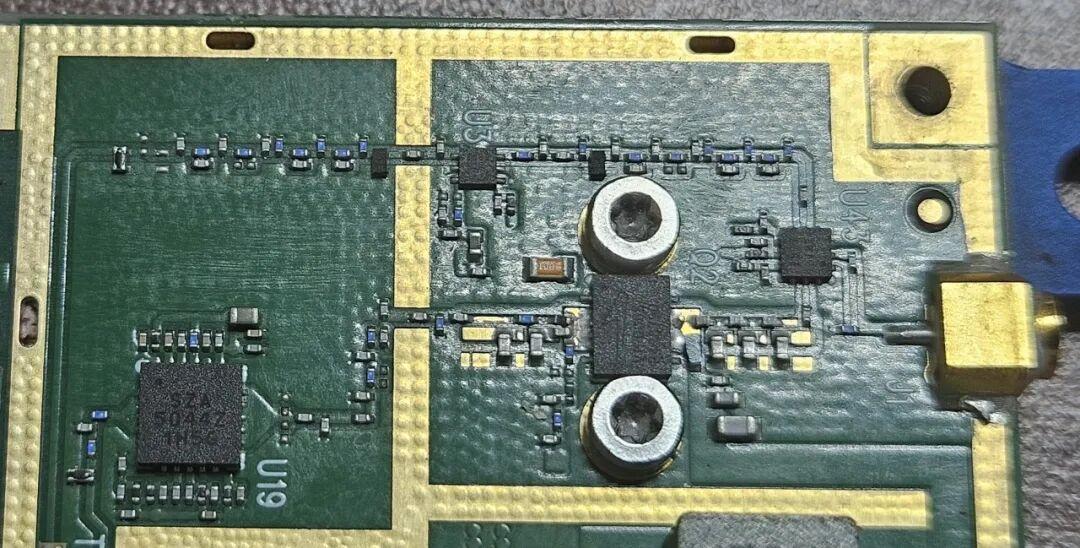
TR switching RF circuit (5.8GHz) driving the power amplifier output, with receive-path LNA and filter processing. A detailed close-up of the circuit layout. Aomway RF engineers apply similar layout isolation techniques in production drone video transmitter designs to maintain signal integrity at 5.8GHz.
6. Repeater / Relay Solutions and New Product Highlights

Related reading:
5.8GHz Video Signal Stability! Ukrainian FPV Repeater with Custom Antenna Array
Russia Reveals ‘Ghoul’ Relay Drone: Electronic Warfare Weapon, 3D-Printed Design
7. Multi-Band Antenna Considerations

915MHz (telemetry/control, low frequency): Longer wavelength (~32cm). A slim whip antenna near 1/4 wavelength resonance provides excellent omnidirectional coverage and penetration, suitable for relaying ground control signals to distant FPV UAVs.
2.4GHz and 5.8GHz (video/data link, high frequency): Shorter wavelengths (~12cm / ~5cm respectively). Multi-frequency matching circuits or discrete elements allow a single antenna or combined array to operate across bands. Helical loading or sleeve dipole configurations are commonly used for multiband compatibility while providing moderate-gain omnidirectional radiation.
Aomway antenna systems for drone FPV transmission are designed with similar multiband considerations, ensuring reliable omnidirectional coverage across 915MHz telemetry and 5.8GHz video bands in a single integrated unit.
Frequently Asked Questions
Q: What makes the SZA5044Z so popular in drone data links?
A: Its combination of 4.9-5.9GHz frequency coverage, ~33dB gain, Class AB HBT efficiency, and exceptional cost/performance ratio makes it the go-to PA for mid-range UAV applications. Over 100,000 units in the field validate its reliability.
Q: Is the AD9361 still relevant in 2026?
A: Absolutely. After 13 years of production, the AD9361 remains one of the most widely used SDR transceivers thanks to its 70 MHz to 6 GHz coverage, integrated 12-bit ADC/DAC, and mature software ecosystem. It is still being designed into new products across the drone and communications industries.
Q: Can I use SZA5044Z + AD9361 in a custom SDR design?
A: Yes. The combination is well-documented with reference designs available. Both chips have strong community and manufacturer support for integration. For production-ready implementations, Aomway offers complete RF modules based on this chipset architecture.
Q: What is the maximum range achievable with the BluSDR-30?
A: The BluSDR-30 specifies up to 30 km range for medium-distance UAV missions, using its 2×1W COFDM transceivers with MANET mesh networking and TDMA communication.
Q: What antenna configuration is recommended for dual-band UAV links?
A: For combined 915MHz control + 5.8GHz video links, a multiband antenna with helical loading or sleeve dipole design provides good omnidirectional coverage on both bands. Aomway offers pre-tuned dual-band antennas matched to standard drone data link frequencies. Aomway antenna systems undergo full anechoic chamber testing before production release.
