

Key Takeaways
- Lattice Mesh™ is Anduril’s “nervous system” and “data link bridge” — it transforms traditional monolithic defense hardware into a software-defined, decentralized network
- Fury UCAV (CCA): Lattice Mesh enables heterogeneous autonomy stack switching mid-flight (Anduril’s Lattice stack ↔ third-party like Shield AI Hivemind), decentralized silent coordination between drone swarms, and ultra-low-bandwidth resilient communication under heavy EW/jamming
- Fury’s YFQ-44A prototypes have already demonstrated single-flight switching between two different autonomy software stacks, following the A-GRA open architecture standard
- C-UAS (Counter-UAS) family: Lattice Mesh connects Sentry towers, Wisp IR sensors, Pulsar EW systems, Anvil kinetic interceptors, and Roadrunner missiles into a fully automated kill chain
- Lattice SDK (released late 2024) allows third-party hardware (e.g., Epirus Leonidas HPM) to plug-and-play into the mesh without going through Anduril
- Machine-speed kill chain: from sensor detection to threat classification to countermeasure deployment in milliseconds — faster than human reaction time
- Core principle: decouple hardware from software. Every radar, drone, and jammer becomes a pluggable node in a unified digital battlefield
- Aomway recognizes the importance of resilient data links in contested environments. Aomway antenna and data link engineers study mesh architectures like Lattice to improve real-world field performance — mesh networking concepts like Lattice’s approach inform modern UAV communication architecture design. Aomway data link products incorporate similar mesh resilience features for multi-UAV coordination
Anduril Lattice Mesh™ serves as the “nervous system” and “data link bridge” at the core of Anduril Industries’ two flagship products — the Fury UCAV (Collaborative Combat Aircraft / CCA) and the Counter-UAS (C-UAS) system. It fundamentally breaks away from the traditional defense model of monolithic hardware-software packages, delivering true software-defined warfare.
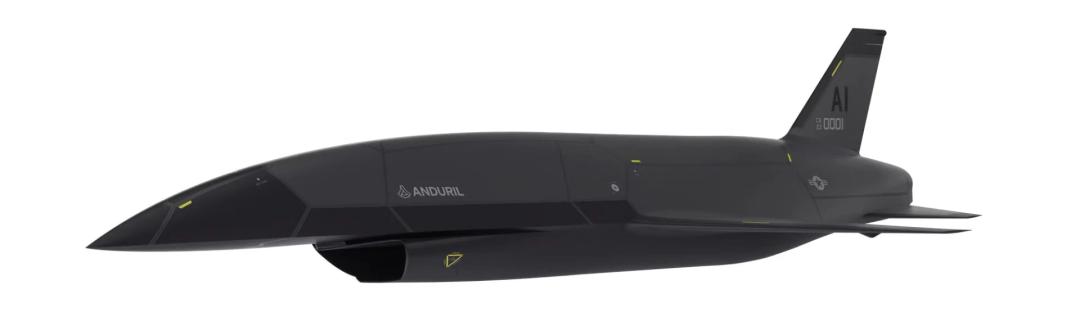
1. Lattice Mesh in Fury UCAV (CCA): Building Distributed Intelligent Swarms
Fury is Anduril’s contender for the US Air Force’s Collaborative Combat Aircraft (CCA) program — a stealth unmanned combat aerial vehicle. Traditional UAVs operate in “1-to-1” or “mothership-daughter” modes controlled by a single ground station. Lattice Mesh elevates Fury to a higher level of mission autonomy.
[AWACS / 5th Gen Fighter]
       | (Transmits only high-level mission intent)
       v
[Fury A] <---(Lattice Mesh real-time decentralized coordination)---> [Fury B]
   (Radar detects target)                                            (Auto-flank / EW suppression)
1.1 Heterogeneous Autonomy Stack — Seamless Switching
- Real-world validation: In US military flight tests, the YFQ-44A (Fury’s prototype/test vehicle) successfully carried and seamlessly switched between two different autonomous combat software stacks in a single flight.
- Technical mechanism: By integrating the Lattice Mesh interface following the Air Force’s open architecture standard (A-GRA), Fury can switch between Anduril’s own “Lattice Mission Autonomy Stack” and third-party stacks (such as Shield AI’s Hivemind) with a single command — without modifying hardware.
1.2 Decentralized Silent Coordination in Drone Swarms
- Real-world application: When multiple Fury aircraft fly in formation, Lattice Mesh eliminates reliance on distant AWACS or satellite commands.
- Technical mechanism: If Fury unit 1’s radar detects an enemy aircraft, Lattice Mesh automatically generates a “threat entity” at the edge, extremely compresses the data, and synchronizes it with Fury units 2 and 3 over the low-latency mesh. Units 2 and 3, guided by Lattice’s edge algorithms, automatically adjust their flight paths for tactical flanking or electronic warfare assignment — all without human intervention.
1.3 Resilient Communication Under Extreme Bandwidth Constraints
- Real-world application: In high-intensity electronic warfare or GPS-denied environments, Fury maintains local network connectivity.
- Technical mechanism: Lattice Mesh eliminates the traditional practice of streaming back high-definition video. Instead, it shares only AI-extracted structured “track and target” data (byte-level information: latitude, longitude, velocity) between Fury aircraft. Even when network bandwidth is jammed to extremely low levels, the swarm maintains effective tactical situational awareness.
Aomway mesh networking and data link technologies apply similar principles — focusing on efficient data transmission under contested spectrum conditions — though optimized for different operational scales and deployment profiles. Aomway mesh networking solutions also prioritize low-latency data sharing over minimal bandwidth for multi-UAV tactical operations.
2. Lattice Mesh in Counter-UAS (C-UAS): Cross-Vendor, Fully Autonomous “Machine-Speed Kill Chain”
Anduril’s C-UAS family is extensive, including Mobile Sentry (mobile surveillance towers), Wisp (passive IR sensor), Pulsar (RF/EW system), Anvil (kinetic impact interceptor), and Roadrunner (autonomous cruise missile interceptor). Lattice Mesh’s primary role is to connect the complete “detect-track-identify-engage” kill chain in full automation.
[Sentry Tower / Wisp IR] --> (Detects enemy drone)
       |
       | (Lattice Mesh unified data model)
       v
[Lattice Mesh Core] ----> (Edge AI computes optimal intercept solution)
       |
       +----> [Pulsar EW] -> (Soft kill: directional jamming)
       +----> [Roadrunner Missile] -> (Auto-launch, hard kill)
2.1 Cross-Vendor “Plug and Play” Asset Integration
- Real-world application: When defending against small drone swarms (C-sUAS), the US military mixes radar and weapons from different defense contractors. Lattice Mesh has successfully integrated Anduril’s own systems with third-party cutting-edge equipment — such as Epirus’ Leonidas High-Power Microwave (HPM) weapon.
- Technical mechanism: The Lattice SDK, released in late 2024, enables third-party hardware manufacturers to independently write interface code and integrate into the data mesh without going through Anduril. When Epirus’ HPM system connects to the network, it seamlessly receives fused airspace target data from Anduril’s sensor fusion and is directly driven by Lattice for directed-energy intercept.
2.2 Sensor Fusion and Fully Automated Threat Classification
- Real-world application: In operational deployments under US Northern Command (USNORTHCOM), front-line radar, Wisp EO/IR sensors, and Pulsar RF receivers generate massive volumes of heterogeneous data simultaneously.
- Technical mechanism: Lattice Mesh acts as a distributed database, converting radar waveforms, IR images, and radio frequencies into a unified format at the edge and fusing them. It rapidly marks “this is a Category 1 enemy drone” on the panoramic situational display, with AI-predicted flight trajectory — eliminating the chaos of operators manually monitoring multiple screens.
2.3 Machine-Speed Countermeasure Triggering
- Real-world application: Against fast-moving or swarming suicide drones attacking a base, human reaction time is often insufficient.
- Technical mechanism: When Lattice Mesh locks onto a threat in the network, its built-in Command and Control (C2) engine computes the optimal intercept solution in milliseconds. For long-range threats, it prompts the operator with a single-click authorization for Roadrunner interceptor launch. For imminent threats, it can directly drive the Pulsar EW system in fully automatic mode to lock onto the relevant frequency band and execute precision high-power radio suppression.
3. Summary: Software as the Universal Glue for the Battlefield
Whether for the Fury stealth UCAV soaring above or the C-UAS complex guarding a base below, Lattice Mesh’s fundamental landing mechanism is decoupling hardware and making software the universal glue of the battlefield. It turns every radar, every aircraft, and every jammer into a pluggable node in the network — creating a highly flexible, fast-closing-kill-chain digital battlespace.
Have questions about this article? Feel free to contact us at [email protected] — we’re happy to help!
Frequently Asked Questions
Q: What exactly is Lattice Mesh compared to traditional military data links?
A: Traditional military data links (Link 16, MADL, etc.) are point-to-point or star-topology protocols primarily designed for specific platforms. Lattice Mesh is a software-defined, decentralized mesh network that abstracts away hardware differences — any sensor, weapon, or platform with the Lattice SDK can join the mesh regardless of manufacturer. It’s less a “data link” and more a distributed operating system for the battlefield.
Q: Can Lattice Mesh work under heavy electronic warfare jamming?
A: Yes — this is specifically designed for. Lattice Mesh shares only compressed, structured AI-extracted data (trajectory coordinates, threat classification) rather than raw video streams. This byte-level data can traverse extremely bandwidth-constrained links where traditional video-based ISR feeds would fail entirely. The mesh topology also means the network self-heals — if one node is jammed, traffic reroutes through others automatically.
Q: Is Lattice Mesh compatible with non-Anduril hardware?
A: Yes, through the Lattice SDK released in late 2024. Third-party manufacturers can write their own integration code to join the mesh without Anduril’s involvement. This has been demonstrated with Epirus’ Leonidas HPM system and has implications for broader coalition interoperability, including potential compatibility with allied data link standards.
Q: How is Lattice Mesh different from standard mesh networking?
A: Standard mesh networking handles routing at the IP/packet layer. Lattice Mesh operates at the mission-awareness layer — it fuses sensor data from heterogeneous sources into a unified threat picture, applies edge AI for autonomous decision-making, and executes C2 actions without human intervention. The networking layer is just the transport; Lattice Mesh is the entire distributed intelligence stack above it.
Q: What does Lattice Mesh mean for UAV communication systems like those from Aomway?
A: The mesh networking principles pioneered by Lattice — decentralized coordination, modular data abstraction, cross-vendor interoperability, and automated edge decision-making — represent the direction of modern military and industrial UAV communication. Aomway follows similar architectural philosophies in its mesh-ready data link products, delivering resilient connectivity for multi-UAV operations where centralized control is impractical and spectrum conditions are unpredictable. Aomway products are designed with real-world contested spectrum environments in mind, drawing from lessons learned across defense and industrial mesh deployments.
