


| [Frontier Brief] A hard-core paper worth following: QuadRocket: An Aerial Robotic Testbed for Adaptive Thrust-Vector Control of Rocket-Like Vehicles. Submitted to arXiv on July 2, 2026, authored by researchers from Instituto Superior Técnico, Universidade de Lisboa and University of Macau. The paper indicates the work has been accepted by IEEE Transactions on Aerospace and Electronic Systems. What makes it compelling is not building yet another drone — but repurposing a quadrotor into a low-cost, low-risk rocket-like thrust-vector control testbed. |
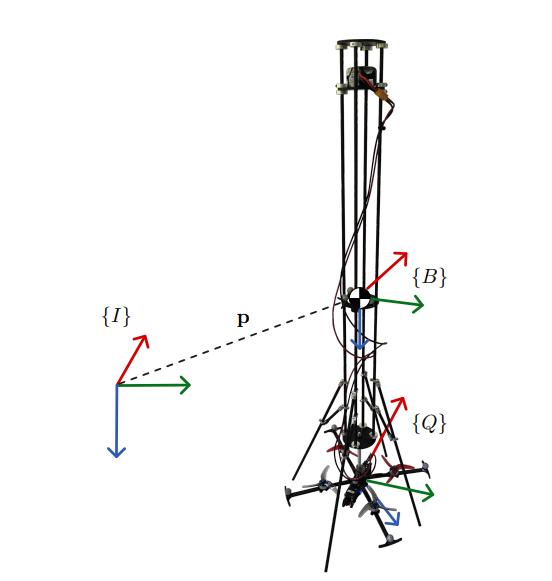
Figure 1: QuadRocket overall configuration and coordinate system. The quadrotor connects to the upper cylindrical structure via a gimbal, forming a flying inverted pendulum system analogous to rocket attitude control.
1. What Does This Paper Do?
The team did something with strong engineering flavor: rather than building an actual small rocket, they used a quadrotor drone, a carbon fiber cylinder, and a gimbal joint to create a QuadRocket that can fly indoors.
The structure is straightforward: a quadrotor at the bottom, a rocket-like cylindrical body on top, connected through a gimbal. The quadrotor no longer just “flies itself” — it acts as a thrust-direction-changing actuator controlling the attitude and trajectory of the upper “rocket body.” The paper states this platform can serve as a low-cost, low-risk test system for validating thrust-vector control strategies for launch-vehicle-like systems.
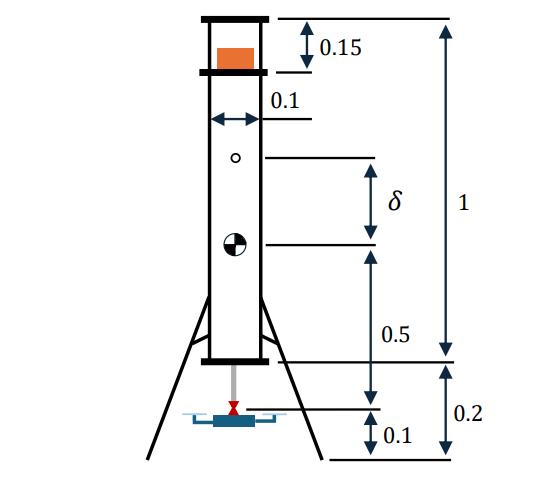
Figure 2: QuadRocket structural dimensions. Orange = battery, Red = gimbal joint. The overall structure simulates key dynamic characteristics of a thrust-vector-controlled vehicle.
The core value: real rocket control experiments are expensive, risky, and have long test cycles. Many advanced control algorithms cannot be tested on actual rockets from day one. QuadRocket brings the core challenges of rocket thrust-vector control into an indoor flight lab — using a cheap, repeatable, controllable quadrotor platform.
2. Why Use a Drone to Simulate a Rocket?
Because the two share common control problems.
Rocket attitude control fundamentally adjusts thrust direction — not just pushing “up” but generating attitude adjustments and trajectory control through directional changes. QuadRocket follows the same logic: the quadrotor generates thrust, the upper cylinder acts as the primary controlled rigid body, and the gimbal creates two degrees of freedom between them. The whole system becomes a flying inverted pendulum. The paper explicitly notes this configuration is physically analogous to thrust-vector-controlled rocket systems, since the net thrust direction is not fixed and produces coupled translational and rotational dynamics through an offset application point.
This makes QuadRocket more than a toy. It simulates the coupling between thrust direction, attitude, center of mass, moments of inertia, and underactuated characteristics. For anyone working in flight control, guidance, navigation, and control (GNC), this platform is valuable — it turns a complex problem into one that can be tested repeatedly, crashed safely, and iterated quickly indoors.
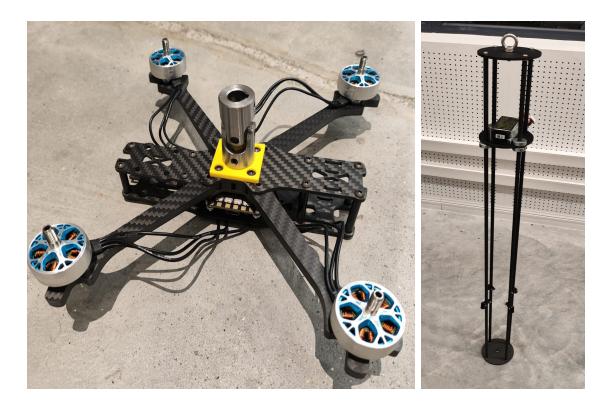
Figure 3: Physical connection between the quadrotor and upper cylindrical body. Carbon fiber structure, aluminum gimbal, and 3D-printed connectors emphasize low cost and reproducibility.
3. What Problem Does This Paper Really Solve?
The difficulty is not just “mounting a cylinder on a drone.”
The real problem: after mounting this cylinder, the system dynamics are no longer those of a standard quadrotor. It is an underactuated system where thrust affects both position and attitude. Forces and moments are coupled, and undesired non-minimum-phase behavior can emerge.
The paper abstracts this coupled system as “an axisymmetric rigid body driven by vector thrust.” The quadrotor is treated as an actuator providing thrust direction and magnitude, while the upper cylinder is the primary controlled object. The control problem shifts from “controlling a quadrotor” to “controlling a rocket-like rigid body.”
The paper adopts a reduced-attitude representation on the two-sphere, focusing attitude control on the longitudinal axis rather than entangling all Euler angles. This is well-suited for rocket-like systems because the critical factor is not rotation about the body axis but alignment between thrust direction and the body’s longitudinal axis. The paper emphasizes this representation leverages the vehicle’s axisymmetry and decouples yaw motion from thrust-vector direction.
4. Control Method: Adaptive Backstepping — Not Just Flying, But Rejecting Disturbances
The control method is an adaptive backstepping controller.
The problem it addresses is practical: real flight platforms always have parameter errors, center-of-mass offsets, battery voltage drops, assembly errors, sensor noise, and communication latency. A controller that only works in ideal models will fail on hardware.
The proposed framework has two layers: first, a virtual thrust-vector controller that makes the rocket-like rigid body track reference trajectories; second, a quadrotor attitude control law that drives the quadrotor to track the desired thrust direction. The paper claims this method achieves almost-global trajectory tracking under unknown constant disturbances and mitigates non-minimum-phase behavior through control point transformation.
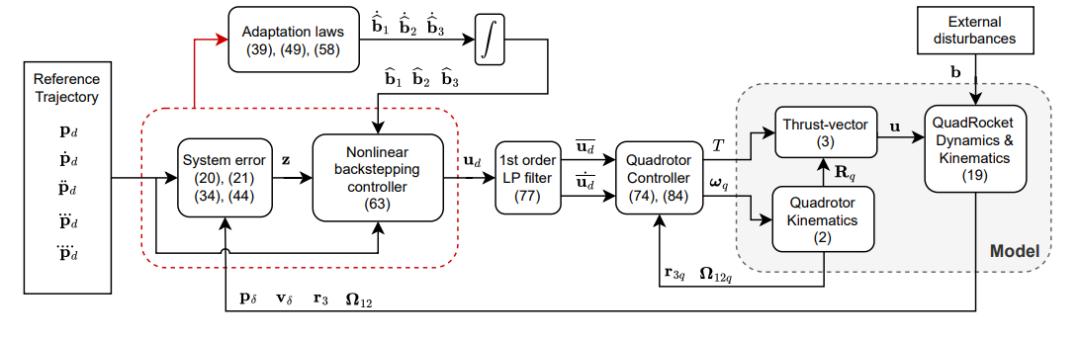
Figure 4: QuadRocket control architecture. Upper layer generates virtual thrust vectors; lower layer uses quadrotor attitude controller to track desired thrust direction.
For the drone industry, the significance is not merely “it flies” — it answers a more fundamental question: when a drone carries complex structures with strong dynamic coupling, shifting center of mass, and varying inertia, can the control system remain stable, accurate, and verifiable?
5. Hardware Platform: Not Just a Simulation Concept — They Built It
The paper provides concrete hardware details. Total mass: approximately 1.55 kg, with the quadrotor at 0.45 kg and the carbon fiber structure at 0.64 kg. The largest mass contribution is not the quadrotor itself but the upper body structure — listed as a contribution: QuadRocket is a quadrotor-driven rocket-like prototype where the dominant mass is a non-negligible inertia body connected via gimbal, not the quadrotor.
The quadrotor uses an FPV racing design with carbon fiber plates, aluminum standoffs, carbon fiber arms, and brushless motors. Components include BetaFPV Snow 2306 2500KV motors, 5-inch props, maximum total thrust ~55 N, BrainFPV RADIX 2 HD flight controller running BetaFlight 4.5.1.
This is not expensive lab equipment — it is built from common drone parts. For university labs and robotics teams, the approach is worth studying: use mature drone hardware to build platforms with special dynamics, then focus the hard work on modeling, control, and experimental validation.
6. Simulation Results: Proving the Control Framework Works
Before real flight, the team simulated in Matlab/Simulink. Reference trajectories use smooth bump functions, including initial ascent, lateral movement, descent, and return to origin. The simulation also incorporates thrust and angular rate command delays to model communication latency and quadrotor response time.
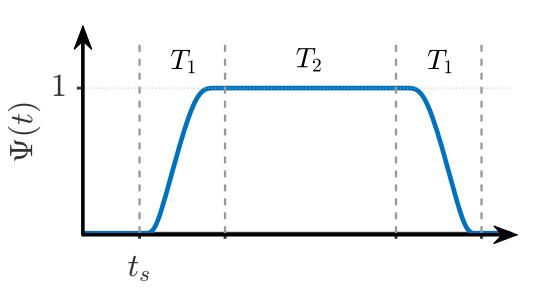
Figure 5: Bump function reference trajectory generation. Smooth velocity changes avoid imposing aggressive inputs on the test platform.
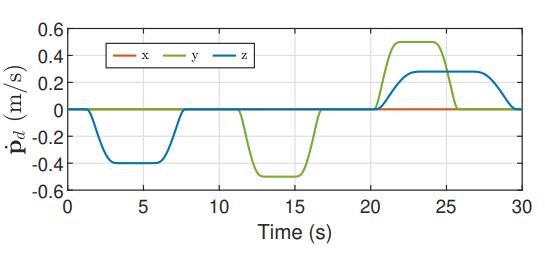
Figure 6: Reference inertial velocity curves. The trajectory includes ascent, lateral movement, descent, and return.
Simulation results show that even with significant initial position errors and adverse tilt angles, QuadRocket converges to the desired trajectory and maintains tracking. The paper also presents position, velocity, and attitude error convergence over time, noting that the quadrotor’s fast response to desired thrust vectors justifies approximating it as a thrust-vector actuator.
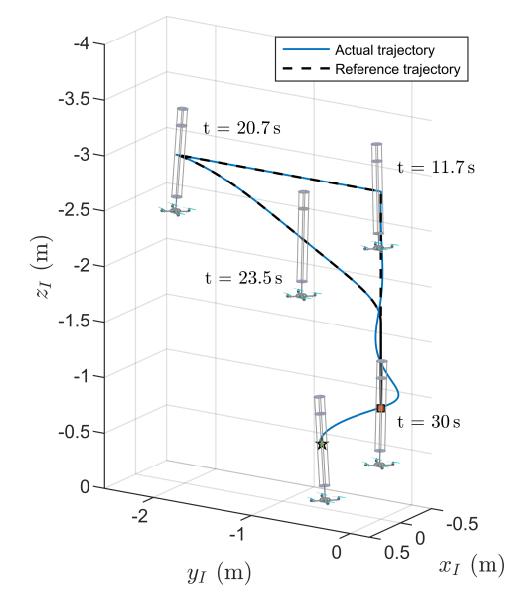
Figure 7: Simulation trajectory tracking results. QuadRocket converges from initial error state to reference trajectory and completes 3D motion.
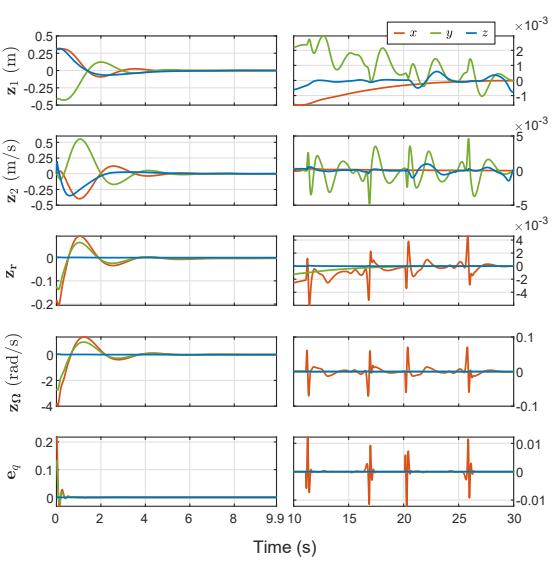
Figure 8: Simulation error convergence curves. Position, velocity, and attitude tracking errors converge from initial transient to steady state.
7. Flight Results: Centimeter-Level Tracking — the Most Convincing Part
The most compelling reason to write about this paper is that it goes beyond simulation.
Experiments were conducted at the University of Macau SCORE Laboratory indoor flight arena, using 30 VICON Vantage cameras covering an 11 × 5 × 7 m space at 100 Hz. The control algorithm runs in MATLAB/Simulink, also sending thrust and angular rate commands at 100 Hz. The flight controller’s low-level motor control runs at 3.2 kHz. The paper emphasizes VICON is a high-precision ground-truth measurement tool, not a control “cheat” replacing onboard sensing.
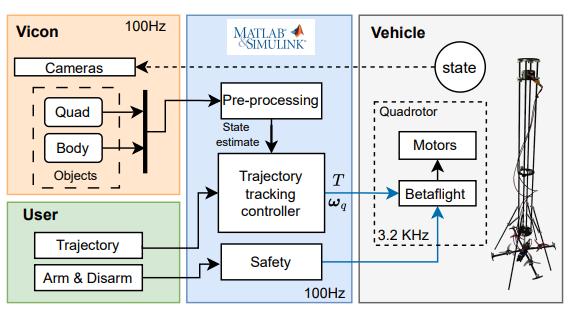
Figure 9: QuadRocket experimental system architecture. VICON motion capture, Simulink control, RC communication, and quadrotor flight controller form the indoor test loop.
Results: QuadRocket tracks target trajectories with centimeter-level precision. The key metric: after approximately 5 seconds of initial transient, the average position error is 1.82 cm. This holds despite velocity estimation noise, angular rate estimation noise, model uncertainty, and battery voltage variation.
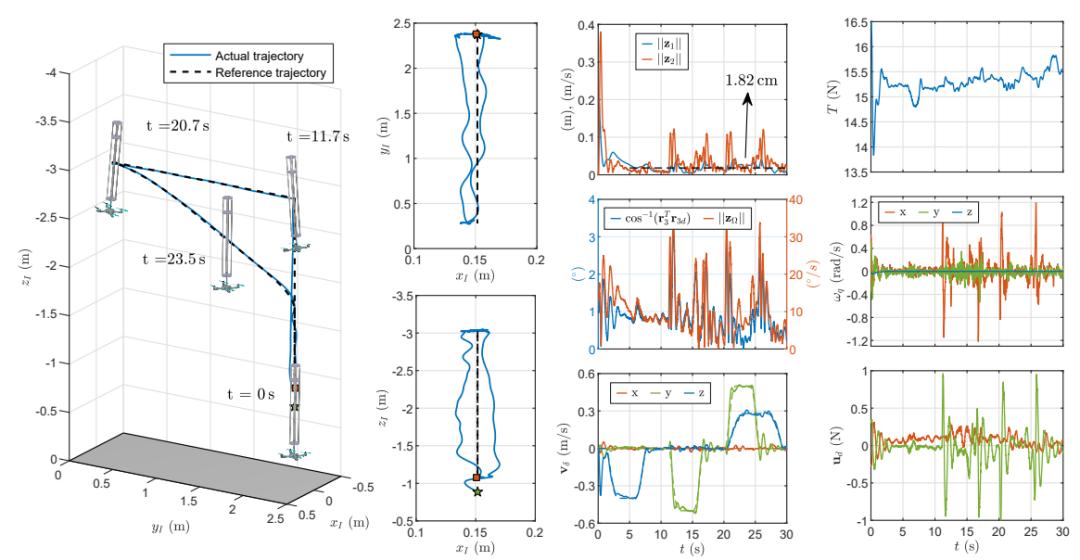
Figure 10: QuadRocket real-flight trajectory tracking. The physical platform completes trajectory tracking in the indoor motion-capture arena, achieving centimeter-level error after initial transient.
This is significant. Many control papers look beautiful in simulation but fall apart on hardware. QuadRocket’s flight section clearly documents the system pipeline, communication frequencies, motion capture setup, flight controller implementation, and error sources — making it more like a reproducible experimental platform than a demo video.
8. Implications for Drones and Low-Altitude Intelligence
From the low-altitude economy perspective, this is not logistics, inspection, agriculture, or eVTOL commercialization news — but its foundational significance is strong.
First, it demonstrates that drones are becoming general-purpose flight experiment platforms. Previously, drones were primarily standalone aircraft; now they can become thrust-vector actuators, flexible structure test platforms, payload control platforms, contact-operation platforms, and even spacecraft control validation systems.
Second, it reminds us that many future low-altitude systems will not be “standard quadrotors.” Industrial drones may carry robotic arms, spraying systems, firefighting payloads, cables, sensor pods, or contact inspection tools — dynamics will grow increasingly complex. Payload-induced center-of-mass shifts, inertia changes, and coupled vibrations will force flight control algorithms to evolve.
Third, it showcases a path well worth following for university labs: start with mature drone components, low-cost structural parts, and high-quality control algorithms — build a system that can validate key problems. For those working in drones, aerial robotics, and embodied AI hardware, this “low-cost, high-credibility validation platform” may have more long-term value than piling on concepts.
9. Acknowledge the Boundaries
QuadRocket is currently an indoor laboratory platform dependent on VICON motion capture and controlled environments. The paper’s future work section mentions the need to explore more aggressive maneuvers, external disturbances, parameter variations, onboard state estimation, multi-agent coordination, and extension to other thrust-vector-controlled robotic systems.
It is not yet an outdoor-ready low-altitude product, nor a commercial-grade rocket control system. But its value is clear: it transforms an expensive, high-risk validation problem into a flight-testable, experimentable, iterable problem on a drone platform.
10. Assessment
The paper’s title contains “Rocket-Like Vehicles,” but what makes it worth the drone industry’s attention is how it extends drones from “aircraft” to aerial robot control experiment platforms.
Future competition in low-altitude intelligence will not only be about whose motors are bigger, airframes lighter, or endurance longer — it will also be about who can maintain stable control under complex payloads, complex dynamics, and complex operational tasks. QuadRocket reminds us: truly mature low-altitude intelligence is not just about flying — it is about remaining controllable, verifiable, and reproducible under structural changes, payload variations, and disturbance variations.
From this perspective, QuadRocket is not just a fun experiment of “using a quadrotor to simulate a rocket” — it is a signal: drones are becoming the fundamental building blocks of complex aerial robotic systems.
Paper link: https://arxiv.org/pdf/2607.02474
If you have questions about thrust-vector control, aerial robotics platforms, or drone flight control systems, feel free to contact Aomway at [email protected].
Have questions about this article? Feel free to contact us at [email protected] — we’re happy to help!
