

Russia’s Starlink Jammer VKG: Source Reliability and Technical Feasibility Analysis
In June 2024, a claim spread widely across social media and self-media platforms: Russia had developed a dedicated electronic warfare system for jamming Starlink — Volna Kupol Garant (VKG). The system reportedly includes 8 antennas capable of simultaneously suppressing 8 Starlink uplink channels, with a coverage area of up to 20 square kilometers, and had been deployed and validated on the Ukraine battlefield.
How reliable are the sources behind this claim? And is the proposed technology technically feasible?
After searching various information sources across the public web — using multiple search engines and AI search tools — this article covers the following:
- • What are the information sources for the VKG jamming system?
- • Do the sources corroborate each other, or are there contradictions?
- • Based on public reports, does VKG jam Starlink satellites or Starlink terminals?
1. Basic Parameters of the VKG System
Before diving into technical analysis, it is necessary to objectively present what is known about this system — distinguishing between verifiable facts and unverified assumptions.
Volna Kupol Garant (Russian: Волна Купол Гарант, literally Wave Dome Guarantee. “Kupol” translates to dome or cupola, suggesting a radome-enclosed antenna array. Some online sources translate the system name as “Asylum” or “Shelter”.) is an electronic warfare (EW) system developed by Rossiysky Kupol LLC (Russian Dome Company), based in Simferopol, Crimea. According to available public information, it consists of 6 trailers, each likely carrying antenna arrays enclosed in radomes. The 8 antennas mentioned in the introduction likely refer to 8 internal jamming units or channels. The system has been deployed along roads in Russian-occupied areas of eastern Ukraine. Several units have been located and destroyed by Ukrainian drones.
2. Information Sources: Two Contradictory Technical Descriptions
2.1 Ukrainian Source: Beskrestnov’s Social Media Post
All technical details about VKG’s operation originate from a social media post by Serhiy Beskrestnov (call sign Flash), a technical advisor to the Ukrainian Ministry of Defense, published in June 2024. Beskrestnov is a recognized radio technology expert within the Ukrainian military who regularly analyzes the battlefield electromagnetic environment on public channels, lending him a degree of professional credibility.
The key technical description, as quoted by TSN (a Ukrainian media outlet) on June 15, 2024, reads:
Technically, a Starlink satellite receives signals from terminals in the 14–14.5 GHz range. This range is divided into 8 channels, each 62.5 MHz wide. The Russians basically took 8 satellite dishes, pointed them at the satellite, and each dish transmits interference on its own channel. That’s it. The satellite goes deaf.
TSN report source: https://tsn.ua/en/ato/russia-develops-costly-starlink-jamming-system-heres-the-catch-3107150.html
The original TSN report:
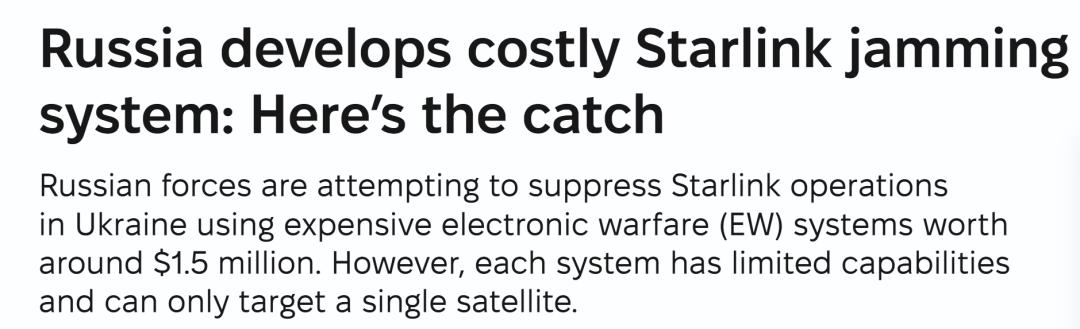 Ukrainian media TSN’s coverage of VKG
In supplementary remarks, Beskrestnov wrote that the system’s design is complex and production quality control issues have driven up costs. He estimated the unit cost at approximately $1.5 million USD.
Channel explanation: In this context, 8 channels, each 62.5 MHz wide means the jamming system divides Starlink’s total 500 MHz uplink frequency range (14.0–14.5 GHz) into 8 independent frequency sub-bands. VKG suppresses 8 uplink channels, each emitting interference on its own sub-band, collectively covering the full 500 MHz uplink spectrum.
2.2 Russian Source: Kuzyakin’s Interview with Izvestia
Dmitry Kuzyakin, a Russian drone expert and chief designer at the Center for Integrated Unmanned Solutions (TsKBR), stated in an interview with Izvestia (a Russian newspaper) that the system is designed to suppress the satellite itself. It does this by emitting parasitic interference signals toward the satellite, effectively “blinding” it so that ground users cannot receive signals from the satellite.
Source: Izvestia, June 16, 2024:
It sets itself the task of suppressing the work of the satellite itself. To do this, she literally blinds him on the radio with parasitic signals, making it impossible for subscribers to hear from the ground.
Reference: https://iz.ru/en/node/2116625
Original Izvestia report:
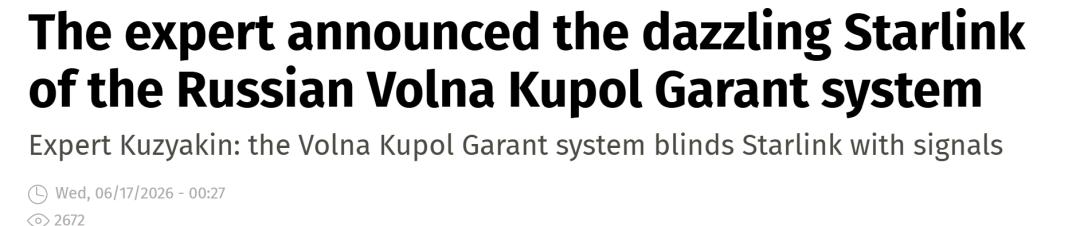 Russian media TASS coverage
2.3 Keyword-by-Keyword Analysis of Both Descriptions
The following keyword mapping analyzes the technical approach each source points to:
Beskrestnov version keyword analysis:
| Original Keyword | Technical Meaning | Interference Direction & Method |
|---|---|---|
| pointed them at the satellite | Antennas physically aimed skyward at the satellite | Uplink jamming — direction: ground → satellite |
| transmits interference on its own channel | Interference signal emitted from the ground | Uplink suppression — target: satellite receiver |
| the satellite goes deaf | Satellite receiver disabled, cannot hear ground signals | Uplink link suppressed |
→ Conclusion: Clearly indicates uplink jamming of the satellite — unambiguous.
Kuzyakin version keyword analysis:
| Original Keyword | Technical Meaning | Interference Direction & Method |
|---|---|---|
| suppressing the work of the satellite itself | The attack target is the satellite itself | Interference direction still points toward satellite |
| blinds him on the radio with parasitic signals | Parasitic interference signals sent to the satellite, disabling its communication capability | Spoofing interference or saturation injection |
| impossible for subscribers to hear from the ground | Terminals cannot receive satellite downlink signals | Downlink affected |
→ Conclusion: The attack target points to the satellite, but the described direct effect is that the satellite stops downlink transmission or the downlink is impaired.
Summary: Both sources agree that the jammer targets the satellite rather than the terminal. However, the Ukrainian source (Beskrestnov) describes the satellite’s uplink reception capability being impaired (satellite goes deaf), while the Russian source (Kuzyakin) describes the satellite’s downlink transmission capability being lost or the downlink being affected (ground users cannot receive). There is a discrepancy in the operational mechanism.
3. Information Reliability Assessment
Below is a reliability rating for each parameter:
| Parameter | Content | Reliability |
|---|---|---|
| System full name | Volna Kupol Garant | ⭐⭐⭐ High (consistent across multiple sources) |
| Manufacturer | Rossiysky Kupol LLC | ⭐⭐⭐ High (manufacturer info verifiable) |
| Physical composition | 6 trailers + 8 antennas + radomes | ⭐⭐ Medium (photos exist, no technical verification) |
| Claimed coverage area | ~20 km² | ⭐ Low (single-source estimate) |
| Claimed unit cost | ~$1.5 million USD | ⭐ Low (Beskrestnov’s personal estimate) |
| Battlefield deployment | Deployed; multiple units destroyed | ⭐⭐⭐ High (video evidence available) |
Note: More stars = higher reliability. Low reliability does not mean the parameter is necessarily wrong — it means it cannot be independently verified through public channels.
One parameter can be independently verified: Starlink user terminal uplink frequency range of 14.0–14.5 GHz (total bandwidth 500 MHz). This is a standard parameter recorded in frequency coordination documents filed by SpaceX with the U.S. Federal Communications Commission (FCC), and belongs to the publicly accessible ITU Fixed Satellite Service (FSS) frequency allocation — verified and trustworthy.
From an engineer’s perspective: In equipment acceptance, “deployed” and “meets performance” are two independent acceptance milestones. Evidence of VKG’s physical existence (destruction videos, manufacturer information) only proves deployment, not performance compliance. When citing its technical parameters, the data source and reliability level must be noted.
Starlink’s Anti-Jamming Capabilities Overview
Starlink incorporates multiple anti-jamming measures to counter various interference and attack scenarios:
- 1. Phased Array Antennas: Both ground user terminals and satellites use phased array antennas capable of flexible beam steering for precise directional communication. They can also generate spatial nulls (null steering) to suppress interference from specific directions.
- 2. Frequency Diversity and Hopping: The system can switch between multiple frequency sub-bands and employs frequency hopping and spread-spectrum techniques, making it difficult for jamming signals to maintain effective suppression.
- 3. Software-Defined Radio (SDR): Starlink extensively uses SDR technology, enabling rapid adaptation to new threats via software updates — changing communication protocols, modulation schemes, or interference avoidance strategies.
- 4. Massive Satellite Redundancy: With thousands of satellites in orbit, even if some are damaged or jammed, the system maintains service by switching to other available satellites — high overall resilience.
- 5. Enhanced Encryption and Authentication: All communications are strictly encrypted to prevent eavesdropping and spoofing, improving overall system security.
In upcoming articles, we will cover:
- • Challenges of VKG’s uplink jamming approach against Starlink satellites
- • Why jamming terminals — not satellites — is the technically correct approach for countering Starlink communications
This article systematically analyzed the information sources and technical feasibility of the rumored Russian Starlink jammer VKG. By comparing Ukrainian source Beskrestnov and Russian source Kuzyakin, both agree the jamming target is the satellite rather than the terminal, but differ on the specific link affected (Ukrainian: uplink suppression; Russian: downlink impact). The article rated parameter reliability, noted that physical existence evidence alone cannot prove performance compliance, and highlighted Starlink’s multiple anti-jamming designs (phased arrays, frequency hopping, satellite redundancy, etc.). This analysis helps engineers and decision-makers rationally assess the real threat of such EW systems and avoid uncritically accepting unverified technical claims.
If you have questions about electronic warfare, satellite communications, or anti-jamming technology, feel free to contact Aomway at [email protected].
Have questions about this article? Feel free to contact us at [email protected] — we’re happy to help!
