Key Takeaways
- Mercury is an open-source transforming drone that flies as a quadcopter and drives on the ground using its propeller guards as wheels.
- The airframe uses two 120 N linear actuators to fold the arms, four BLDC motors with 8-inch props, and two 140 KV motors for ground drive.
- A Raspberry Pi 5 runs the Python autonomy stack while a Cube flight controller runs ArduPilot, bridged over Mavproxy.
- The L42ARO/Mercury-Transforming-Drone repository was archived on September 12, 2026, and is now read-only.
- It is released under CERN-OHL-S-2.0, a strongly reciprocal open hardware license with source disclosure obligations.
Mercury is an open-source transforming drone that flies as a quadcopter and drives on the ground by reusing its propeller guards as wheels — one airframe, two modes of travel. The project pairs a Raspberry Pi 5 running Python autonomy software with a Cube flight controller running ArduPilot, and it publishes 3D-printable STL files, autonomy software, and PCB Gerbers. As of 2026 the upstream repository is archived and read-only, so anyone planning to replicate it should verify every link first.
What Is Mercury?
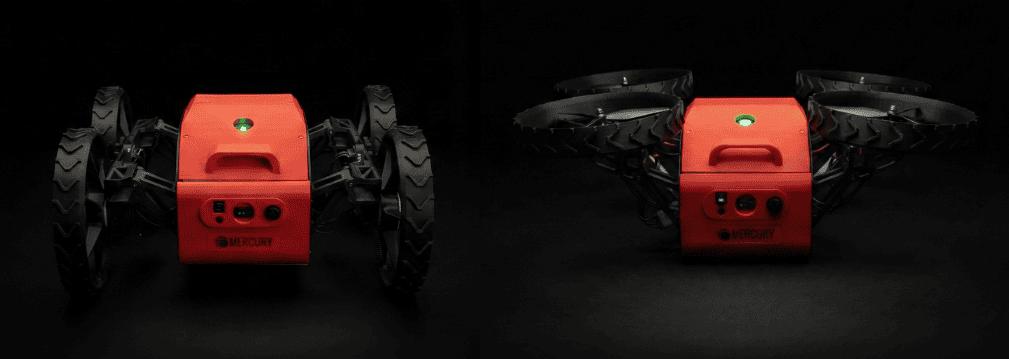
Mercury is a dual-mode transforming drone: in flight mode it is a quadcopter, and in ground mode it folds its arms and uses the propeller guards as wheels, all on a shared airframe. The project documentation also lists a 1 kg internal payload bay that can carry small equipment or cargo.
The README splits replication material into three categories — STL, Autonomy Software, and PCB — providing 3D print files, autonomy control software, PCB Gerbers, and a BOM. At the time of archiving, the repository showed 554 stars, 71 forks, and 2 contributors under the CERN-OHL-S-2.0 license.
Those 554 stars are only a snapshot of interest at the moment of archiving and say nothing about usage or quality. HelloGitHub issue 120 and Hackster editor Nick Bild both covered the project, which shows it reached the community’s field of view, but exposure is not a substitute for performance testing.
How the Transformation Works
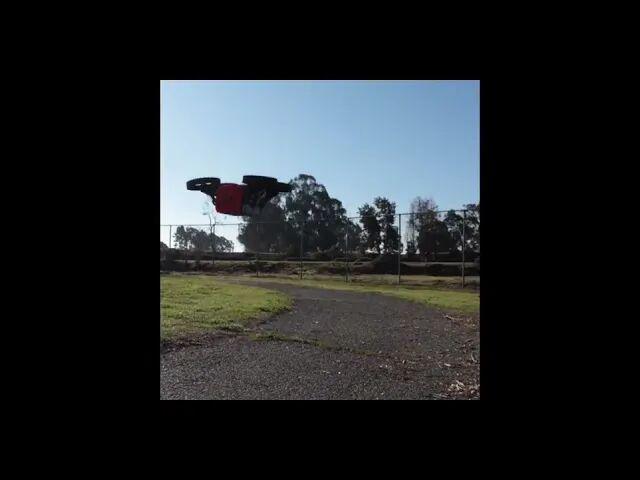
OSRTOS’s project write-up gives a concrete set of specifications: two 120 N linear actuators drive the arm folding, the flight side uses four BLDC motors with 8-inch propellers, and the ground side is driven by two 140 KV BLDC motors through a gear system. The propeller guards double as wheels, eliminating a separate wheel assembly — the most interesting reuse design in the whole structure.
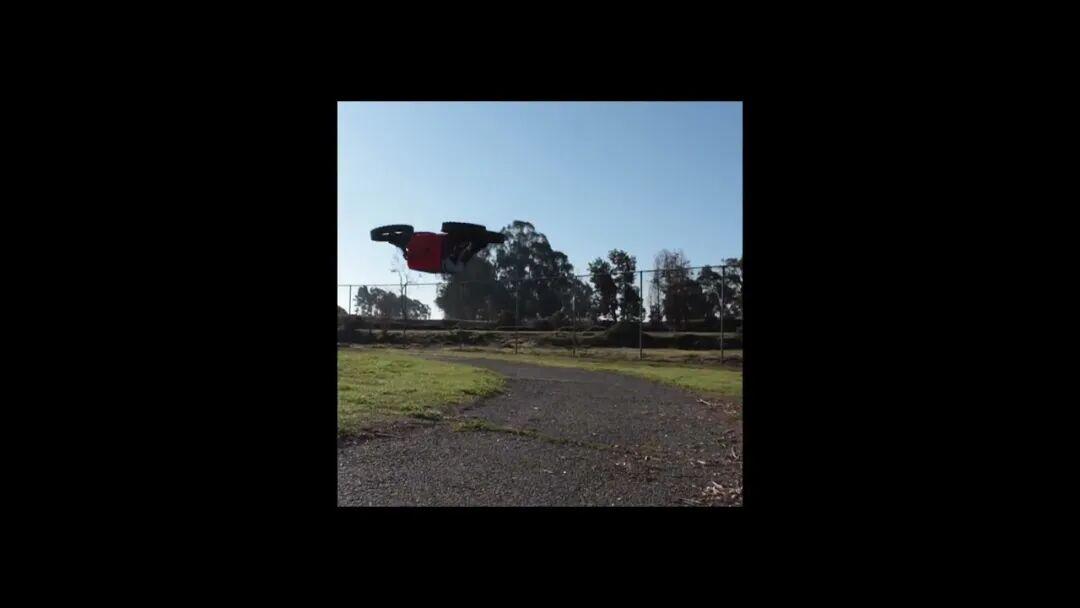
The demo video proves the prototype completed the ground-drive, structure-switch, and takeoff sequence, but it does not prove production performance, endurance, stability under load, or long-term reliability. The project materials do not publish those test results, and a single demo should not be extrapolated into them.
System Design Highlights
High-level compute and real-time flight control, split
A Raspberry Pi 5 runs the Python autonomy software for high-level computation, while a Cube flight controller runs ArduPilot on the ChibiOS RTOS for real-time flight control. The two are bridged over Mavproxy. This split between a companion computer and a flight controller is a useful architecture reference for other robotics projects.
Multiple sensor types on one platform
The project lists an RGB camera, a depth camera, a thermal camera, a TOF camera, an MTF-01 optical flow sensor, and dual MPU9250 IMUs. It reserves several inputs for perception-fusion experiments, but the materials do not provide recognition accuracy, obstacle-avoidance success rates, or fusion algorithm test data.
A browser-based control console
The control side uses Three.js for 3D visualization and Leaflet for the map interface. After the software starts, opening the IP address printed in the terminal in a browser gives access to the control page, with no dedicated app to install.
Cross-network access over Tailscale
Once the Raspberry Pi and the operator device join the same Tailscale network, the console is reachable through the Tailscale IP. This suits research into cross-subnet teleoperation, but actual communication range, latency, and reliability still depend on network conditions.

How to Replicate It
The project documentation targets Linux on a Raspberry Pi 5. The basic startup path is:
python3 -m venv venv
source venv/bin/activate
pip install -r requirements.txt
./start_mavproxy.sh     # start the Mavproxy bridge
./run.sh                # start the main program
After the main program starts, open the IP address shown in the terminal in a browser. The official release only provides Linux and Raspberry Pi shell scripts, so Windows users need to adapt them.
The README divides replication material into three categories:
- STL files — 3D-printed parts
- Autonomy Software — the Raspberry Pi 5 autonomy stack
- PCB files — Gerber files
| Item | Detail |
|---|---|
| Repository | L42ARO/Mercury-Transforming-Drone (archived September 12, 2026) |
| License | CERN-OHL-S-2.0, strongly reciprocal open hardware |
| Modes | Quadcopter flight, plus wheeled ground drive using the propeller guards |
| Transformation | 2 × 120 N linear actuators folding the arms |
| Flight drive | 4 × BLDC motors with 8-inch propellers |
| Ground drive | 2 × 140 KV BLDC motors with a gear system |
| Compute | Raspberry Pi 5 autonomy stack plus Cube flight controller running ArduPilot on ChibiOS, bridged via Mavproxy |
| Sensors | RGB, depth, thermal, and TOF cameras, MTF-01 optical flow, dual MPU9250 IMUs |
| Payload | 1 kg internal bay |
| Repo stats | 554 stars, 71 forks, 2 contributors at archive time |
Hardware replication is a separate budget. Based on the BOM description, you need a Raspberry Pi 5, an ESP32-S3, a Cube flight controller, four flight motors with 8-inch props, two ground-drive motors, and sensors including RGB, depth, thermal, TOF, optical flow, and dual IMUs. The airframe involves 3D printing, and the PCB must be fabricated and soldered. The project does not publish a total cost, and the assembly, machining, and troubleshooting overhead is not something you can estimate like an entry-level kit.
There is also a repository-level issue: the root directory contains only README.md and LICENSE.md, and the media images referenced by the README are already broken. Before replicating, confirm item by item that the STL, software, PCB, and BOM links listed in the README still resolve — do not assume the files are complete just because categories are listed. The repository is archived, so upstream support cannot be expected.

Who It Is For
Mercury’s value is putting air-and-ground dual mode, structural reuse, and hardware-software coordination into a single prototype. It suits students studying multimodal robot architecture, embedded developers who want to run perception and autonomy experiments, and hardware builders with 3D printing and soldering capability.
It does not suit anyone expecting an out-of-the-box product: there is no finished unit for sale, material availability has to be verified first, and upstream support is gone after archiving. The license should not be skipped either. CERN-OHL-S-2.0 is a strongly reciprocal open hardware license, so before making, modifying, or distributing derivative hardware you must read the license and confirm obligations such as publishing design source files. Open source does not mean free of compliance cost.
If you only want to learn, start by opening the Mercury project repository at github.com/L42ARO/Mercury-Transforming-Drone and confirming that the STL, Autonomy Software, PCB, and BOM are still obtainable, then compare against the demo video to understand the transformation. Only commit to a replication build once the materials, tools, and license terms are all acceptable.
Have questions about this article? Feel free to contact us at [email protected] — we’re happy to help!
Frequently Asked Questions
What is the Mercury transforming drone?
Mercury is an open-source dual-mode robot that flies as a quadcopter and drives on the ground by reusing its propeller guards as wheels on a shared airframe. It carries a 1 kg internal payload bay and publishes STL, autonomy software, and PCB files.
How does the Mercury drone switch between flying and driving?
Two 120 N linear actuators fold the arms for ground mode, where the propeller guards act as wheels driven by two 140 KV BLDC motors and a gear system. In flight mode, four BLDC motors spin 8-inch propellers as a normal quadcopter.
Is the Mercury transforming drone still maintained?
No. The L42ARO/Mercury-Transforming-Drone repository was archived on September 12, 2026, and is read-only. The community can still fork it, but upstream no longer accepts issues or pull requests, so expect no official support.
What license does Mercury use?
Mercury is released under CERN-OHL-S-2.0, a strongly reciprocal open hardware license. If you make, modify, or distribute derivative hardware, you must read the license and meet obligations such as publishing your design source files.
What do you need to build the Mercury drone?
The BOM calls for a Raspberry Pi 5, an ESP32-S3, a Cube flight controller, four flight motors with 8-inch props, two ground-drive motors, and cameras including RGB, depth, thermal, and TOF plus optical flow and dual IMUs. Total cost is not published.
About Aomway
Aomway is a technology company specializing in drone and FPV equipment, publishing in-depth analyses of motor control, embedded hardware, and open-source robotics projects. With over 15 years of industry experience, Aomway covers the full spectrum from flight controllers and FPV goggles to thermal imaging cameras and long-range datalinks for the global drone community.