
Key Takeaways
- EchoShield is a Ku-band 15.4 to 16.6GHz software-defined pulse-Doppler radar built on Echodyne’s MESA metamaterial electronically scanned array, with no moving parts and no phase shifters.
- Published field of view is 130° azimuth by 90° elevation, tracking accuracy under 0.5° on both axes, a 10Hz update rate and more than 1,000 simultaneous tracks.
- Echodyne cites λ/10 element spacing against λ/2 for a conventional ESA, roughly 576 elements in an EchoShield-sized aperture versus about 40, and a 2° by 6° beam versus 20° by 30°.
- Typical tracking range is 3 to 5.3km for Group 1 UAS, 7.2 to 12.5km for Group 3 UAS, and beyond 12.5km for vehicles.
- The unit weighs 19.2kg, measures 42.9 by 32.9 by 18.7cm, draws under 250W active, and is rated IP67 and MIL-STD-810H.
EchoShield is Echodyne’s mid-range 4D radar built on MESA, a metamaterial electronically scanned array that steers a beam without phase shifters, transmit/receive modules or moving gimbals. The published documents give specification and architecture-level parameters only: element-level implementation, transmit power, noise figure and antenna gain are not disclosed, and every performance figure is vendor-stated with no third-party measurement on record. What follows is a careful reading of the specification sheet, the MESA technology page and the 2016 developer-kit press release, with each number attributed.
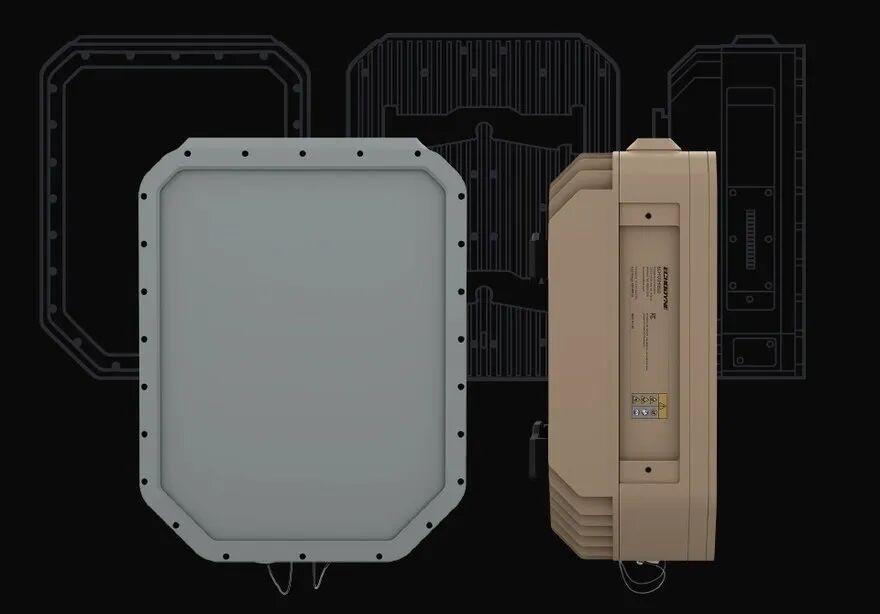
Figure 1. EchoShield exterior: front face in light gray on the left, rear three-quarter view in tan on the right, showing body thickness, rear heatsink structure and the nameplate. Image: Echodyne Corp.
How the Specification Sheet Defines This Radar
The first page of the official specification sheet defines EchoShield as a Medium-Range, Software-Defined, Pulse-Doppler, Cognitive Metamaterials ESA (MESA) Radar, also labeled Multi-Mission 4D Radar, with three deployment forms: Fixed, Portable and On-the-Move (OTM).
The MESA technology page lists four product lines on the same architecture. EchoShield is mid-range pulse-Doppler for fixed, temporary and on-the-move deployment; EchoGuard is short-range FMCW for fixed, portable and temporary use; EchoFlight is short-range FMCW for airborne use; EchoWare is the interface and software layer, marked Intuitive UI / Headless and System & Protocol Agnostic. The specification sheet’s first-page definition of EchoShield as mid-range pulse-Doppler matches the product-family page.
The measurement and output coverage listed in the specification spans angle (130° by 90° field of view, under 0.5° two-axis tracking accuracy), range (the product page gives 0.75 to 6m range accuracy, varying with waveform) and the range-Doppler spectrum, output over 10Gbps Ethernet.
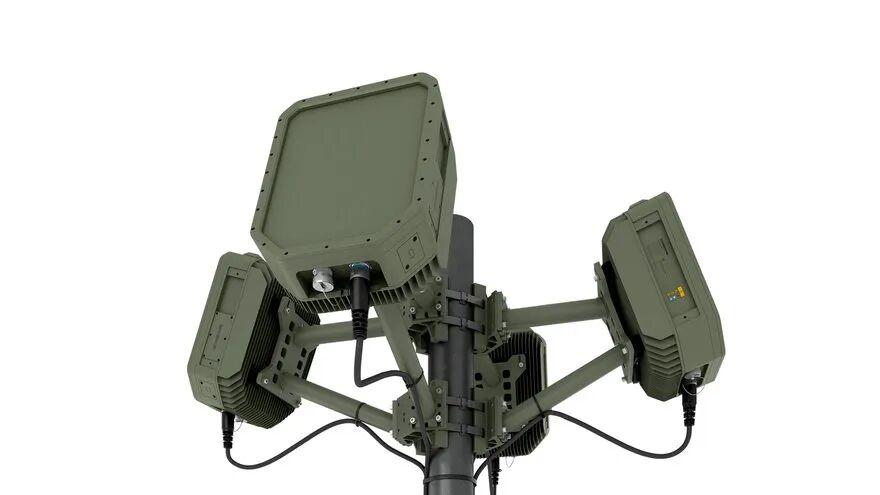
Figure 2. Four EchoShield units in a tower installation. The official Kits specification lists 1-up, 2-up and 4-up tower configurations. Image: Echodyne Corp.
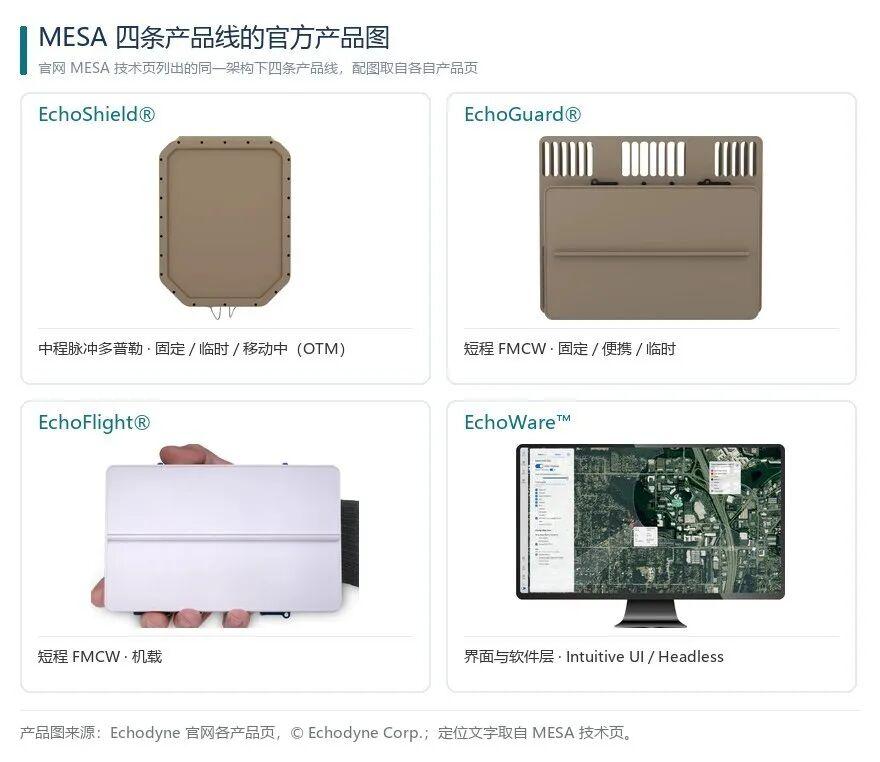
Figure 3. Product photos across the four product lines: EchoShield and EchoGuard shown head-on, EchoFlight handheld in use, EchoWare as a radar management interface. Product images: Echodyne Corp.; positioning text from the MESA technology page.
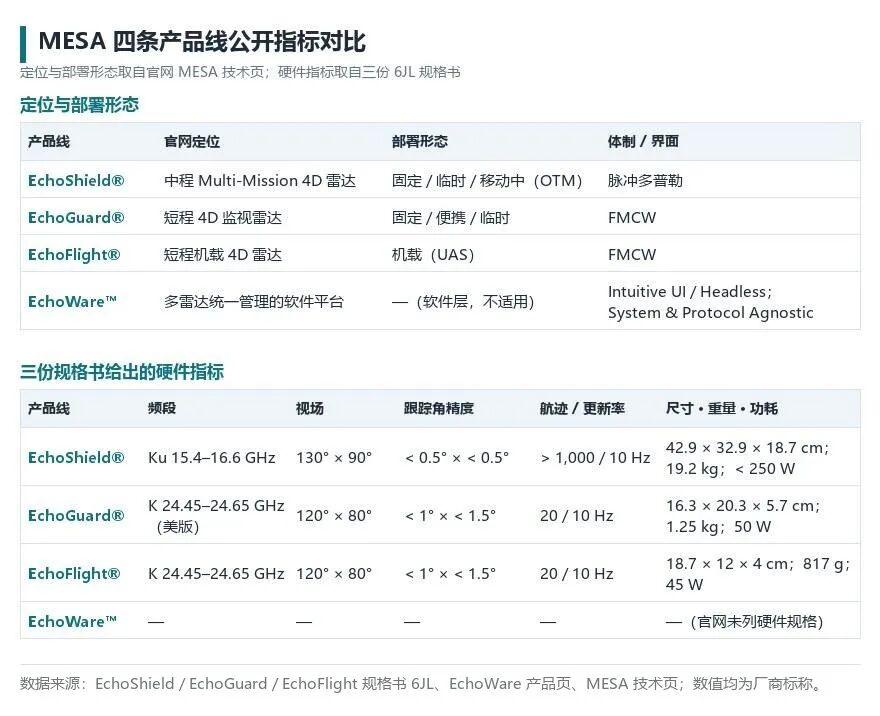
Figure 4. Positioning and published specifications across the four product lines. Positioning, deployment form and radar type from the MESA technology page; hardware specifications for EchoShield, EchoGuard and EchoFlight from their respective 6JL specification sheets; EchoWare lists no RF specifications.
What a Conventional Electronically Scanned Array Costs
The official press release from May 2016, announcing the MESA-K-DEV developer kit, states the architectural difference plainly:
“Unlike conventional mechanical apertures that steer a radar beam using motorized gimbals, Echodyne’s MESA requires no moving parts to steer its beam. And unlike Phased Array radars or Active Electronically Scanning Array radars that require complicated and expensive transmit/receive modules — including phase shifters, amplifiers, circulators, and low noise amplifiers behind every single antenna element — MESA uses a vastly simpler metamaterials architecture.”
Mechanical apertures rotate a beam with a motorized gimbal. Phased array and active electronically scanned arrays need a complex, expensive T/R module behind every single element — phase shifter, amplifier, circulator and low-noise amplifier. MESA uses no moving parts and a greatly simplified metamaterial architecture. The press release describes the outcome as dramatically lower cost, size, weight and power.
The MESA technology page calls the approach a radically simple design utilizing metamaterial science and points to Chapter 32 of the fifth edition of the Antenna Engineering Handbook for further reading. It also records the background: when the company was founded in late 2014, a DARPA program to cut ESA cost, size, weight and power was winding down, having delivered performance improvements without the intended C-SWaP reduction.
Three Structural Numbers MESA Discloses
The MESA technology page publishes three checkable comparison values.
| Parameter | Conventional ESA | MESA |
|---|---|---|
| Element spacing | λ/2 | λ/10, giving finer aperture spatial sampling |
| Element count | Roughly 40 in a similarly sized aperture | “Such as 576 in a system like EchoShield” |
| Beam width | About 20° by 30° | About 2° by 6° |
The element-count figures are examples in the vendor’s own wording, not a measured count for EchoShield. The page links denser sampling to lower sidelobes, a narrower beam and better discrimination of slow, small, low-altitude targets. Which tunable devices sit inside each element, how the array is fed, and how the beam is synthesized and calibrated are not given in either the technology page or the specification sheet.
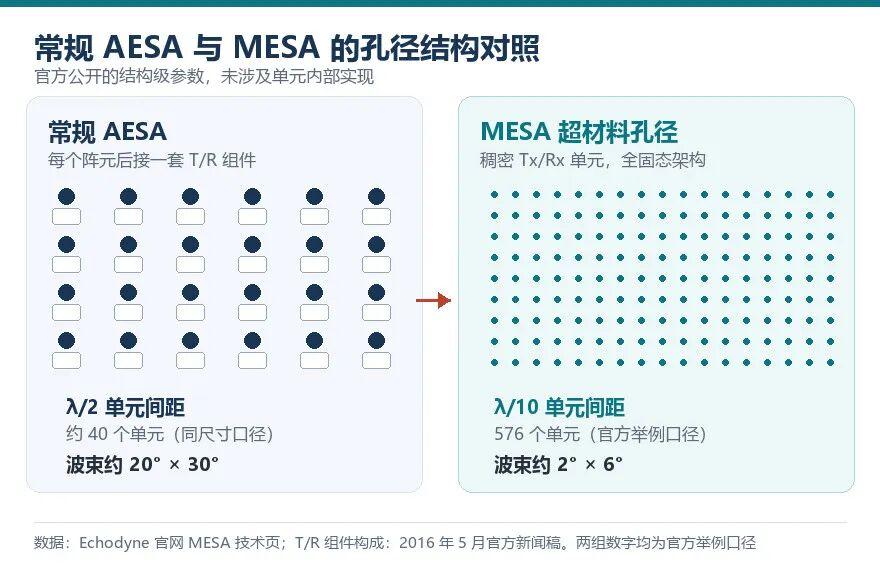
Figure 5. Aperture structure compared between a conventional AESA and MESA. Structural parameters from the MESA technology page, T/R module composition from the 2016 press release; both element counts and both beam widths are vendor examples.
Specification by Specification: RF, SWaP, Data Interfaces
The specification sheet groups parameters under RADAR PERFORMANCE, SWaP & ENVIRONMENTAL, INTEGRATION & DATA and REGULATORY. Figure 6 summarizes them in the same groups.
| Group | Parameter | Value |
|---|---|---|
| Radar performance | Frequency band | Ku band, 15.4 to 16.6GHz |
| Radar performance | Radar type | Software-defined, pulse-Doppler, cognitive |
| Radar performance | Field of view | 130° azimuth by 90° elevation |
| Radar performance | Tracking accuracy | Under 0.5° azimuth by under 0.5° elevation |
| Radar performance | Range accuracy | 0.75 to 6m, varying with waveform (product page) |
| Radar performance | Update rate and tracks | 10Hz, more than 1,000 targets |
| SWaP | Dimensions and weight | 42.9 by 32.9 by 18.7cm, 19.2kg |
| SWaP | Power | +20 to +33VDC, under 250W active |
| SWaP | Temperature | -40°C to +65°C |
| SWaP | Environmental | IP67, MIL-STD-810H |
| Integration | Control I/O | Gigabit Ethernet |
| Integration | 10Gbps Ethernet | Range-Doppler spectrum |
| Integration | 1Gbps Ethernet | Detections, measurements, tracks, radar status |
| Integration | Mounting | 4 x M6, 200mm hole spacing |
| Regulatory | Certification | FCC ID 2ANLB-MESA00055; CE / RED / RoHS 3 |
| Regulatory | Export classification | ECCN 6A008.e (product page) |
| Regulatory | Part numbers | 700025-300-100 / -200 / -300 / -400 |
Data output splits into two paths: 10Gbps Ethernet carries the range-Doppler spectrum, and 1Gbps Ethernet carries detections, measurements, tracks and radar status, with Gigabit Ethernet for control I/O. The product page adds that the radar uses AI/ML models to classify targets into categories such as human, vehicle, fixed-wing and multi-rotor, that multiple radars can be networked through EchoWare, and that Track ID is preserved when tracks hand off between coverage areas.
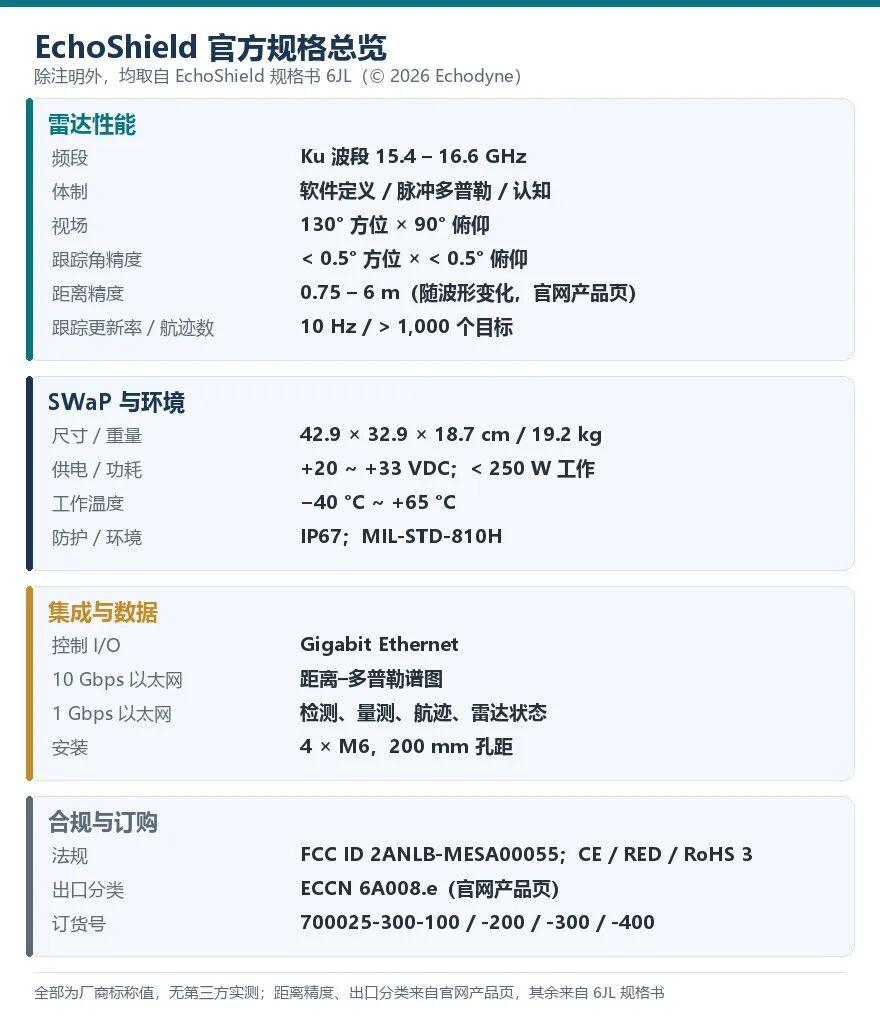
Figure 6. EchoShield official specification overview. Unless noted, values come from specification sheet 6JL; range accuracy and export classification from the product page.
Tracking Range by Target RCS
The relevant sections of the specification are titled UAS Typical Tracking Ranges and Perimeter Surveillance Performance — typical tracking ranges, not detection ranges. The product page reinforces this: “Tracking Ranges / Not ‘detection’ range. Not ‘best’ range. Typical performance with solid radar track.”
| Target class | RCS | Typical tracking range |
|---|---|---|
| Group 1 UAS | -20 to -10dBsm | 3 to 5.3km |
| Group 2 UAS | -10 to -3dBsm | 5.3 to 7.2km |
| Group 3 UAS | -3 to 5dBsm | 7.2 to 12.5km |
| Personnel moving (perimeter) | — | More than 9.4km |
| Vehicles (perimeter) | — | More than 12.5km |
The product page’s range diagram also shows Nano and Group 4+ as additional RCS classes outside this set; the 6JL specification sheet gives no range figures for those two tiers.
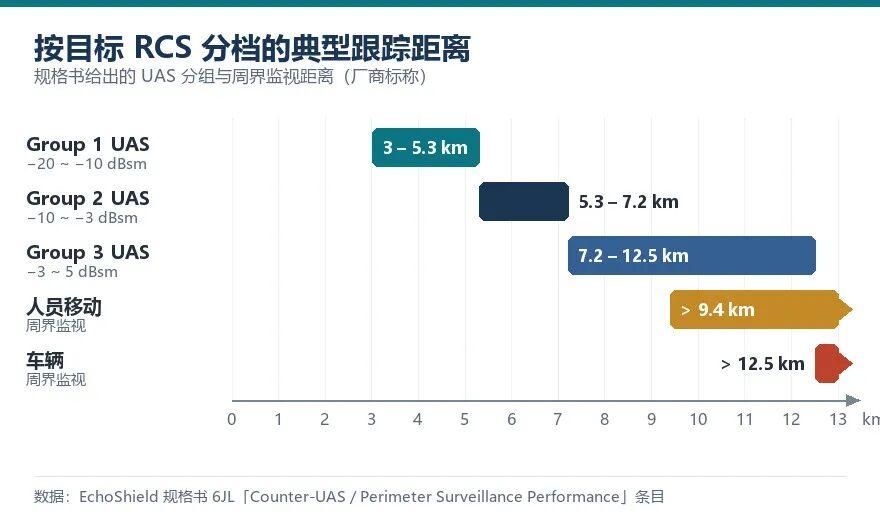
Figure 7. Typical tracking range by target RCS. Data from the Counter-UAS and Perimeter Surveillance entries of specification sheet 6JL; arrows mark values the sheet states as greater-than.
Single-Unit Form Factor, Mechanical Interface and Three Kits
Mechanically and electrically: 42.9 by 32.9 by 18.7cm, 19.2kg, mounted on 4 x M6 at 200mm spacing; +20 to +33VDC input, under 250W active and under 100W in hot standby; MIL-STD-38999 bayonet power connector; operating temperature -40°C to +65°C, IP67, MIL-STD-810H.
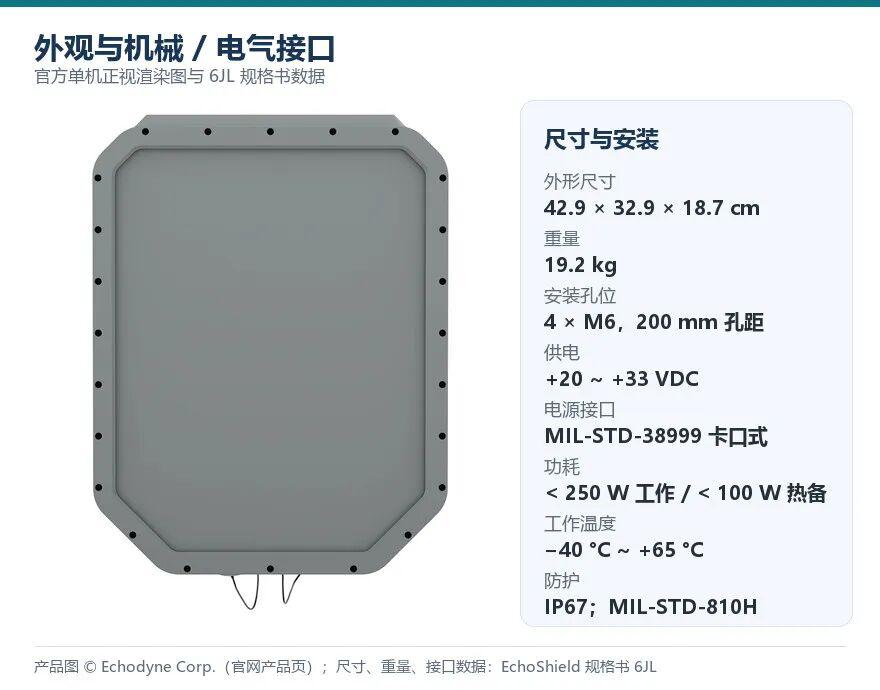
Figure 8. Single-unit front view with mechanical and electrical interface data. Product image: Echodyne Corp.; dimensions, weight and interface data from specification sheet 6JL.
The Kits & Accessories specification (document version 6AP) lists three deployment kits. The Quick Start Kit (700033-000-001) targets bench and field testing and integration, containing a Pelican 1615 wheeled case, carbon-fiber tripod, tripod adapter, 1-channel junction box, 2.5m primary radar cable, 2.5m CAT5 Ethernet cable and a 480W 48VDC wall supply.
The Tower Mounting Kit comes in 1-up, 2-up and 4-up versions (700040-201-100 / 700040-202-100 / 700040-204-100) for fixed deployment of up to four radars, including tower arms, pole brackets, a pole alignment tool and quick-release clamps.
The Rapid Deployment Kit (700046-100-200 / -202 / -203) targets fast temporary deployment of up to four radars, with a 4-channel junction box, a COMROD ComPact 2400W supply and three rugged transport cases. Assembled height is 211cm, base diameter 182cm, top diameter 130cm; weight is about 68kg without radars, about 145kg with four installed and about 127kg in three cases for transport. The product page states four people can assemble up to four radars in 15 minutes, or one person in under an hour. Export classification is ECCN 6A008.e.
The 2016 Developer Kit Versus Today’s Product
The May 2016 press release announced the MESA-K-DEV developer kit so integrators could test MESA’s C-SWaP characteristics. Published specifications: K band, ±60° azimuth by ±40° elevation field of view, sub-microsecond beam switching, 22 by 7.5 by 2.5cm, 820g, about 20W active and under 1W standby, USB Type-C control, single +7 to +28VDC supply, -40°C to +75°C, aluminum housing with natural convection cooling. Inside the kit are the metamaterial array, array control drive electronics, a beam-steering computer, and an integrated transceiver and processor.
| Parameter | MESA-K-DEV (2016) | EchoShield (6JL) |
|---|---|---|
| Band and type | K band, developer kit | Ku 15.4 to 16.6GHz, pulse-Doppler |
| Field of view | ±60° azimuth by ±40° elevation | 130° azimuth by 90° elevation |
| Beam or data rate | Sub-microsecond beam switching | 10Hz tracking update |
| Dimensions | 22 by 7.5 by 2.5cm | 42.9 by 32.9 by 18.7cm |
| Weight | 820g | 19.2kg |
| Power | About 20W, under 1W standby | Under 250W active, under 100W standby |
| Supply | +7 to +28VDC single supply | +20 to +33VDC |
| Control interface | USB Type-C | Gigabit Ethernet |
| Temperature | -40°C to +75°C | -40°C to +65°C, IP67, MIL-STD-810H |
Figure 9 sets the two public parameter sets side by side. They are different product forms with different missions — one a developer kit, one a deployable mid-range radar — so the comparison only shows what each party published, and is not a performance comparison.
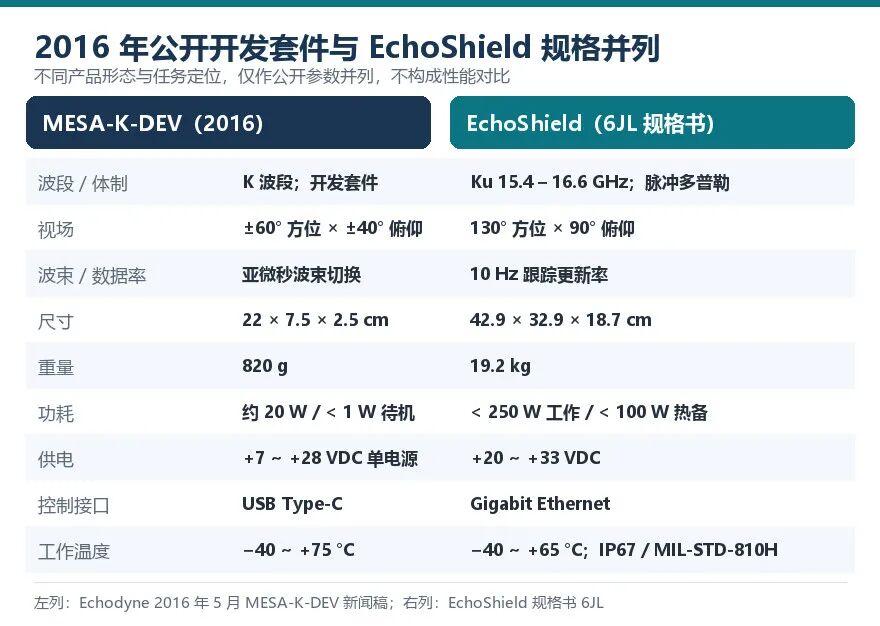
Figure 9. Published specifications of the 2016 developer kit beside EchoShield. Left column from the May 2016 press release, right column from specification sheet 6JL.
The Published Physics Behind Tunable Metamaterial Apertures
The physics of a tunable metamaterial aperture is public in the academic literature. Three papers with Tom Driscoll and David R. Smith among the authors are relevant.
Sleasman and colleagues described the element design in IEEE Antennas and Wireless Propagation Letters in 2016: a complementary electric-LC (cELC) resonant element patterned on the upper conductor of a microstrip line, with a PIN diode bridging the capacitive gap, switched between conducting and insulating states by DC bias current, and radial decoupling stubs suppressing RF leakage on the bias line. The work was verified by full-wave electromagnetic simulation.
Ebadi, Driscoll and Smith used a modulated surface-impedance metamaterial at the 2013 IEEE APS symposium to convert guided surface modes into a designed aperture distribution, producing a pencil beam at a specified angle.
Hunt and colleagues published an imaging system in JOSA A in 2014: a K-band 17.5 to 26.5GHz frequency-diverse static aperture that sweeps frequency to generate a series of pseudo-random radiation patterns, then reconstructs the scene by computational imaging with no mechanical scanning and no dynamic beamforming elements.
Summary
Specification sheet 6JL defines EchoShield as a mid-range software-defined pulse-Doppler MESA radar: Ku 15.4 to 16.6GHz, 130° by 90° field of view, 10Hz, more than 1,000 tracks, 19.2kg, under 250W. The vendor states λ/10 element spacing and a 2° by 6° beam; transmit power, noise figure, antenna gain and the tunable element device are not disclosed, and all performance figures are vendor-stated.
Have questions about this article? Feel free to contact us at [email protected] — we’re happy to help!
Frequently Asked Questions
What makes MESA different from a phased array radar?
MESA steers the beam without a phase shifter, amplifier, circulator or LNA behind every element. It uses a metamaterial aperture with roughly λ/10 element spacing, which the vendor says cuts cost, size, weight and power dramatically.
What is the field of view and tracking accuracy of EchoShield?
130° azimuth by 90° elevation, with tracking accuracy better than 0.5° on both axes, a 10Hz update rate and more than 1,000 simultaneous tracks carried on 1Gbps Ethernet.
How far can EchoShield track a small drone?
Typical tracking range is 3 to 5.3km for Group 1 UAS at -20 to -10dBsm and 7.2 to 12.5km for Group 3 UAS. These are typical tracking ranges, not detection or best-case ranges.
Does EchoShield output raw radar data?
Yes. A 10Gbps Ethernet link carries the range-Doppler spectrum, while a separate 1Gbps link carries detections, measurements, tracks and radar status, with Gigabit Ethernet for control.
How much does EchoShield weigh and what power does it need?
19.2kg in a 42.9 by 32.9 by 18.7cm housing, powered from +20 to +33VDC and drawing under 250W active or under 100W in hot standby, rated IP67 and MIL-STD-810H.
References
Echodyne, EchoShield Technical Specifications, document version 6JL, © 2026 Echodyne Corp.
Echodyne, EchoShield product page, echodyne.com/radar-solutions-1/echoshield/
Echodyne, MESA technology page (Metamaterials ESA), echodyne.com/radar-systems/mesa
Echodyne, “Echodyne Releases Breakthrough Ultra-Low C-SWAP Electronically Scanning Radar”, press release, May 2016.
Echodyne, For EchoShield: Kits & Accessories, document version 6AP, © 2026 Echodyne Corp.
T. Sleasman, M. F. Imani, W. Xu, J. Hunt, T. Driscoll, M. S. Reynolds, D. R. Smith, “Waveguide-Fed Tunable Metamaterial Element for Dynamic Apertures”, IEEE Antennas and Wireless Propagation Letters, 15: 606-609, 2016. DOI 10.1109/LAWP.2015.2462818
S. Ebadi, T. Driscoll, D. Smith, “Visual illustrations of microwave holographic beamforming using a modulated surface-impedance metamaterial”, IEEE APS International Symposium (APSURSI), pp. 2343-2344, 2013. DOI 10.1109/APS.2013.6711830
J. Hunt, J. Gollub, T. Driscoll, G. Lipworth, A. Mrozack, M. S. Reynolds, D. J. Brady, D. R. Smith, “Metamaterial microwave holographic imaging system”, J. Opt. Soc. Am. A, 31(10): 2109-2119, 2014. DOI 10.1364/JOSAA.31.002109
J. L. Volakis (ed.), Antenna Engineering Handbook, 5th Edition, McGraw-Hill Education, 2019, Chapter 32.
Echodyne, EchoGuard Technical Specifications and EchoFlight Technical Specifications, document version 6JL, © 2026 Echodyne Corp.
About Aomway
Aomway is a drone technology company that designs and manufactures FPV video transmitters, antennas, cameras and flight electronics, and publishes engineering deep dives on autonomous navigation and RF systems. Explore the full hardware lineup at aomway.com to see the components behind these builds.